


Influence of artificial aging: mechanical and physicochemical properties of dental composites under static and dynamic compression
- PMID: 34453210
- PMCID: PMC8817055
- DOI: 10.1007/s00784-021-04122-0
Influence of artificial aging: mechanical and physicochemical properties of dental composites under static and dynamic compression
Abstract
Objective: The aim of the study was to evaluate the influence of filler content, degradation media and time on the mechanical properties of different dental composites after in vitro aging.
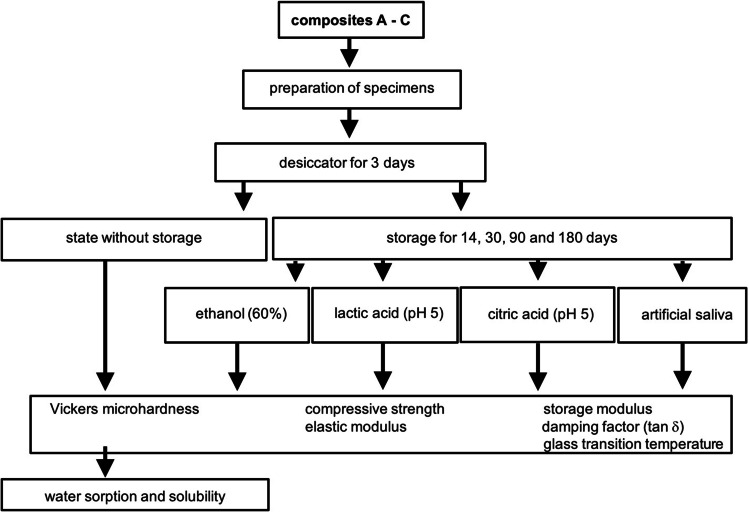
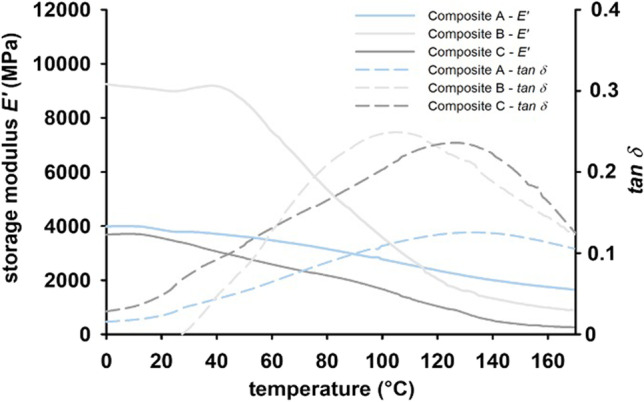
Materials and methods: Specimens (1 mm3) of three commercially available composites (GrandioSO®, Arabesk Top®, Arabesk Flow®) with respect to their filler content were stored in artificial aging media: artificial saliva, ethanol (60%), lactic acid (pH 5) and citric acid (pH 5). Parameters (Vickers microhardness, compressive strength, elastic modulus, water sorption and solubility) were determined in their initial state (control group, n = 3 for microhardness, n = 5 for the other parameters) and after 14, 30, 90 and 180 days (n = 3 for microhardness, n = 5 for the other parameters for each composite group, time point and media). Specimens were also characterized with dynamic-mechanical-thermal analysis (compression tests, F = ± 7 N; f = 0.5 Hz, 1 Hz and 3.3 Hz; t = 0-170 °C).
Results: Incorporation of fillers with more than 80 w% leads to significantly better mechanical properties under static and dynamic compression tests and a better water sorption behavior, even after chemical degradation. The influence of degradation media and time is of subordinate importance for chemical degradation.
Conclusion: Although the investigated composites have a similar matrix, they showed different degradation behavior. Since dentine and enamel occur only in small layer thickness, a test specimen geometry with very small dimensions is recommended for direct comparison. Moreover, the use of compression tests to determine the mechanical parameters for the development of structure-compatible and functionally adapted composites makes sense as an additional standard. Clinical relevance Preferential use of highly filled composites for occlusal fillings is recommended.
Keywords: Artificial aging; Dental composites; Mechanical and physicochemical properties; Static and dynamic compression tests.
© 2021. The Author(s).
Conflict of interest statement
The authors declare no competing interests.
Figures




References
-
- Torres CRG, Schwendicke F (2020) General principles of tooth preparation and carious tissue removal. In: modern operative dentistry. Springer, pp 183–221
-
- Sadava DE, Hillis DM, Heller HC, Berenbaum M. Biologie. 9. Auflage edn. Heidelberg: Spektrum Akademischer Verlag; 2011.
-
- Ehrenstein GW. Polymer-Werkstoffe: Struktur - Eigenschaften - Anwendung. 3., vollständig überarbeitete Auflage edn. München: Hanser, Carl; 2010.
-
- Grellmann W, Altstädt V. Kunststoffprüfung. 2. Aufl. edn. München: Hanser; 2011.
MeSH terms
Substances
LinkOut - more resources
Full Text Sources
