


Patient characteristics and outcome in three different working models of home-based rehabilitation: a longitudinal observational study in primary health care in Norway
- PMID: 34454475
- PMCID: PMC8403406
- DOI: 10.1186/s12913-021-06914-2
Patient characteristics and outcome in three different working models of home-based rehabilitation: a longitudinal observational study in primary health care in Norway
Abstract
Background: The organisation of health care services for older adults varies within and between countries. In Norway, primary care physiotherapy services offer home-based rehabilitation to older adults. The aim of this study was to compare patients' characteristics and treatment outcomes in three working models of home-based rehabilitation.
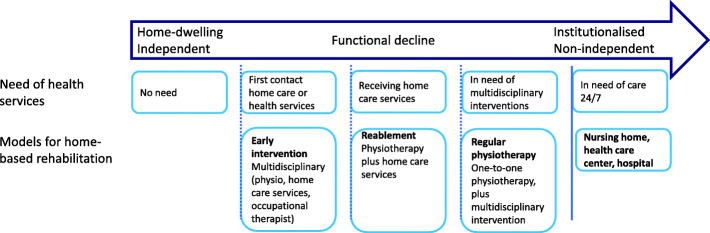
Methods: Patients referred to home-based rehabilitation in a large municipality in Norway were invited to participate in this prospective observational study. The three working models, early intervention, reablement and regular physiotherapy, were organised according to the patients' function and degree of independence. The older adults (≥ 65 years) were allocated to the different models by either a multidisciplinary group of health care personnel or by direct referral. Patients' demographic and clinical characteristics, including physical function (Patient-specific functional scale, PSFS), physical performance (Short Physical Performance Battery, SPPB) and health-related quality of life (EQ-5D) were registered at baseline and follow-up (maximum 6 months after baseline). One-way ANOVA was used to analyse group differences in clinical characteristics and paired t-tests to analyse changes from baseline to follow-up.
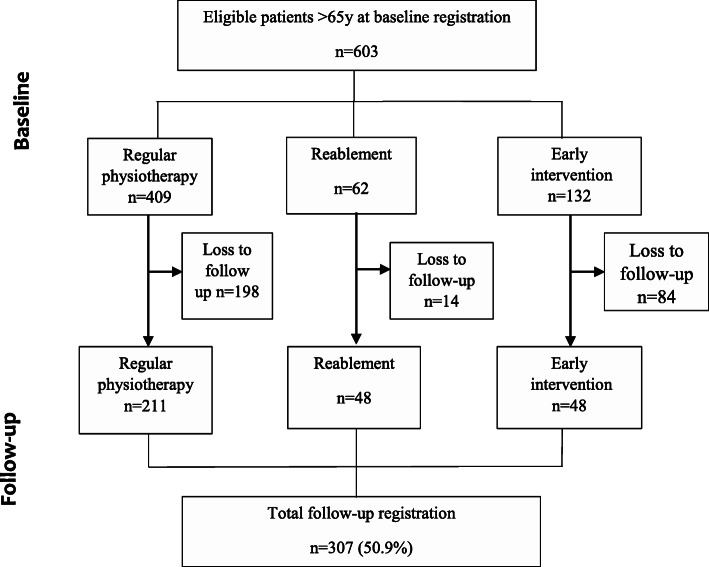
Results: In total, 603 and 402 patients (median (interquartile range) age: 84 (77-88) years) completed baseline and follow-up assessments, respectively. Patients in all three working models had an increased risk for functional decline. Patients receiving early intervention (n = 62) had significantly (p < 0.001) better physical performance and health-related quality of life (SPPB mean 7.9, SD 2.7; EQ-5D:mean 0.59, SD 0.19), than patients receiving reablement (n = 132) (SPPB: mean 5.5, SD 2.6; EQ-5D: mean 0.50, SD 0.15) and regular physiotherapy (n = 409) (SPPB: mean 5.6, SD 2.8; EQ-5D: mean 0.41, SD 0.22). At follow-up, the three working models showed significantly improvements in physical function (PSFS: mean change (95 % CI): 2.5 (1.9 to 3.2); 1.8 (0.5 to 3.1); 1.7 (0.8 to 2.6), for regular physiotherapy, reablement, and early intervention, respectively). Patients receiving regular physiotherapy and reablement also significantly improved physical performance and health-related quality of life.
Conclusions: While older adults receiving reablement and regular physiotherapy showed similar patient characteristics and treatment outcomes, early intervention identified older patients at risk of functional decline at an earlier stage. These results are relevant for policy makers when designing and improving prevention and rehabilitation strategies in primary health care.
Keywords: Functional decline; Health-related quality of life; Home-based physiotherapy; Mobility; Older adults; Physical function; Prevention; Primary health care; Reablement; Rehabilitation.
© 2021. The Author(s).
Conflict of interest statement
The authors report no conflicts of interest. The authors alone are responsible for the content and writing of the paper. Financial support was obtained by the Norwegian Fund for Post-Graduate Training in Physiotherapy, Trondheim Municipality and the Norwegian University of Science and Technology.
Figures
References
-
- UN . World Population Ageing 2017. New York: UN Department of Economic and Social Affairs; 2017.
Publication types
MeSH terms
Grants and funding
LinkOut - more resources
Full Text Sources
