


Associations between polyfluoroalkyl substance and organophosphate flame retardant exposures and telomere length in a cohort of women firefighters and office workers in San Francisco
- PMID: 34454526
- PMCID: PMC8403436
- DOI: 10.1186/s12940-021-00778-z
Associations between polyfluoroalkyl substance and organophosphate flame retardant exposures and telomere length in a cohort of women firefighters and office workers in San Francisco
Abstract
Background: Environmental chemical exposures can affect telomere length, which in turn has been associated with adverse health outcomes including cancer. Firefighters are occupationally exposed to many hazardous chemicals and have higher rates of certain cancers. As a potential biomarker of effect, we assessed associations between chemical exposures and telomere length in women firefighters and office workers from San Francisco, CA.
Methods: We measured serum concentrations of polyfluoroalkyl substances (PFAS), urinary metabolites of flame retardants, including organophosphate flame retardants (OPFRs), and telomere length in peripheral blood leukocytes in women firefighters (N = 84) and office workers (N = 79) who participated in the 2014-15 Women Workers Biomonitoring Collaborative. Multiple linear regression models were used to assess associations between chemical exposures and telomere length.
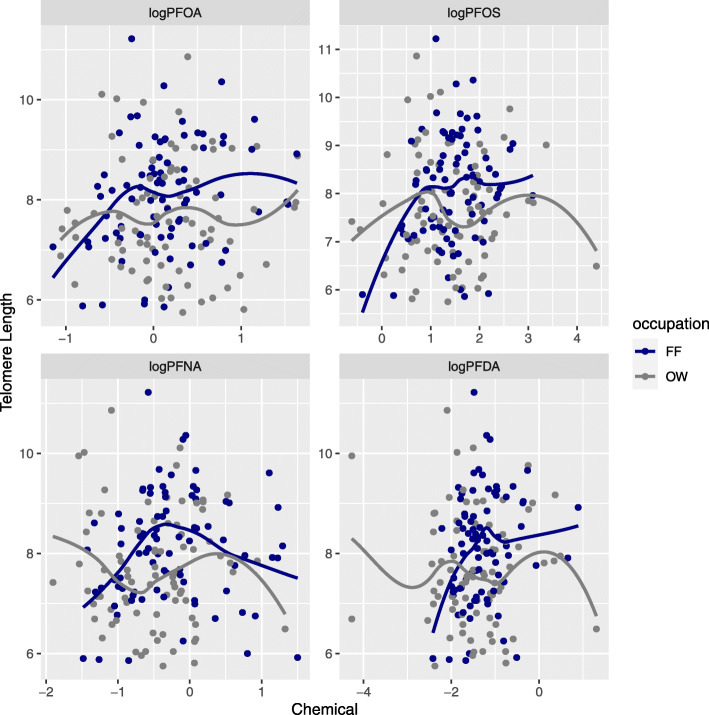
Results: Regression results revealed significant positive associations between perfluorooctanoic acid (PFOA) and telomere length and perfluorooctanesulfonic acid (PFOS) and telomere length among the whole cohort. Models stratified by occupation showed stronger and more significant associations among firefighters as compared to office workers. Among firefighters in models adjusted for age, we found positive associations between telomere length and log-transformed PFOA (β (95%CI) = 0.57(0.12, 1.02)), PFOS (0.44 (0.05, 0.83)), and perfluorodecanoic acid (PFDA) (0.43 (0.02, 0.84)). Modeling PFAS as categories of exposure showed significant associations between perfluorononanoic acid (PFNA) and telomere length among firefighters. Significant associations between OPFR metabolites and telomere length were seen for bis (1,3-dichloro-2-propyl) phosphate (BDCPP) and telomere length among office workers (0.21(0.03, 0.40)) and bis (2-chloroethyl) phosphate (BCEP) and telomere length among firefighters (- 0.14(- 0.28, - 0.01)). For OPFRs, the difference in the direction of effect by occupational group may be due to the disparate detection frequencies and concentrations of exposure between the two groups and/or potential unmeasured confounding.
Conclusion: Our findings suggest positive associations between PFAS and telomere length in women workers, with larger effects seen among firefighters as compared to office workers. The OPFR metabolites BDCPP and BCEP are also associated with telomere length in firefighters and office workers. Associations between chemical exposures and telomere length reported here and by others suggest mechanisms by which these chemicals may affect carcinogenesis and other adverse health outcomes.
Keywords: Firefighters; Organophosphate flame retardants; Polyfluoroalkyl substances; Telomeres.
© 2021. The Author(s).
Conflict of interest statement
The authors declare that they have no competing interests.
Figures
Update of
-
Associations between polyfluoroalkyl substance and organophosphate flame retardant exposures and telomere length in a cohort of women firefighters and office workers in San Francisco.medRxiv [Preprint]. 2020 Nov 10:2020.11.05.20226183. doi: 10.1101/2020.11.05.20226183. medRxiv. 2020. Update in: Environ Health. 2021 Aug 28;20(1):97. doi: 10.1186/s12940-021-00778-z. PMID: 33173912 Free PMC article. Updated. Preprint.
References
-
- International Agency for Research on Cancer. IARC Monographs on the Evaluation of Carcinogenic Risks to Humans: Painting, Firefighting, and Shiftwork. [Internet]. Lyon, France: World Health Organization; 2010. Report No.: Vol. 98. Available from: https://monographs.iarc.fr/wp-content/uploads/2018/06/mono98.pdf - PMC - PubMed
-
- Daniels RD, Kubale TL, Yiin JH, Dahm MM, Hales TR, Baris D, Zahm SH, Beaumont JJ, Waters KM, Pinkerton LE. Mortality and cancer incidence in a pooled cohort of US firefighters from San Francisco, Chicago and Philadelphia (1950–2009) Occup Environ Med. 2014;71(6):388–397. doi: 10.1136/oemed-2013-101662. - DOI - PMC - PubMed
-
- LeMasters GK, Genaidy AM, Succop P, Deddens J, Sobeih T, Barriera-Viruet H, et al. Cancer Risk Among Firefighters: A Review and Meta-analysis of 32 Studies. J Occup Environ Med [Internet]. 2006;48(11):1189-202. Available from: https://journals.lww.com/joem/Fulltext/2006/11000/Cancer_Risk_Among_Fire... - PubMed
Publication types
MeSH terms
Substances
Grants and funding
LinkOut - more resources
Full Text Sources
Research Materials
Miscellaneous
