


Protocol for the Controlled evaLuation of Angiotensin Receptor blockers for COVID-19 respIraTorY disease (CLARITY): a randomised controlled trial
- PMID: 34454580
- PMCID: PMC8397850
- DOI: 10.1186/s13063-021-05521-0
Protocol for the Controlled evaLuation of Angiotensin Receptor blockers for COVID-19 respIraTorY disease (CLARITY): a randomised controlled trial
Abstract
Background: SARS-CoV-2 binds to membrane-bound angiotensin-converting enzyme 2 (ACE2) which may result in downregulation of membrane-bound ACE2. ACE2 is a key regulator of the renin-angiotensin system (RAS) and is responsible for degrading angiotensin II and thereby counteracting its pro-inflammatory, pro-fibrotic effects mediated through the angiotensin II type 1 receptor (AT1R). As AT1R is directly blocked by angiotensin receptor blockers (ARBs), these agents may offer a safe, low-cost solution for reducing COVID-19 respiratory outcomes.
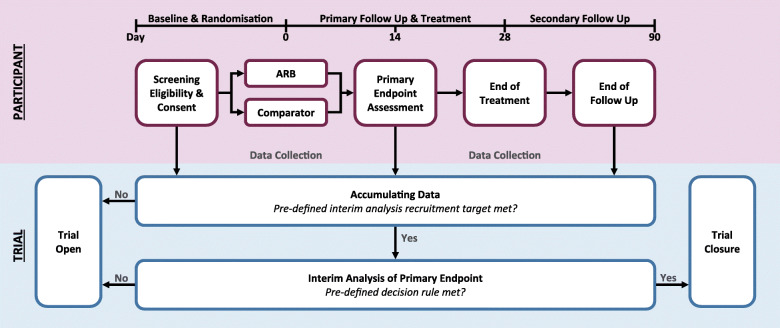
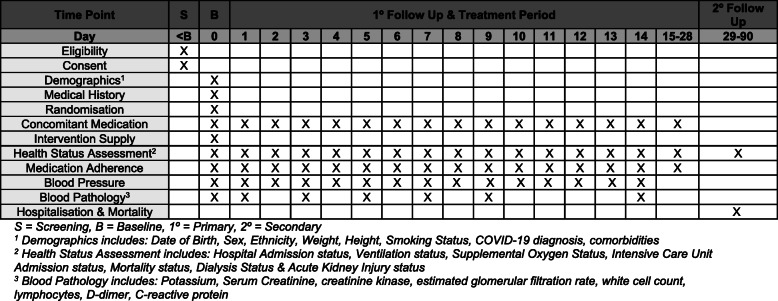
Methods and discussion: CLARITY is a pragmatic, adaptive, two-arm, multi-centre, comparative effectiveness phase III randomised controlled trial that examines whether ARBs reduce COVID-19 severity among high-risk patients. Recruiting in India and Australia, the trial will compare treatment with a maximum tolerated daily dose of an ARB to standard of care. Treatment allocation is blinded in India but open-label in Australia due to interruptions to placebo supply in the latter. The primary endpoint is a 7-point ordinal scale of clinical states, ranging from no limitation of activities (category 1) to death (category 7), assessed on day 14. Secondary outcomes include the 7-point scale assessed at day 28 and 28- and 90-day mortality. The design adapts the sample size based on accumulating data via frequent interim analyses and the use of predictive probability to determine whether the current sample size is sufficient or continuing accrual would be futile. The trial commenced recruitment on 18 August 2020.
Trial registration: ClinicalTrials.gov, NCT04394117 . Registered on 19 May 2020. Clinical Trial Registry of India: CTRI/2020/07/026831).
Keywords: Angiotensin receptor blockers; Bayesian adaptive design; COVID-19; RCT; Renin-angiotensin system.
© 2021. The Author(s).
Conflict of interest statement
CH, SK, AW, AB, JM, LB, NB, MK, VR, MJoh, EL, AR, AM, TS, and MJon have no conflicts of interest to disclose.
CP serves on advisory boards for AstraZeneca, Boehringer Ingelheim, Merck Sharp and Dohme, and Novartis.
CJ serves on advisory boards for AstraZeneca, Boehringer Ingelheim, Chiesi, GlaxoSmithKline, Novartis, and Sanofi-Genzyme.
VJ has received grants from Baxter Healthcare, Biocon, and GlaxoSmithKline and speaker fees/advisory board from AstraZeneca, Baxter Healthcare, NephroPlus, and Sanofi—all outside the submitted work. All fees paid to the organisation.
MJar is responsible for research projects that have received unrestricted funding from Amgen, Baxter, Bayer, CSL Behring, Eli Lilly, Gambro, and Merck Sharp and Dohme; has served on advisory boards sponsored by Akebia, AstraZeneca, Baxter, Bayer, Boehringer Ingelheim, Merck Sharp and Dohme, and Vifor; serves on the Steering Committee for trials sponsored by Chinook, CSL Behring, and Janssen; serves on a Steering Committee for an investigator-initiated trial in COVID-19 disease with funding support from Dimerix; spoken at scientific meetings sponsored by Amgen, Janssen, Roche, and Vifor; with any consultancy, honoraria, or travel support paid to the institution.
Figures
References
-
- Ritchie H, Ortiz-Ospina E, Beltekian D, et al. Coronavirus (COVID-19) cases 2021 [Available from: https://ourworldindata.org/covid-cases]. Accessed May 1 2021.
-
- Johns Hopkins University and Medicine COVID-19 Dashboard. Johns Hopkins Coronavirus Resource Centre [Available from: https://coronavirus.jhu.edu/map.html]. Accessed May 15 2020.
-
- Docherty AB, Harrison EM, Green CA, Hardwick HE, Pius R, Norman L, Holden KA, Read JM, Dondelinger F, Carson G, Merson L, Lee J, Plotkin D, Sigfrid L, Halpin S, Jackson C, Gamble C, Horby PW, Nguyen-van-Tam JS, Ho A, Russell CD, Dunning J, Openshaw PJM, Baillie JK, Semple MG. Features of 20 133 UK patients in hospital with covid-19 using the ISARIC WHO Clinical Characterisation Protocol: prospective observational cohort study. BMJ. 2020;369:m1985. doi: 10.1136/bmj.m1985. - DOI - PMC - PubMed
-
- International Severe Acute Respiratory and Emerging Infections Consortium (ISARIC). COVID-19 Report: 19 May 2020,2020.
Publication types
MeSH terms
Substances
Associated data
Grants and funding
LinkOut - more resources
Full Text Sources
Medical
Research Materials
Miscellaneous
