


Effectiveness of deep cervical fascial manipulation and yoga postures on pain, function, and oculomotor control in patients with mechanical neck pain: study protocol of a pragmatic, parallel-group, randomized, controlled trial
- PMID: 34454582
- PMCID: PMC8399821
- DOI: 10.1186/s13063-021-05533-w
Effectiveness of deep cervical fascial manipulation and yoga postures on pain, function, and oculomotor control in patients with mechanical neck pain: study protocol of a pragmatic, parallel-group, randomized, controlled trial
Abstract
Introduction: Mechanical neck pain (MNP) is a commonly occurring musculoskeletal condition that is usually managed using electrical modalities, joint mobilization techniques, and therapeutic exercises, but has limited evidence of their efficacy. Pathology (densification) of the deep cervical fascia that occurs due to the increased viscosity of hyaluronic acid (HA) may induce neck pain and associated painful symptoms of the upper quarter region. Fascial manipulation (FM) and yoga poses are considered to reduce the thixotropy of the ground substances of the deep fascia and improve muscle function. The purpose of this study is to investigate the effect of FM and sequential yoga poses (SYP) when compared to the usual care on pain, function, and oculomotor control in MNP.
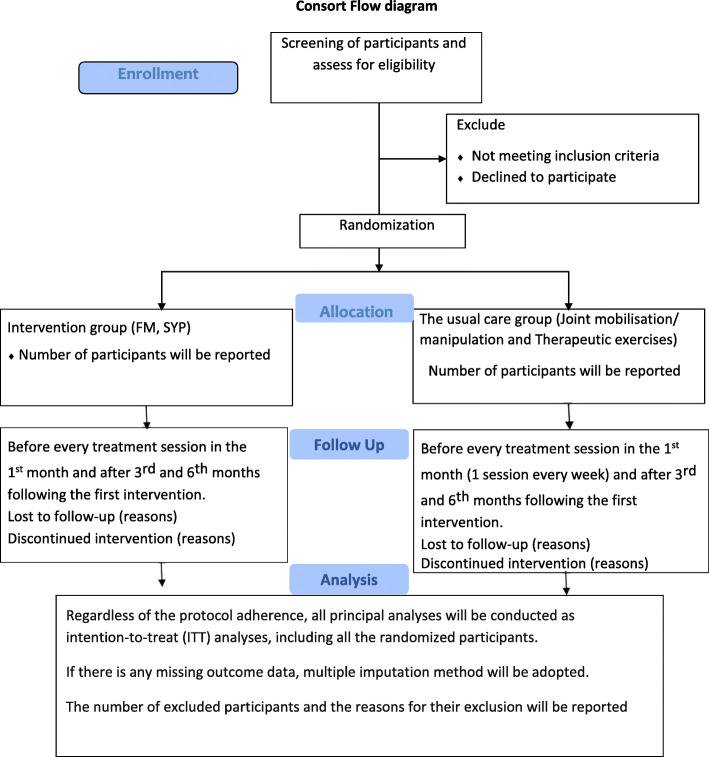
Methods: This FaCe-Man trial will recruit 160 patients with subacute and chronic mechanical neck pain diagnosed using predefined criteria. Participants will be randomized to either the intervention group or the usual care group, using a random allocation ratio of 1:1. Patients in the intervention group will receive FM (4 sessions in 4 weeks) and SYP (12 weeks) whereas the standard care group will receive cervical mobilization/ thoracic manipulation (4 sessions in 4 weeks) and therapeutic exercises (12 weeks). The primary outcome is the change in the numeric pain rating scale (NPRS). The secondary outcomes include changes in the patient-specific functional scale and oculomotor control, myofascial stiffness, fear-avoidance behavior questionnaire, and elbow extension range of motion during neurodynamics test 1.
Discussion: If found effective, FM along with SYP investigated in this trial can be considered as a treatment strategy in the management of mechanical neck pain. Considering the magnitude of the problem, and the pragmatic and patient-centered approach to be followed, it is worth investigating this trial.
Trial registration: ClinicalTrials.gov CTRI/2020/01/022934 . Registered on January 24, 2020 with ctri.nic.in. Clinical Trials Registry - India.
Keywords: Active stretching; Cervical pain; Connective tissue; Eye movements; Musculoskeletal manipulation; Soft tissue therapy.
© 2021. The Author(s).
Conflict of interest statement
The authors declare that there are no financial or other competing interests.
Figures
References
-
- Muñoz-García D, Gil-Martínez A, López-López A, Lopez-de-Uralde-Villanueva I, La Touche R, Fernández-Carnero J. Chronic Neck Pain and Cervico-Craniofacial Pain Patients Express Similar Levels of Neck Pain-Related Disability, Pain Catastrophizing, and Cervical Range of Motion. Pain Res Treat. 2016:7296032. 10.1155/2016/7296032. Epub 2016 Mar 29. PMID: 27119020; PMCID: PMC4828545. - PMC - PubMed
-
- Guzman J, Hurwitz EL, Carroll LJ, Haldeman S, Cote P, Carragee EJ, et al. A new conceptual model of neck pain: linking onset, course, and care Bone and Joint Decade 2000-2010 Task Force on Neck Pain and Its Associated Disorders. Spine. 2008;33(4 Suppl):S14–S23. doi: 10.1097/BRS.0b013e3181643efb. - DOI - PubMed
-
- Fernández-de-las-Peñas C, Cleland J, Huijbregts P. Neck and arm pain syndromes. Evidence-informed screening, diagnosis, and management. 1st ed. Churchill Livingstone: Elsevier; 2011.
-
- Yeun YR, Han SJ. Factors associated with neck/shoulder pain in young adults. Biomed Res. 2017;28(16):7117–7121.
Publication types
MeSH terms
LinkOut - more resources
Full Text Sources
Medical
