


Functional connectivity of spoken language processing in early-stage Parkinson's disease: An MEG study
- PMID: 34455187
- PMCID: PMC8403765
- DOI: 10.1016/j.nicl.2021.102718
Functional connectivity of spoken language processing in early-stage Parkinson's disease: An MEG study
Abstract
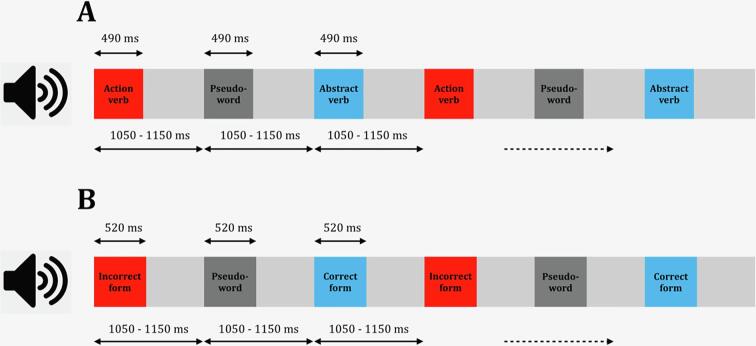
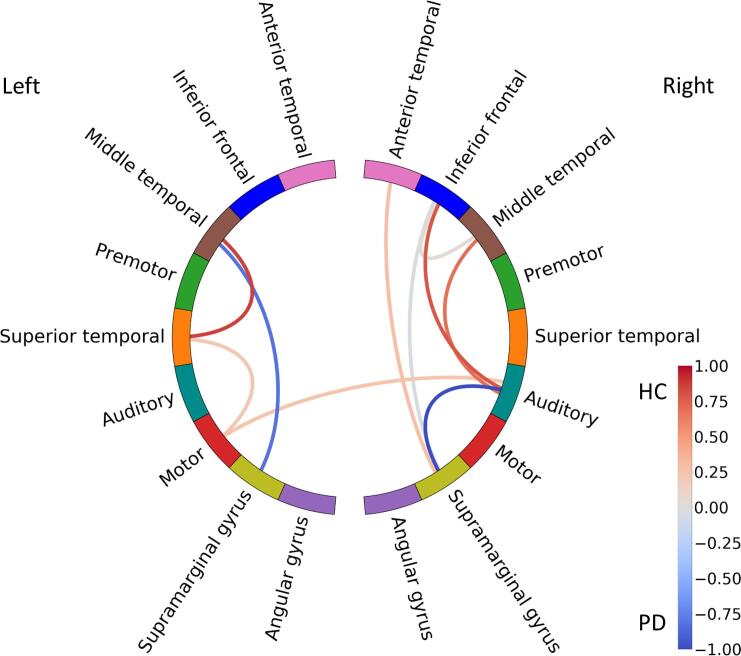
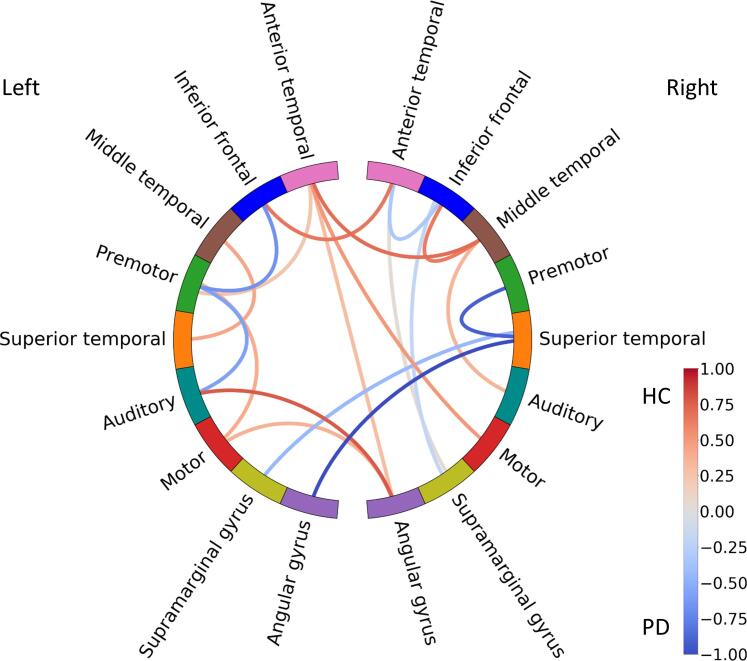
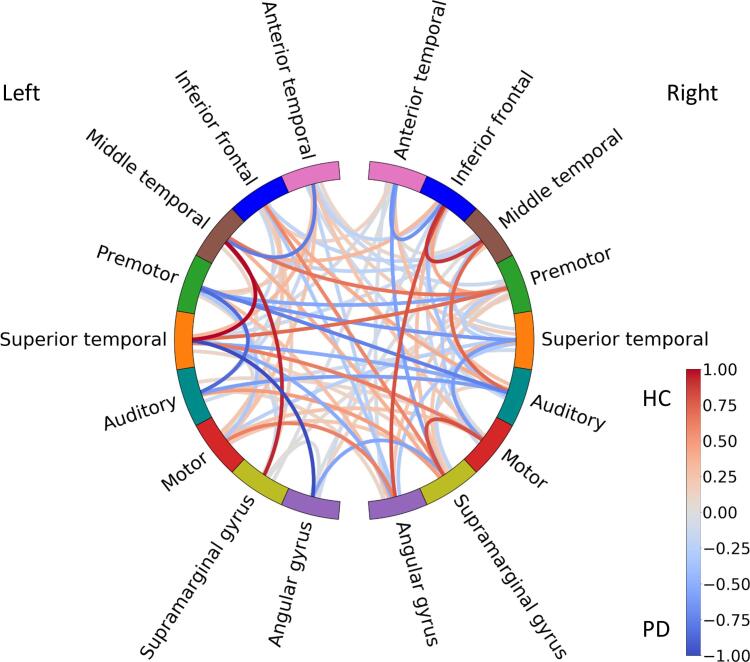
Parkinson's disease (PD) is a neurodegenerative disorder, well-known for its motor symptoms; however, it also adversely affects cognitive functions, including language, a highly important human ability. PD pathology is associated, even in the early stage of the disease, with alterations in the functional connectivity within cortico-subcortical circuitry of the basal ganglia as well as within cortical networks. Here, we investigated functional cortical connectivity related to spoken language processing in early-stage PD patients. We employed a patient-friendly passive attention-free paradigm to probe neurophysiological correlates of language processing in PD patients without confounds related to active attention and overt motor responses. MEG data were recorded from a group of newly diagnosed PD patients and age-matched healthy controls who were passively presented with spoken word stimuli (action and abstract verbs, as well as grammatically correct and incorrect inflectional forms) while focussing on watching a silent movie. For each of the examined linguistic aspects, a logistic regression classifier was used to classify participants as either PD patients or healthy controls based on functional connectivity within the temporo-fronto-parietal cortical language networks. Classification was successful for action verbs (accuracy = 0.781, p-value = 0.003) and, with lower accuracy, for abstract verbs (accuracy = 0.688, p-value = 0.041) and incorrectly inflected forms (accuracy = 0.648, p-value = 0.021), but not for correctly inflected forms (accuracy = 0.523, p-value = 0.384). Our findings point to quantifiable differences in functional connectivity within the cortical systems underpinning language processing in newly diagnosed PD patients compared to healthy controls, which arise early, in the absence of clinical evidence of deficits in cognitive or general language functions. The techniques presented here may aid future work on establishing neurolinguistic markers to objectively and noninvasively identify functional changes in the brain's language networks even before clinical symptoms emerge.
Keywords: Action verb; Classification; Functional connectivity; Magnetoencephalography (MEG); Morphosyntax; Parkinson’s disease (PD).
Copyright © 2021 The Authors. Published by Elsevier Inc. All rights reserved.
Figures

Comment in
-
The Parkinson disease connectome - insights from new imaging studies.Nat Rev Neurol. 2021 Sep;17(9):527-528. doi: 10.1038/s41582-021-00543-3. Nat Rev Neurol. 2021. PMID: 34312532 No abstract available.
References
-
- Abrevaya S., Sedeño L., Fitipaldi S., Pineda D., Lopera F., Buritica O., Villegas A., Bustamante C., Gomez D., Trujillo N., Pautassi R., Ibáñez A., García A.M., Kumfor F. The Road less traveled: alternative pathways for action-verb processing in parkinson's disease. J. Alzheimers Dis. 2017;55(4):1429–1435. doi: 10.3233/JAD-160737. - DOI - PubMed
-
- Amboni M., Tessitore A., Esposito F., Santangelo G., Picillo M., Vitale C., Giordano A., Erro R., de Micco R., Corbo D., Tedeschi G., Barone P. Resting-state functional connectivity associated with mild cognitive impairment in Parkinson’s disease. J. Neurol. 2015;262(2):425–434. - PubMed
-
- Arnott W.L., Chenery H.J., Murdoch B.E., Silburn P.A. Morphosyntactic and syntactic priming: an investigation of underlying processing mechanisms and the effects of Parkinson's disease. J. Neurolinguistics. 2005;18(1):1–28. doi: 10.1016/j.jneuroling.2004.02.002. - DOI
Publication types
MeSH terms
LinkOut - more resources
Full Text Sources
Medical
