Review
. 2021 Aug 11:9:716300.
doi: 10.3389/fcell.2021.716300. eCollection 2021.

Hearing Loss in Neurological Disorders

Affiliations
Review

Hearing Loss in Neurological Disorders

Siyu Li et al. Front Cell Dev Biol. .

Abstract

Sensorineural hearing loss (SNHL) affects approximately 466 million people worldwide, which is projected to reach 900 million by 2050. Its histological characteristics are lesions in cochlear hair cells, supporting cells, and auditory nerve endings. Neurological disorders cover a wide range of diseases affecting the nervous system, including Alzheimer's disease (AD), Parkinson's disease (PD), Huntington's disease (HD), autism spectrum disorder (ASD), etc. Many studies have revealed that neurological disorders manifest with hearing loss, in addition to typical nervous symptoms. The prevalence, manifestations, and neuropathological mechanisms underlying vary among different diseases. In this review, we discuss the relevant literature, from clinical trials to research mice models, to provide an overview of auditory dysfunctions in the most common neurological disorders, particularly those associated with hearing loss, and to explain their underlying pathological and molecular mechanisms.

Keywords: autism spectrum disorder; hearing loss; molecular mechanisms; neurodegenerative diseases; pathological mechanisms.


Conflict of interest statement

The authors declare that the research was conducted in the absence of any commercial or financial relationships that could be construed as a potential conflict of interest.

Figures
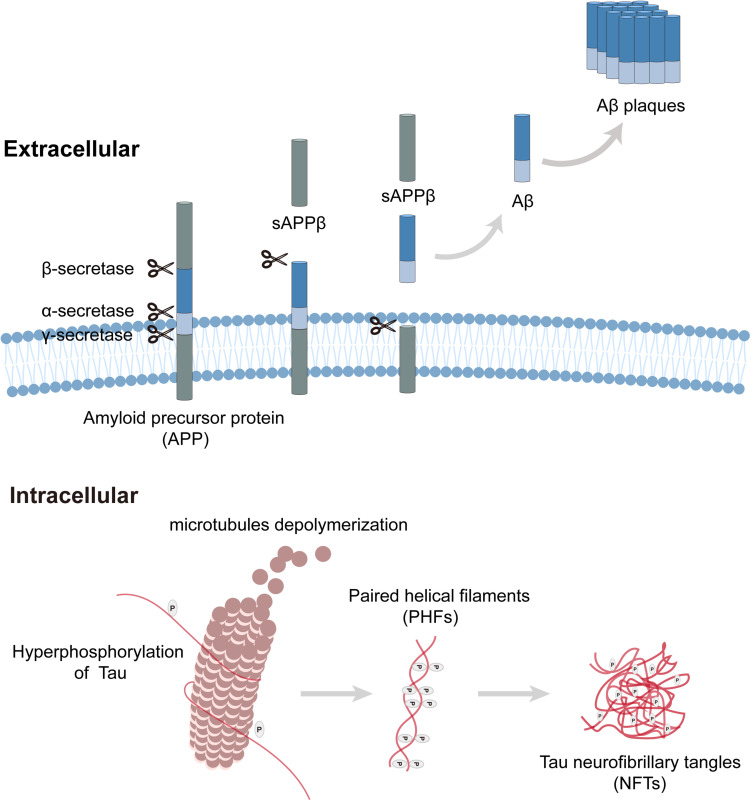
FIGURE 1
FIGURE 1
Amyloid plaque formation extracellular and tau pathology intracellular. Amyloid precursor protein (APP) is a transmembrane protein that can be cleaved by three kinds of secretases. In the process of amyloid plaque formation, APP is cleaved by β-secretase and γ-secretase sequentially, then amyloid-β peptides release to extracellular and clump together to form deposits (Aβ plaques). Tau plays a critical role in microtubule assembly and stabilization, hyperphosphorylation of tau leads to microtubules depolymerization, and paired helical filaments (PHF) aggregate to form tau neurofibrillary tangles (NFTs).
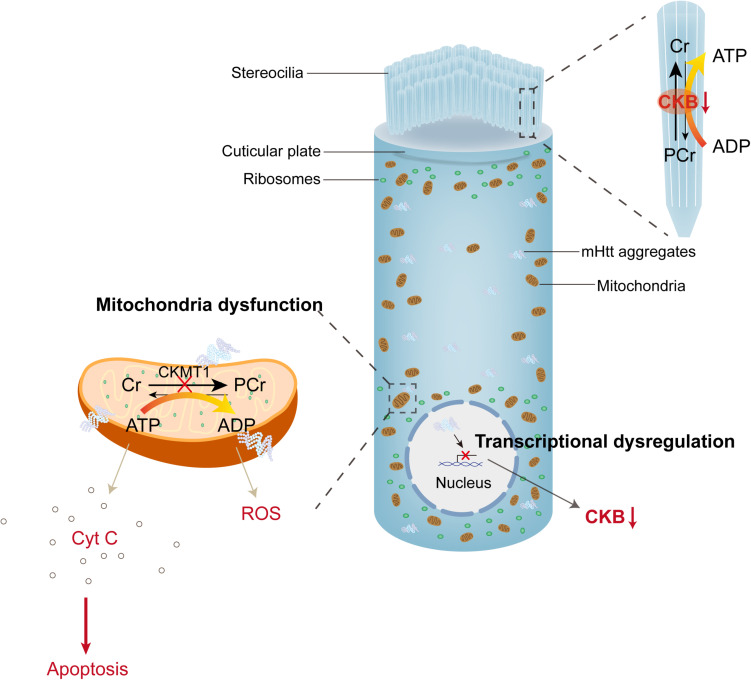
FIGURE 2
FIGURE 2
mHtt aggregates induced toxicity and dysregulated PCr-CK system in hair cells. The PCr-CK system plays a critical role in providing ATP in hair bundles of hair cells, mitochondrial creatine kinase (CKMT1) phosphorylates creatine (Cr) to phosphocreatine (PCr). In the stereocilia, brain-type creatine kinase (CKB) regenerates ATP from PCr. Expression of mHtt in hair cells impairs the function of mitochondria, releases cytochrome C and reactive oxygen species (ROS) to the cytoplasm. On the other hand, mHtt aggregates lead to protein sequestration (including many transcriptional factors), then induce transcriptional dysregulation, which reduces the expression of CKB (creatine kinase).

References

    1. Alzheimer’s Association (2020). 2020 Alzheimer’s disease facts and figures. Alzheimers Dement. 16 391–460. 10.1002/alz.12068 - DOI - PubMed
    1. Akil O., Weber C. M., Park S. N., Ninkina N., Buchman V., Lustig L. R. (2008). Localization of synucleins in the mammalian cochlea. J. Assoc. Res. Otolaryngol. 9 452–463. 10.1007/s10162-008-0134-y - DOI - PMC - PubMed
    1. Albers M. W., Gilmore G. C., Kaye J., Murphy C., Wingfield A., Bennett D. A., et al. (2015). At the interface of sensory and motor dysfunctions and Alzheimer’s disease. Alzheimers Dement. 11 70–98. 10.1016/j.jalz.2014.04.514 - DOI - PMC - PubMed
    1. Appler J. M., Goodrich L. V. (2011). Connecting the ear to the brain: molecular mechanisms of auditory circuit assembly. Prog. Neurobiol. 93 488–508. 10.1016/j.pneurobio.2011.01.004 - DOI - PMC - PubMed
    1. Arndt T. L., Stodgell C. J., Rodier P. M. (2005). The teratology of autism. Int. J. Dev. Neurosci. 23 189–199. 10.1016/j.ijdevneu.2004.11.001 - DOI - PubMed

LinkOut - more resources