doi: 10.21769/BioProtoc.2153.
Olfactory Avoidance Test (Mouse)
Affiliations
- PMID: 34458469
- PMCID: PMC8376533
- DOI: 10.21769/BioProtoc.2153
Item in Clipboard
Olfactory Avoidance Test (Mouse)
Bio Protoc.
.
Abstract
In mice, olfaction plays a pivotal role in the various behaviors, such as feeding, mating, nursing and avoidance. Behavioral tests that analyze abilities of odor detection and recognition using genetically modified mice reveal the contribution of target genes to the olfactory processing. Here, we describe the olfactory avoidance test to investigate the odor detection ability in mice.
Keywords: Avoidance; Behavioral test; Freezing; Mouse; Odor detection threshold; Olfaction.
Copyright © 2017 The Authors; exclusive licensee Bio-protocol LLC.
Figures
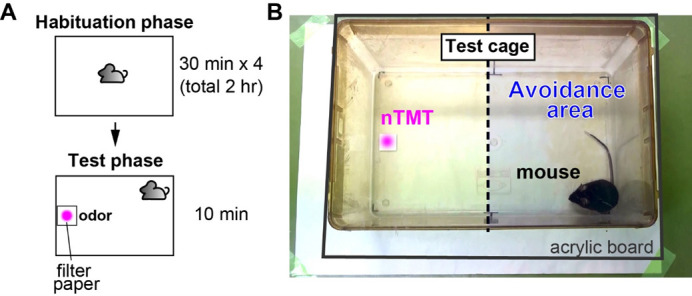
A. Schema of the experimental procedure; B. Apparatus of the olfactory avoidance test.
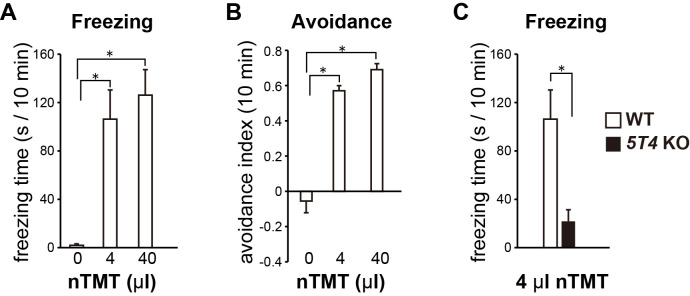
A and B. Freezing time (A) and avoidance index (B) in wild-type mice; C. When a lower amount (4 μl) of nTMT was employed, 5T4 knockout mice remarkably reduced the freezing time, compared with wild-type mice (see the detail in
Takahashi et al., 2016
).
References
-
- Holm S.(1979). A simple sequentially rejective multiple test procedure. Scand J Statist 6(2): 65-70.
-
- Kobayakawa K., Kobayakawa R., Matsumoto H., Oka Y., Imai T., Ikawa M., Okabe M., Ikeda T., Itohara S., Kikusui T., Mori K. and Sakano H.(2007). Innate versus learned odour processing in the mouse olfactory bulb. Nature 450(7169): 503-508. - PubMed
-
- Takahashi H., Ogawa Y., Yoshihara S., Asahina R., Kinoshita M., Kitano T., Kitsuki M., Tatsumi K., Okuda M., Tatsumi K., Wanaka A., Hirai H., Stern P. L. and Tsuboi A.(2016). A subtype of olfactory bulb interneurons is required for odor detection and discrimination behaviors. J Neurosci 36(31): 8210-8227. - PMC - PubMed
LinkOut - more resources
Full Text Sources