Review
. 2021 Dec;73(6):1520-1538.
doi: 10.1007/s43440-021-00316-1. Epub 2021 Aug 30.

COVID-19: potential therapeutics for pediatric patients

Affiliations
Review

COVID-19: potential therapeutics for pediatric patients

Nour K Younis et al. Pharmacol Rep. 2021 Dec.

Abstract

The global spread of COVID-19 has imparted significant economic, medical, and social burdens. Like adults, children are affected by this pandemic. However, milder clinical symptoms are often experienced by them. Only a minimal proportion of the affected patients may develop severe and complicated COVID-19. Supportive treatment is recommended in all patients. Antiviral and immunomodulatory medications are spared for hospitalized children with respiratory distress or severe to critical disease. Up till now, remdesivir is the only USFDA-approved anti-COVID-19 medication indicated in the majority of symptomatic patients with moderate to severe disease. Dexamethasone is solely recommended in patients with respiratory distress maintained on oxygen or ventilatory support. The use of these medications in pediatric patients is founded on evidence deriving from adult studies. No randomized controlled trials (RCTs) involving pediatric COVID-19 patients have assessed these medications' efficacy and safety, among others. Similarly, three novel monoclonal anti-SARS-CoV-2 spike protein antibodies, bamlanivimab, casirivimab and imdevimab, have been recently authorized by the USFDA. Nonetheless, their efficacy has not been demonstrated by multiple RCTs. In this review, we aim to dissect the various potential therapeutics used in children with COVID-19. We aspire to provide a comprehensive review of the available evidence and display the mechanisms of action and the pharmacokinetic properties of the studied therapeutics. Our review offers an efficient and practical guide for treating children with COVID-19.

Keywords: COVID-19; Pediatric patients; SARS-CoV-2; Therapeutics.


Conflict of interest statement

The authors declare no conflict of interest.

Figures
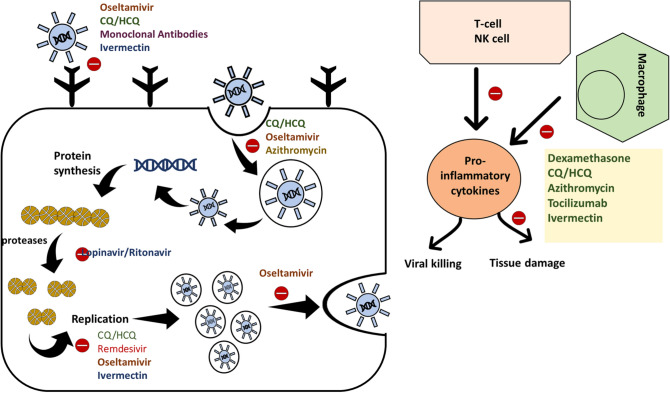
Fig. 1
Fig. 1
The potential therapeutics of COVID-19 and their suggested mechanisms of action. Chloroquine/hydroxychloroquine (CQ/HCQ) is known for its anti-inflammatory and antimicrobial effects. They inhibit viral fusion, endocytosis, and intracellular replication. Similarly, they modulate the inflammatory response mounted against the virus by attenuating the excessive uncontrolled release of pro-inflammatory cytokines. Oseltamivir is a selective inhibitor of the neuraminidase enzymes of the influenza virus. These enzymes are involved in various viral processes including viral entry, replication, packaging, and release. Hence, their use in SARS-CoV-2 infection may thwart the cellular processing of this virus at different levels. Remdesivir is a potent inhibitor of viral replication. It exerts its effect through the selective inhibition of the RNA-dependent RNA polymerase. Remdesivir, unlike CQ/HCQ, oseltamivir, and ivermectin, is a direct inhibitor of RNA-dependent RNA polymerase. CQ/HCQ, oseltamivir, and ivermectin hinder indirectly the replication through a cascade of events. On the contrary, dexamethasone, azithromycin, and tocilizumab are recognized for their anti-inflammatory effects. They control the inflammatory response mounted against the infection and hamper the progression to uncontrolled hyperinflammation and tissue destruction. These medications may alleviate the cytokine storm syndrome that may be associated with severe and complicated SARS-CoV-2 infections. Hence, they attenuate the tissue damage that may accompany viral killing. Similarly, the newly synthesized anti-SARS-CoV-2 spike protein antibodies are inhibitors of viral fusion and internalization. Viral endocytosis is also impeded by azithromycin. Moreover, ivermectin seems to inhibit viral uptake and replication as well as pro-inflammatory cytokines production
Fig. 2
Fig. 2
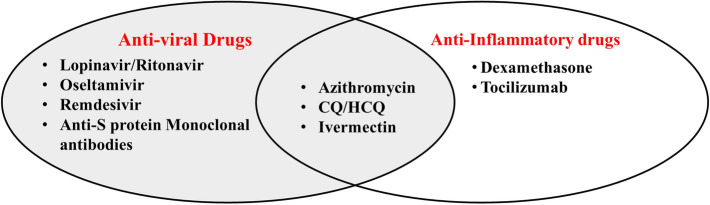
The distribution of the discussed COVID-19 therapeutics as per their main mechanism of action. Lopinavir/ritonavir, oseltamivir, remdesivir, and anti-SARS-CoV-2 spike (S) protein monoclonal antibodies are anti-viral drugs with distinct SARS-CoV-2 inhibitory effects. Azithromycin, chloroquine/hydroxychloroquine, and ivermectin display both antiviral and anti-inflammatory properties. Dexamethasone and tocilizumab display no direct antiviral properties; however, they exert anti-inflammatory effects that contribute in attenuating excessive pro-inflammatory responses
Fig. 3
Fig. 3
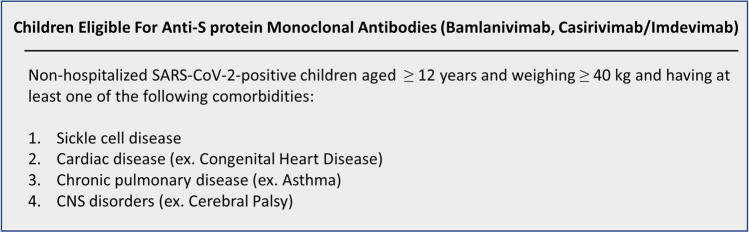
Indications for anti-SARS-CoV-2 spike protein monoclonal antibodies in children [126, 128]
Fig. 4
Fig. 4
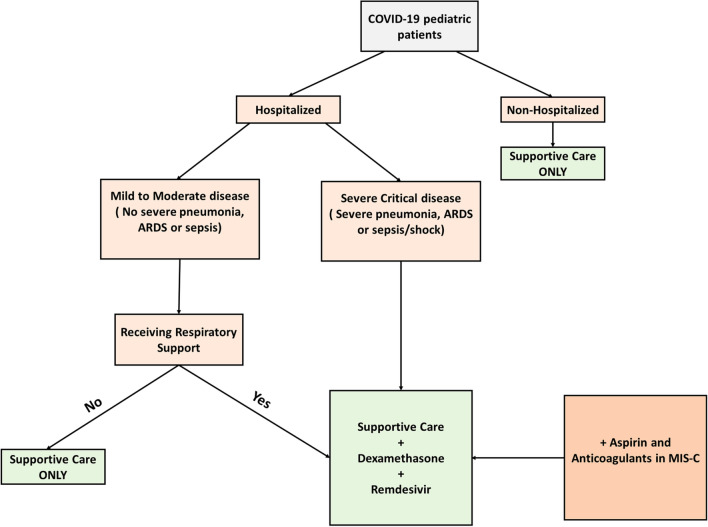
Suggested treatment algorithm. Supportive care consisting of fluids replacement and fever reduction should be offered to all COVID-19 pediatric patients regardless of hospitalization status and disease severity. Patients requiring respiratory support (oxygen or mechanical ventilation) should receive dexamethasone and remdesivir in addition to supportive care. Aspirin and anticoagulants should be add to the treatment of children with multisystem inflammatory syndrome. If remdesivir is contraindicated, other immunomodulators, such as IVIG and tocilizumab, may be considered in children with MIS as well. ARDS Acute respiratory distress syndrome, MIS-C multisystem inflammatory syndrome in children

References

    1. Wang C, Horby PW, Hayden FG, Gao GF. A novel coronavirus outbreak of global health concern. Lancet. 2020;395:470–473. - PMC - PubMed
    1. Ding Q, Lu P, Fan Y, Xia Y, Liu M. The clinical characteristics of pneumonia patients coinfected with 2019 novel coronavirus and influenza virus in Wuhan, China. J Med Virol. 2020;92(9):1549–1555. - PMC - PubMed
    1. Zhu N, Zhang D, Wang W, Li X, Yang B, Song J, et al. A Novel coronavirus from patients with pneumonia in China, 2019. N Engl J Med. 2020;382:727–733. - PMC - PubMed
    1. Younis NK, Zareef RO, Mohammad Ali NM, Maktabi R. The era of the coronavirus disease 2019 pandemic: a review on dynamics, clinical symptoms and complications, diagnosis, and treatment. Genetic Testing Molecular Biomarkers. 2021;25:85–101. - PubMed
    1. Younis NK, Rahm M, Bitar F, Arabi M. COVID-19 in the MENA region: facts and findings. J Infect Dev Ctries. 2021;15:342–349. - PubMed

MeSH terms

LinkOut - more resources