


[Development of classification criteria for uveitis by the standardization of uveitis nomenclature (SUN) working group]
- PMID: 34459962
- PMCID: PMC8413183
- DOI: 10.1007/s00347-021-01486-2
[Development of classification criteria for uveitis by the standardization of uveitis nomenclature (SUN) working group]
Abstract
Background: The standardization of uveitis nomenclature (SUN) working group is an international expert committee, which follows the aim to develop a standardized and internationally recognized terminology for the field of uveitis. This appears to be important in view of the demand for evidence-based medicine, especially for relatively rare diseases such as uveitis.
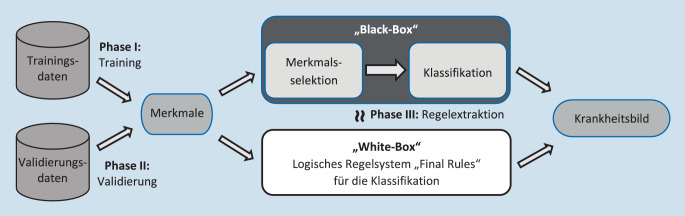
Methods: A databank of > 4000 uveitis patients was compiled using formal consensus techniques, for whom a majority consensus was previously achieved in the diagnosis. The patient data were analyzed within the subclasses of uveitis and divided into a training set and a validation set. Multinomial logistic regressions with LASSO regularization were carried out on the training set with machine learning (ML). The accuracy of the rules that were developed to express the criteria of ML, were assessed by a masked observer in a random sample of 10%.
Results: The estimations of total accuracy according to the uveitis classes in the validation set were high for all forms of uveitis: anterior uveitis 96.7% (95% confidence interval, CI 92.4-98.6%), intermediate uveitis 99.3% (95% CI 96.1-99.9%), posterior uveitis 98.0% (95% CI 94.3-99.3%), panuveitis 94.0% (95% CI 89.0-96.8%) and infectious posterior uveitis/panuveitis 93.3% (95% CI 89.1-96.3%).
Conclusion: Classification criteria are presented, which show a high degree of accuracy (low misclassification rates) and are therefore suitable for future clinical and translational research.
Zusammenfassung: HINTERGRUND: Die Standardization of Uveitis Nomenclature (SUN) Working Group ist eine internationale Expertenkommission, die das Ziel verfolgt, eine standardisierte und international anerkannte Terminologie für das Gebiet der Uveitis zu erarbeiten. Dies erscheint angesichts der Forderung nach evidenzbasierter Medizin gerade bei relativ seltenen Erkrankungen wie der Uveitis wichtig.
Methoden: Unter Verwendung formaler Konsensustechniken wurde eine Datenbank von > 4000 Uveitispatienten erstellt, bei denen zuvor eine Mehrheitsübereinstimmung in der Diagnose erzielt wurde. Die Patientendaten wurden innerhalb der Uveitissubklasse analysiert und in einen Trainingssatz und einen Validierungssatz aufgeteilt. Mit maschinellem Lernen (ML) wurden multinomiale logistische Regressionen mit Lasso-Regularisierung auf dem Trainingssatz durchgeführt. Die Genauigkeit der Regeln, die entwickelt wurden, um die Kriterien des maschinellen Lernens auszudrücken, wurde von einem maskierten Beobachter in einer 10 %igen Zufallsstichprobe bewertet.
Ergebnisse: Die Schätzungen der Gesamtgenauigkeit nach Uveitisklassen im Validierungsset waren für alle Uveitisformen hoch: anteriore Uveitiden 96,7 % (95 %-Konfidenzintervall [CI] 92,4–98,6); intermediäre Uveitiden 99,3 % (95 %-CI 96,1–99,9); posteriore Uveitiden 98,0 % (95 %-CI 94,3–99,3); Panuveitiden 94,0 % (95 %-CI 89,0–96,8) und infektiöse posteriore Uveitiden/Panuveitiden 93,3 % (95 %-CI 89,1–96,3).
Schlussfolgerungen: Es werden Klassifikationskriterien präsentiert, die einen hohen Grad an Genauigkeit (geringe Fehlklassifikationsraten) aufweisen und sich daher gut für die künftige klinische und translationale Forschung eignen.
Keywords: Classification criteria; Evidence based medicine; Machine learning; Research; Uveitis.
© 2021. The Author(s).
Comment in
-
[Here comes the "SUN" …].Ophthalmologe. 2021 Sep;118(9):881-882. doi: 10.1007/s00347-021-01487-1. Epub 2021 Sep 1. Ophthalmologe. 2021. PMID: 34476553 German. No abstract available.
References
-
- Jabs DA, Rosenbaum JT, Nussenblatt RP, the Standardization of Uveitis Nomenclature (SUN) Working Group Standardization of uveitis nomenclature for reporting clinical data. Report of the first international workshop. Am J Ophthalmol. 2005;140:509–516. doi: 10.1016/j.ajo.2005.03.057. - DOI - PMC - PubMed
Publication types
MeSH terms
LinkOut - more resources
Full Text Sources
