[Preprint]. 2021 Dec 9:2021.08.21.21262393.
doi: 10.1101/2021.08.21.21262393.

Global disparities in SARS-CoV-2 genomic surveillance

Affiliations

Global disparities in SARS-CoV-2 genomic surveillance

Anderson F Brito et al. medRxiv. .

Update in

  • Global disparities in SARS-CoV-2 genomic surveillance.
    Brito AF, Semenova E, Dudas G, Hassler GW, Kalinich CC, Kraemer MUG, Ho J, Tegally H, Githinji G, Agoti CN, Matkin LE, Whittaker C; Bulgarian SARS-CoV-2 sequencing group; Communicable Diseases Genomics Network (Australia and New Zealand); COVID-19 Impact Project; Danish Covid-19 Genome Consortium; Fiocruz COVID-19 Genomic Surveillance Network; GISAID core curation team; Network for Genomic Surveillance in South Africa (NGS-SA); Swiss SARS-CoV-2 Sequencing Consortium; Howden BP, Sintchenko V, Zuckerman NS, Mor O, Blankenship HM, de Oliveira T, Lin RTP, Siqueira MM, Resende PC, Vasconcelos ATR, Spilki FR, Aguiar RS, Alexiev I, Ivanov IN, Philipova I, Carrington CVF, Sahadeo NSD, Branda B, Gurry C, Maurer-Stroh S, Naidoo D, von Eije KJ, Perkins MD, van Kerkhove M, Hill SC, Sabino EC, Pybus OG, Dye C, Bhatt S, Flaxman S, Suchard MA, Grubaugh ND, Baele G, Faria NR. Brito AF, et al. Nat Commun. 2022 Nov 16;13(1):7003. doi: 10.1038/s41467-022-33713-y. Nat Commun. 2022. PMID: 36385137 Free PMC article.

Abstract

Genomic sequencing provides critical information to track the evolution and spread of SARS-CoV-2, optimize molecular tests, treatments and vaccines, and guide public health responses. To investigate the spatiotemporal heterogeneity in the global SARS-CoV-2 genomic surveillance, we estimated the impact of sequencing intensity and turnaround times (TAT) on variant detection in 167 countries. Most countries submit genomes >21 days after sample collection, and 77% of low and middle income countries sequenced <0.5% of their cases. We found that sequencing at least 0.5% of the cases, with a TAT <21 days, could be a benchmark for SARS-CoV-2 genomic surveillance efforts. Socioeconomic inequalities substantially impact our ability to quickly detect SARS-CoV-2 variants, and undermine the global pandemic preparedness.


Figures
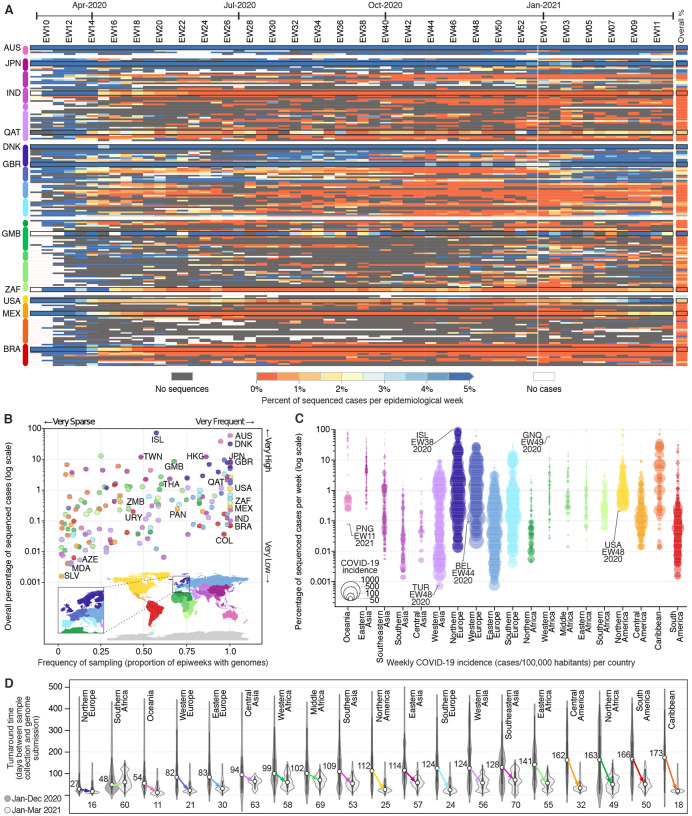
Fig. 1.
Fig. 1.. Disparities in SARS-CoV-2 global genomic surveillance.
(A) Percentage of reported cases that were sequenced per country, per epidemiological week (EW), between February 23rd, 2020 and March 27th, 2021 (based on metadata submitted to GISAID up to May 30th, 2021). Updated numbers on sequence submissions and proportion of sequenced cases are available on the GISAID Submissions Dashboard at gisaid.org. (B) Frequency and overall percentage of sequenced cases per country. This plot summarizes the data shown in (A), where the x-axis shows the percentage of EWs with sequenced cases, and the y-axis displays the overall percentage of cases shown in the rightmost column of panel (A). (C) Percentage of cases sequenced per EW per country, per geographic region (classified according to the UNSD geoscheme). Each circle represents an EW with at least one sequenced case, and their diameters highlight the incidence (cases per 100,000 habitants), e.g. “ISL-EW38–2020” shows data from week 38 in 2020, in Iceland. (D) Distribution of turnaround times of genomes collected in different geographic regions, in 2020 and 2021. Countries are highlighted in panels of this figure using the ISO 3166–1 nomenclature.
Figure 2.
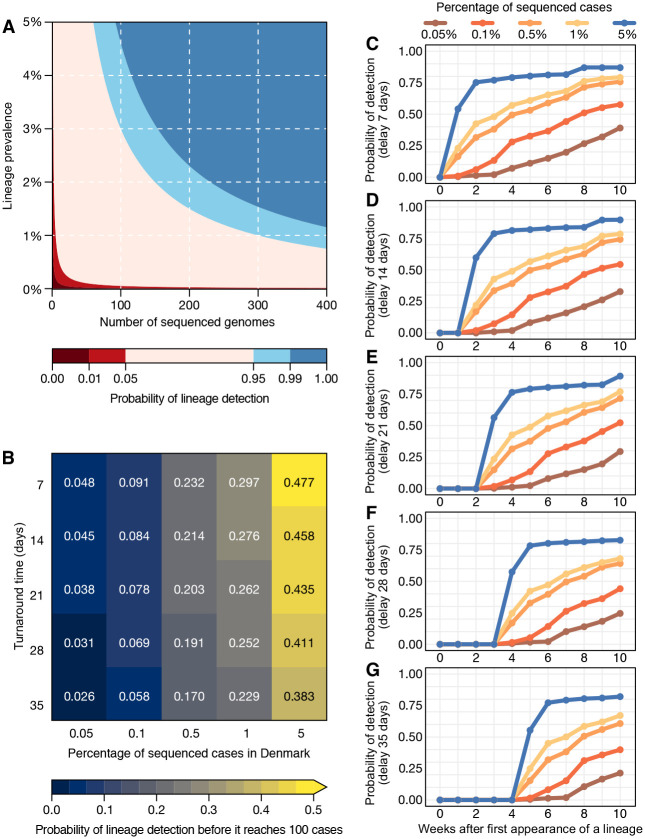
Figure 2.. Detection of SARS-CoV-2 lineages under different genomic surveillance scenarios.
(A) The probability of detecting at least one genome of a rare lineage under different sequencing regimes. (B) Relative importance of decreasing genome sequencing turnaround time (TAT) versus increasing sequencing percentage, measured as probability that a lineage found in simulated datasets was detected before it had reached 100 cases (described in Fig. S6). (C-G) Probability of lineage detection considering TATs of 7, 14, 21, 28 and 35 days.
Figure 3.
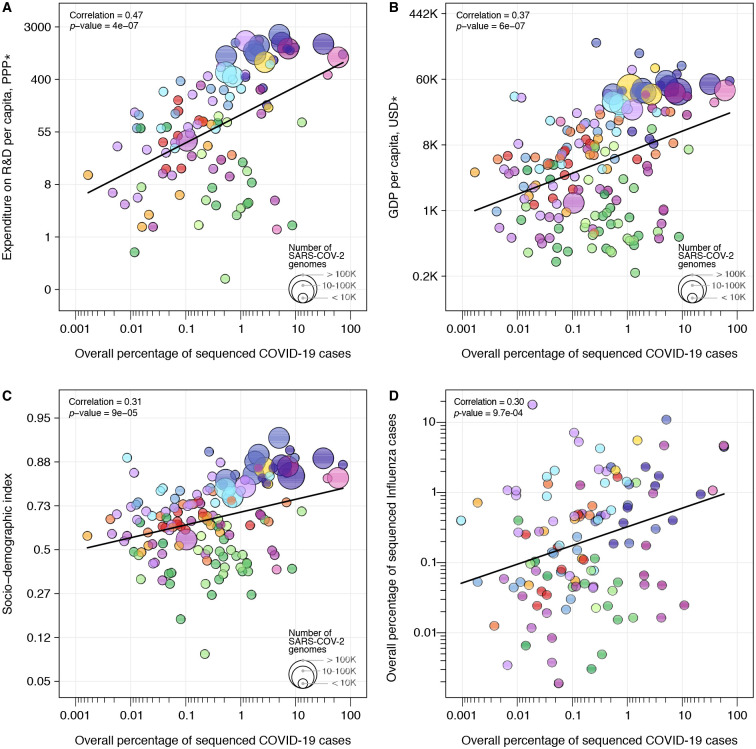
Figure 3.. Case sequencing percentages and socioeconomic covariates.
Covariates that show the highest correlation with the overall percentage of COVID-19 sequenced cases (during the period shown in Fig. 1A). (A) Expenditure on R&D per capita; (B) GDP per capita; (C) Socio-demographic index; (D) Overall percentage of influenza virus sequenced cases in 2019 (HA segment). For correlations between covariates and turnaround time, see Fig. S7. The colour scheme is the same as in Figure 1 and 2. Solid line shows the linear fit. *PPP = purchasing power parity, USD = US dollar 2005.

References

    1. WHO. WHO COVID-19 Explorer (2021), (available at https://worldhealthorg.shinyapps.io/covid/).
    1. Lauring A. S., Hodcroft E. B., Genetic Variants of SARS-CoV-2—What Do They Mean? JAMA. 325, 529–531 (2021). - PubMed
    1. Lancet The, Genomic sequencing in pandemics. Lancet. 397, 445 (2021). - PMC - PubMed
    1. CDC, Cases, Data, and Surveillance (2021), (available at https://www.cdc.gov/coronavirus/2019-ncov/cases-updates/variant-surveill...).
    1. WHO, Tracking SARS-CoV-2 variants. WHO; (2021), (available at https://www.who.int/en/activities/tracking-SARS-CoV-2-variants/).

Publication types