. 2021 Aug 31;6(4):101128msystems0077021.
doi: 10.1128/mSystems.00770-21. Epub 2021 Aug 31.

The Future of Virology is Synthetic

Affiliations

The Future of Virology is Synthetic

Richard Allen White 3rd. mSystems. .

Abstract

The virosphere (i.e., global virome) represents a vast library of unknown genes on the planet. Synthetic biology through engineering principles could be the key to unlocking this massive global gene repository. Synthetic viruses may also be used as tools to understand "the rules of life" in diverse microbial ecosystems. Such insights may be crucial for understanding the assembly, diversity, structure, and scale of virus-mediated function. Viruses directly affect resilience, stability, and microbial community selection via death resistance cycles. Interpreting and clarifying these effects is essential for predicting the system's ecology, evolution, and ecosystem stability in an increasingly unstable global climate. A "silent looming pandemic" due to multidrug-resistant microbes will directly impact the global economy, and synthetic virology could provide a future strategy of treatment using targeted viral therapy. This commentary will discuss current techniques for manipulating viruses synthetically, contributing to improved human health and sustainable agriculture.

Keywords: Hendrix product; bacteriophage (phage); climate change; engineering; massive parallel sequencing (MPS); multidrug-resistant microbes; mycovirus; rules of life; silent pandemic; sustainable agriculture; synthetic biology; viral auxiliary metabolic genes (vAMGs); virosphere; viruses.


Conflict of interest statement

Conflict of Interest Disclosures: R.A.W. is the founder, CEO, and equity holder of RAW Molecular Systems (RAW) INC. He declares that he has no conflict of interest related to this work.

Figures
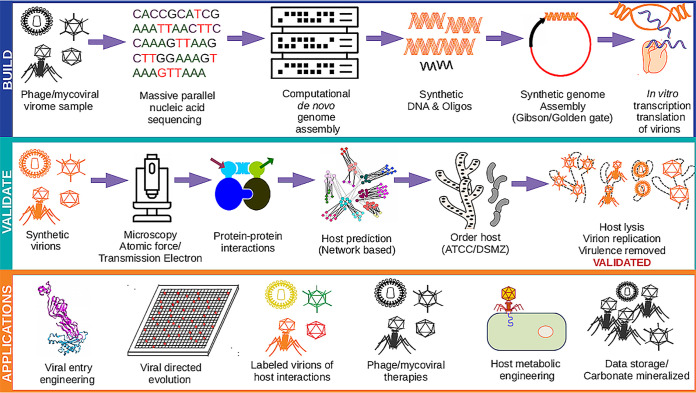
FIG 1
FIG 1
Building synthetic viruses from start to finish, including applications. (Top [blue]) Process of building synthetic viruses. First, viral nucleic acids must be extracted and then sequenced using massively parallel nucleic acid sequencing. After sequencing, computational pipelines assemble the viral genomes de novo. Once the viral genomes are assembled computationally, synthetic DNA and oligonucleotides (oligos) can be ordered. Next, the synthetic DNA and oligos can be assembled into full-length viral genomes using Gibson or Golden Gate assembly. Finally, the assembled viral genome can be converted into viral particles using in vitro transcription and translation into synthetic virions. (Middle [teal]) How to validate synthetic virions. Microscopy, either atomic force or transmission electron microscopy, should be used to validate the presence of virions. Protein-protein interactions with complete or incomplete virions can be used to measure host-viral interactions. Hosts can be predicted computationally utilizing a variety of methods (3). If the host is currently available, it can be ordered and then validated for virion replication, host lysis, or removal of host virulence genes. (Bottom [orange]) Variety of applications for synthetic virions. These applications range from viral nucleic acid data storage and mineralizing virions into carbonates to phage/mycoviral therapies.

References

    1. Cello J, Paul AV, Wimmer EJ. 2002. Chemical synthesis of poliovirus cDNA: generation of infectious virus in the absence of natural template. Science 297:1016–1018. doi: 10.1126/science.1072266. - DOI - PubMed
    1. Smith HO, Hutchison CA, Pfannkoch C, Venter JC. 2003. Generating a synthetic genome by whole genome assembly: phiX174 bacteriophage from synthetic oligonucleotides. Proc Natl Acad Sci USA 100:15440–15445. doi: 10.1073/pnas.2237126100. - DOI - PMC - PubMed
    1. Coclet C, Roux S. 2021. Global overview and major challenges of host prediction methods for uncultivated phages. Curr Opin Virol 49:117–126. doi: 10.1016/j.coviro.2021.05.003. - DOI - PubMed
    1. Hershey A, Chase M. 1952. Independent functions of viral protein and nucleic acid in growth of bacteriophage. J Gen Physiol 36:39–56. doi: 10.1085/jgp.36.1.39. - DOI - PMC - PubMed
    1. Bueso YF, Tangney M. 2017. Synthetic biology in the driving seat of the bioeconomy. Trends Biotechnol 35:373–378. doi: 10.1016/j.tibtech.2017.02.002. - DOI - PubMed

LinkOut - more resources