


Incidence and predictors of persistent pelvic pain following hysterectomy in women with chronic pelvic pain
- PMID: 34464585
- PMCID: PMC9297195
- DOI: 10.1016/j.ajog.2021.08.038
Incidence and predictors of persistent pelvic pain following hysterectomy in women with chronic pelvic pain
Abstract
Background: Chronic pelvic pain is a debilitating problem that afflicts 15% to 20% of women in the United States. Although more than 200,000 hysterectomies are performed annually for the treatment of chronic pelvic pain, previous studies indicate that 1 in 4 women undergo the discomfort and morbidity of hysterectomy without the relief of pain. The factors that predict treatment failure remain poorly characterized.
Objective: To describe the incidence of persistent pelvic pain 6 months following hysterectomy in women with chronic pelvic pain and determine whether a simple, self-reported measure of central sensitization is associated with a greater risk of persistent pelvic pain following hysterectomy.
Study design: We conducted a prospective, observational cohort study of women undergoing hysterectomy at an academic tertiary care center for a benign indication. Patients with preoperative chronic pelvic pain, defined as average pelvic pain ≥3 on a 0 to 10 numeric rating scale for >3 months before hysterectomy, were included in this analysis. The patients completed validated assessments of pain, anxiety, depression, and centralized pain (using the 2011 Fibromyalgia Survey Criteria, 0-31 points) preoperatively and 6 months after hysterectomy. The demographic information, surgical history, intraoperative findings, and surgical pathology were abstracted from the electronic medical records. Multivariate logistic regression was used to identify the independent predictors of persistent pelvic pain 6 months following hysterectomy, defined as <50% improvement in pelvic pain severity.
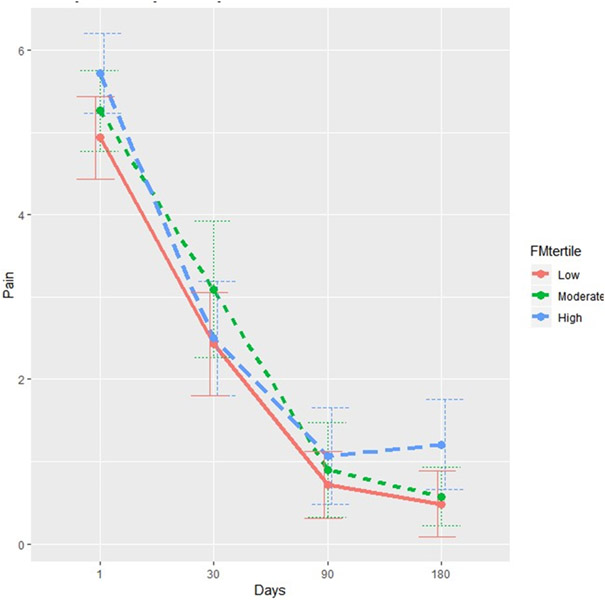
Results: Among 176 participants with pelvic pain before hysterectomy, 126 (71.6%) were retained at 6 months, and 15 (11.9%) reported persistent pelvic pain. There was no difference in age (P=.46), race (P=.55), average pain severity during menses (P=.68), average overall pelvic pain (P=.10), or pain duration (P=.80) in those with and without persistent pelvic pain. Whereas intraoperative findings of endometriosis (P=.05) and uterine fibroids (P=.03) were associated with a higher incidence of persistent pain on univariate analysis, the surgical route (P=.46), pelvic adhesions (0.51), uterine weight (P=.66), and adenomyosis on histopathology (P=.27) were not related to the risk of persistent pain. Higher preoperative centralized pain scores (P=.01) but not depression (P=.64) or anxiety (P=.45) were more common in women with persistent pelvic pain. Multivariate logistic regression adjusting for age, preoperative pain severity, anxiety, depression, and operative findings of endometriosis and fibroids indicated that every 1-point increase in centralized pain before hysterectomy was associated with a 27% increase in the odds of persistent pelvic pain (odds ratio, 1.27; 95% confidence interval, 1.03-1.57) 6 months after surgery.
Conclusion: Although the majority of women with chronic pelvic pain report considerable improvement in pain following hysterectomy, higher degrees of centralized pain before hysterectomy is a robust predictor of persistent pelvic pain.
Keywords: central sensitization; centralized pain; endometriosis; fibromyalgia; hysterectomy; nociplastic pain; pelvic pain; persistent pain.
Copyright © 2021. Published by Elsevier Inc.
Conflict of interest statement
Figures
References
-
- Mathias SD, Kuppermann M, Liberman RF, Lipschutz RC, Steege JF. Chronic pelvic pain: prevalence, health-related quality of life, and economic correlates. Obstet Gynecol. 1996;87(3):321–327. - PubMed
-
- Jones G, Jenkinson C, Kennedy S. The impact of endometriosis upon quality of life: a qualitative analysis. J Psychosom Obstet Gynaecol. 2004;25(2):123–133. - PubMed
-
- Peveler R, Edwards J, Daddow J, Thomas E. Psychosocial factors and chronic pelvic pain: a comparison of women with endometriosis and with unexplained pain. Journal of psychosomatic research. 1996;40(3):305–315. - PubMed
Publication types
MeSH terms
Grants and funding
LinkOut - more resources
Full Text Sources
Medical
