


Racial/Ethnic Inequities in Healthcare-associated Infections Under the Shadow of Structural Racism: Narrative Review and Call to Action
- PMID: 34466126
- PMCID: PMC8390539
- DOI: 10.1007/s11908-021-00758-x
Racial/Ethnic Inequities in Healthcare-associated Infections Under the Shadow of Structural Racism: Narrative Review and Call to Action
Abstract
Purpose of review: The purpose of this study is to review racial and ethnic inequities in the incidence and prevention of healthcare-associated infections (HAIs) in the USA, identify gaps in the literature, and recommend future directions to mitigate these inequities.
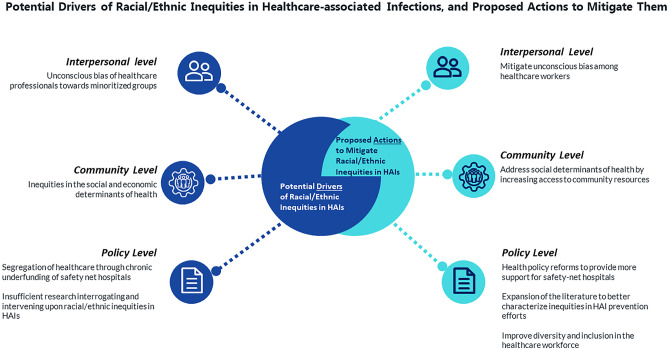
Recent findings: While some existing literature has identified the presence of racial/ethnic inequities in HAI incidence and outcomes, few studies to date have evaluated whether HAI prevention efforts have mitigated these inequities. Factors contributing to inequities in HAI prevention may include unconscious bias of healthcare professionals towards minoritized patients; socioeconomic and structural inequities disparately affecting minoritized communities; the racial segregation of quality healthcare through hospital price discrimination; divergent reimbursement rates between public and private insurers; policies or performance metrics which underfund and financially penalize safety-net hospitals; and insufficient research evaluating and addressing HAI inequities.
Summary: Expansion of the literature is needed to further interrogate root causes and evaluate the impact of interventions on racial/ethnic inequities in HAI incidence. Measures to mitigate inequities might include teaching healthcare workers how to recognize and mitigate unconscious biases, expanding community resources which address the social and structural determinants of health, increasing access to preventive health services, reforming federal and institutional policies to better support safety-net hospitals and disincentivize price discrimination, and improving diversity and inclusion within the health workforce.
Keywords: Health policy; Healthcare-associated infections (HAIs); Racial/ethnic disparities; Social determinants of health; Structural racism.
© The Author(s), under exclusive licence to Springer Science+Business Media, LLC, part of Springer Nature 2021.
Conflict of interest statement
Conflict of InterestJiabi Chen, Rohan Khazanchi, Gonzalo Bearman, and Jasmine Marcelin declare that they have no conflict of interest.
References
Papers of particular interest, published recently, have been highlighted as:
• Of importance
-
- Frey WH. The US will become ‘minority white’ in 2045, Census projects. In: Brookings. 2018. http://www.brookings.edu/blog/the-avenue/2018/03/14/the-us-will-become-m.... Accessed 23 Feb 2021.
-
- • Bailey ZD, Feldman JM, Bassett MT. How structural racism works – racist policies as a root cause of U.S. racial health inequities. N Engl J Med. 2021;384:768–773. 10.2105/ajph.90.8.1212. Overview of the history of structural racism in the United States, and the relationship of racist policies to present-day racial health inequities. - PMC - PubMed
-
- Jones CP. Confronting institutionalized racism. Phylon (1960-). 2002;50:7–22. https://www.jstor.org/stable/4149999.
-
- 2018 national healthcare quality and disparities report. Rockville, MD:Agency for Healthcare Research and Quality. 2019. https://www.ahrq.gov/sites/default/files/wysiwyg/research/findings/nhqrd.... Accessed 25 Mar 2021. - PubMed
Publication types
LinkOut - more resources
Full Text Sources
Research Materials
Miscellaneous
