. 2020 Dec 15;1(1):31-40.
doi: 10.1021/jacsau.0c00057. eCollection 2021 Jan 25.

Broadly Neutralizing Synthetic Cannabinoid Vaccines

Affiliations

Broadly Neutralizing Synthetic Cannabinoid Vaccines

Mingliang Lin et al. JACS Au. .

Abstract

Synthetic cannabinoids (SCs) constitute a significant portion of psychoactive substances forming a major public health risk. Due to the wide variety of SCs, broadly neutralizing antibodies generated by active immunization present an intriguing pathway to combat cannabinoid use disorder. Here, we probed hapten design for antibody affinity and cross reactivity against two classes of SCs. Of the 10 haptens screened, 3 vaccine groups revealed submicromolar IC50, each targeting 5-6 compounds in our panel of 22 drugs. Moreover, SCs were successfully sequestered when administered by vaping or intraperitoneal injection, which was confirmed within animal models by observing locomotion, body temperature, and pharmacokinetics. We also discovered synergistic effects to simultaneously blunt two drug classes through an admixture vaccine approach. Collectively, our study provides a comprehensive foundation for the development of vaccines against SCs.


Conflict of interest statement

The authors declare no competing financial interest.

Figures
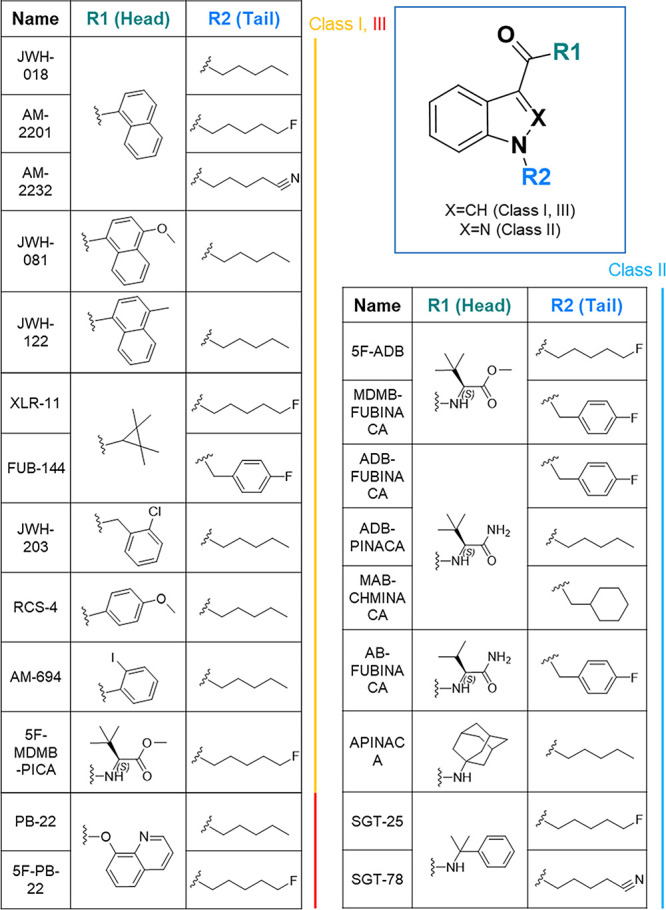
Figure 1
Figure 1
Structural framework of prevalent SCs and the selected drug catalogue in this study. Four fragments consisting of prevalent SCs, namely core, linker, head, and tail. Head and tail fragments are labeled as R1 and R2, respectively. The catalogue includes 22 selected drugs distributed in 3 classes with their structure composition listed.
Figure 2
Figure 2
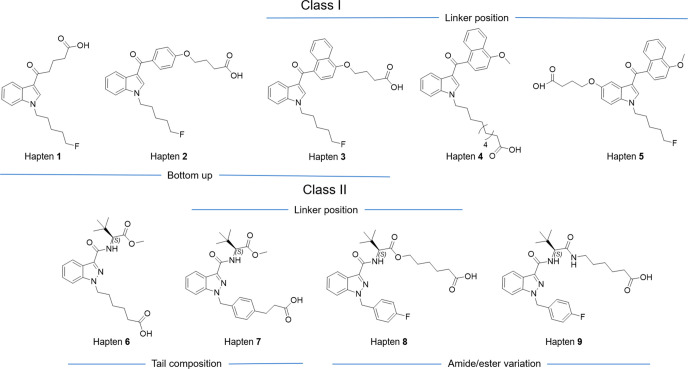
Hapten design. Two classes of haptens, five for Class I and four for Class II, categorized by the class of drugs they target.
Figure 3
Figure 3
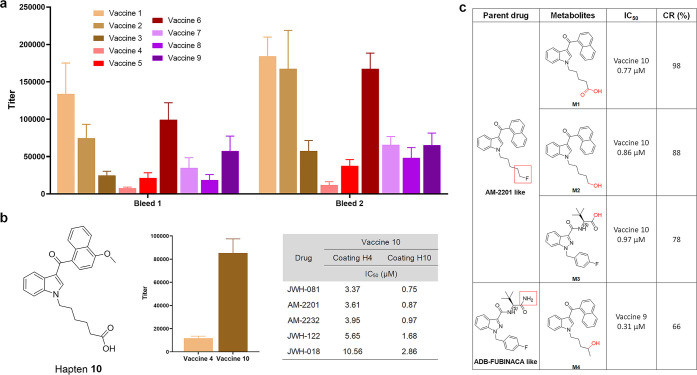
Immune response of screening vaccines. (a) Midpoint titers of vaccines 19, using sera from vaccinated mice (n = 6/group) on days 21 (bleed 1) and 35 (bleed 2). All bars are shown as mean ± SEM. (b) Structure of optimized hapten 10. Titer comparison of vaccines 4 and 10 from second bleeding, and effects of two different coatings on drug IC50 of vaccine 10 antisera. Assays are run using mice sera pooling from whole vaccine groups (n = 6). (c) Metabolism patterns of two types of synthetic cannabinoids. Affinity are measured in vaccine 9 or 10 with cross reactivity calculated relative to JWH-081 or ADB-FUBINACA in Table 1.
Figure 4
Figure 4
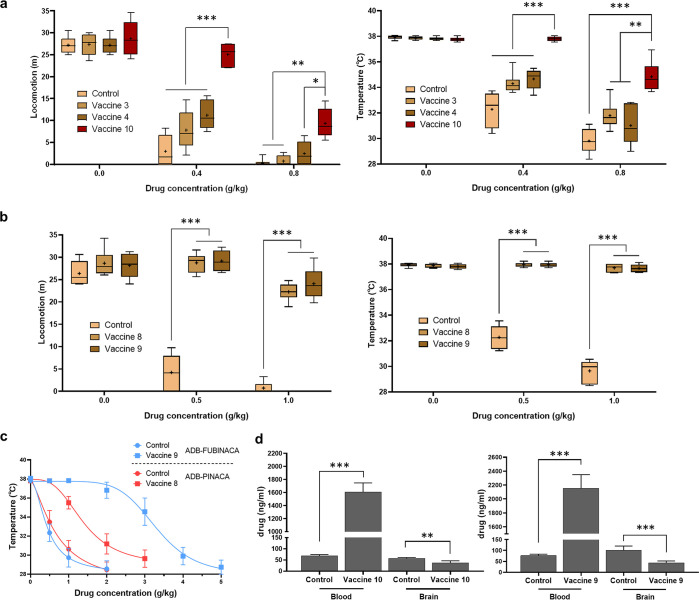
Vaccine efficacy by intraperitoneal drug administration. Behavior results in mice locomotion and body temperature of vaccines 3, 4, and 10 (a) and vaccines 8 and 9 (b), compared to the KLH vaccinated control mice. Mice accepted i.p. injection of each drug twice with different doses at 1 week intervals. Data are shown as median with quartiles ±10–90% CI (n = 6); +, mean. Significance is denoted by asterisks determined by repeated-measures two-way ANOVA, Tukey multiple comparison test (***P < 0.001, **P < 0.01, *P < 0.05). (c) Cumulative dose curve of drug effects on temperature. Mice of vaccines 8 and 9 were given ADB-PINACA and ADB-FUBINACA, respectively, and compared to KLH vaccinated control mice. Repeated administrations and temperature measurements were performed at 15 min intervals. Symbols are shown as mean ± SEM, (n = 6). Nonlinear regression fit (inhibitor vs response, variable slope, 4 parameters, IC50 = 0.44, 0.57, 1.40, 3.65 g/kg from low to high). (d) Blood-brain biodistribution of vaccines 10 and 9 vaccine groups using AM-2232 and ADB-FUBINACA as drug surrogates. All bars are shown as mean ± SEM (n = 6). Significance is denoted by asterisks determined by unpaired t test (***P < 0.001, **P < 0.01).
Figure 5
Figure 5
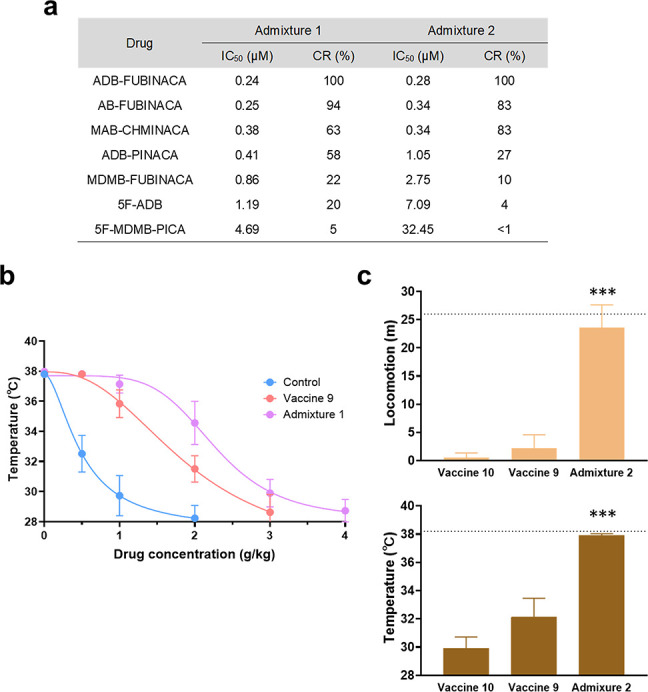
Immune response and vaccine efficacy of admixture vaccines. (a) IC50 of admixture 1 and 2 vaccine groups against drugs in Class II. (b) Cumulative dose curve of the drug effect on temperature. Mice of nonvaccinated control, vaccine 9, and admixture 1 were given ADB-PINACA. Same procedure as mentioned before. Symbols are shown as mean ± SEM, (n = 6). Nonlinear regression fit (inhibitor vs response, variable slope, 4 parameters, IC50 = 0.49, 1.80, 2.47 g/kg from low to high). (c) Behavior results of admixture 2 challenged with 1 mg/kg ADB-FUBINACA + 0.5 mg/kg AM-2201, in comparison to the individual vaccine groups. Dotted lines indicate the average of preinjected baseline (n = 6). Significance is denoted by asterisks determined by one-way ANOVA and a Dunnett post hoc test (***P < 0.001). All bars are shown as mean ± SEM.
Figure 6
Figure 6
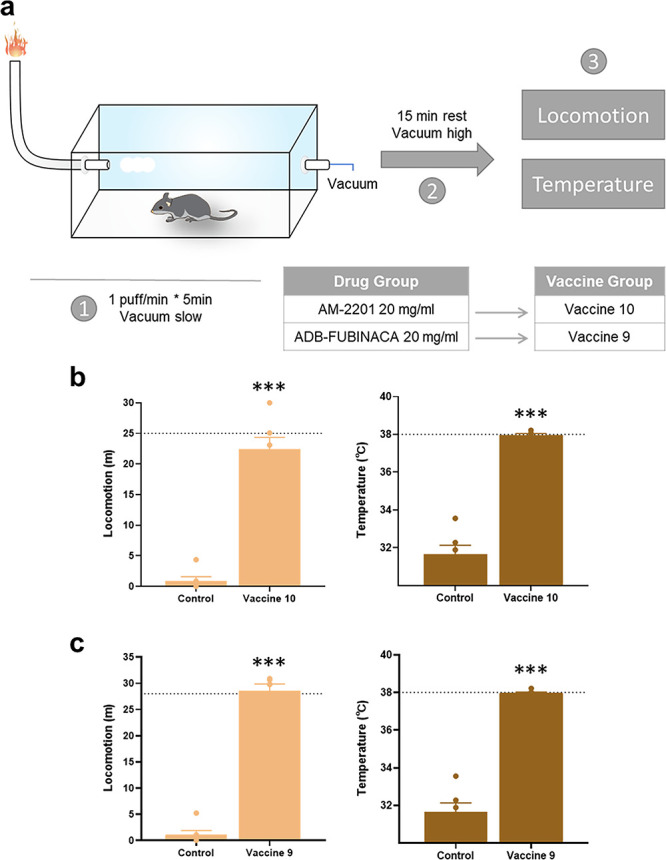
Vaccine efficacy by vaping drug administration. (a) Illustration of vaping apparatus and experimental schedule. Behavior results of Class I vaccine 10 (b) and Class II vaccine 9 (c) compared to the KLH vaccinated control group. Dotted lines indicate the average of preinjected baseline (n = 6). Significance is denoted by asterisks determined by unpaired t test (***P < 0.001). All bars are shown as mean ± SEM.

References

    1. World Drug Report 2019, Sales No. E.19.XI.8; United Nations publication, 2019.
    1. Evans-Brown M.; Gallegos A.; Christie R.. Fentanils and synthetic cannabinoids: driving greater complexity into the drug situation. An update from the EU Early Warning System; Publications Office of the European Union, 2018.
    1. Castaneto M. S.; Gorelick D. A.; Desrosiers N. A.; Hartman R. L.; Pirard S.; Huestis M. A. Synthetic cannabinoids: Epidemiology, pharmaco-dynamics, and clinical implications. Drug Alcohol Depend. 2014, 144, 12–41. 10.1016/j.drugalcdep.2014.08.005. - DOI - PMC - PubMed
    1. Trecki J.; Gerona R. R.; Schwartz M. D. Synthetic Cannabinoid-Related Illnesses and Deaths. N. Engl. J. Med. 2015, 373 (2), 103–107. 10.1056/NEJMp1505328. - DOI - PubMed
    1. Gummin D. D.; Mowry J. B.; Spyker D. A.; Brooks D. E.; Beuhler M. C.; Rivers L. J.; Hashem H. A.; Ryan M. L. 2018 Annual Report of the American Association of Poison Control Centers’ National Poison Data System (NPDS): 36th Annual Report. Clin. Toxicol. 2019, 57 (12), 1220–1413. 10.1080/15563650.2019.1677022. - DOI - PubMed