Patterns of Atopic Eczema Disease Activity From Birth Through Midlife in 2 British Birth Cohorts
- PMID: 34468687
- PMCID: PMC8411362
- DOI: 10.1001/jamadermatol.2021.2489
Patterns of Atopic Eczema Disease Activity From Birth Through Midlife in 2 British Birth Cohorts
Abstract
Importance: Atopic eczema is characterized by a heterogenous waxing and waning course, with variable age of onset and persistence of symptoms. Distinct patterns of disease activity such as early-onset/resolving and persistent disease have been identified throughout childhood; little is known about patterns into adulthood.
Objective: This study aimed to identify subtypes of atopic eczema based on patterns of disease activity through mid-adulthood, to examine whether early life risk factors and participant characteristics are associated with these subtypes, and to determine whether subtypes are associated with other atopic diseases and general health in mid-adulthood.
Design, setting, and participants: This study evaluated members of 2 population-based birth cohorts, the 1958 National Childhood Development Study (NCDS) and the 1970 British Cohort Study (BCS70). Participant data were collected over the period between 1958 and 2016. Data were analyzed over the period between 2018 and 2020.
Main outcomes and measures: Subtypes of atopic eczema were identified based on self-reported atopic eczema period prevalence at multiple occasions. These subtypes were the outcome in models of early life characteristics and an exposure variable in models of midlife health.
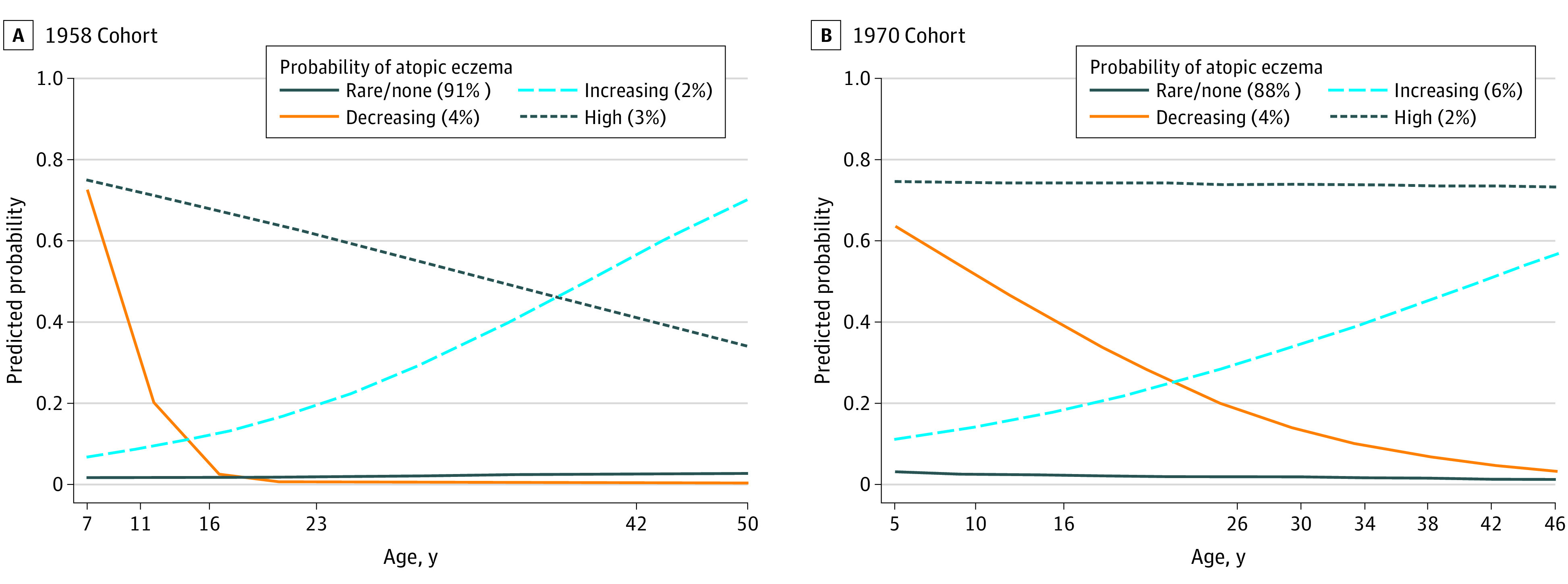
Results: Latent class analysis identified 4 subtypes of atopic eczema with distinct patterns of disease activity among 15 939 individuals from the NCDS (51.4% male, 75.4% White) and 14 966 individuals from the BCS70 (51.6% male, 78.8% White): rare/no (88% to 91%), decreasing (4%), increasing (2% to 6%), and persistently high (2% to 3%) probability of reporting prevalent atopic eczema with age. Sex at birth and early life factors, including social class, region of residence, tobacco smoke exposure, and breastfeeding, predicted differences between the 3 atopic eczema subtypes and the infrequent/no atopic eczema group, but only female sex differentiated the high and decreasing probability subtypes (odds ratio [OR], 1.99; 95% CI, 1.66-2.38). Individuals in the high subtype were most likely to experience asthma and rhinitis, and those in the increasing subtype were at higher risk of poor self-reported general (OR, 1.29; 95% CI, 1.09-1.53) and mental (OR 1.45; 95% CI, 1.23-1.72) health in midlife.
Conclusions and relevance: The findings of this cohort study suggest that extending the window of observation beyond childhood may reveal clear subtypes of atopic eczema based on patterns of disease activity. A newly identified subtype with increasing probability of activity in adulthood warrants additional attention given observed associations with poor self-reported health in midlife.
Conflict of interest statement
Figures