Consensus-Based Recommendations on the Prevention of Squamous Cell Carcinoma in Solid Organ Transplant Recipients: A Delphi Consensus Statement
- PMID: 34468690
- PMCID: PMC9937447
- DOI: 10.1001/jamadermatol.2021.3180
Consensus-Based Recommendations on the Prevention of Squamous Cell Carcinoma in Solid Organ Transplant Recipients: A Delphi Consensus Statement
Abstract
Importance: There is a paucity of evidence to guide physicians regarding prevention strategies for cutaneous squamous cell carcinoma (CSCC) in solid organ transplant recipients (SOTRs).
Objective: To examine the development and results of a Delphi process initiated to identify consensus-based medical management recommendations for prevention of CSCC in SOTRs.
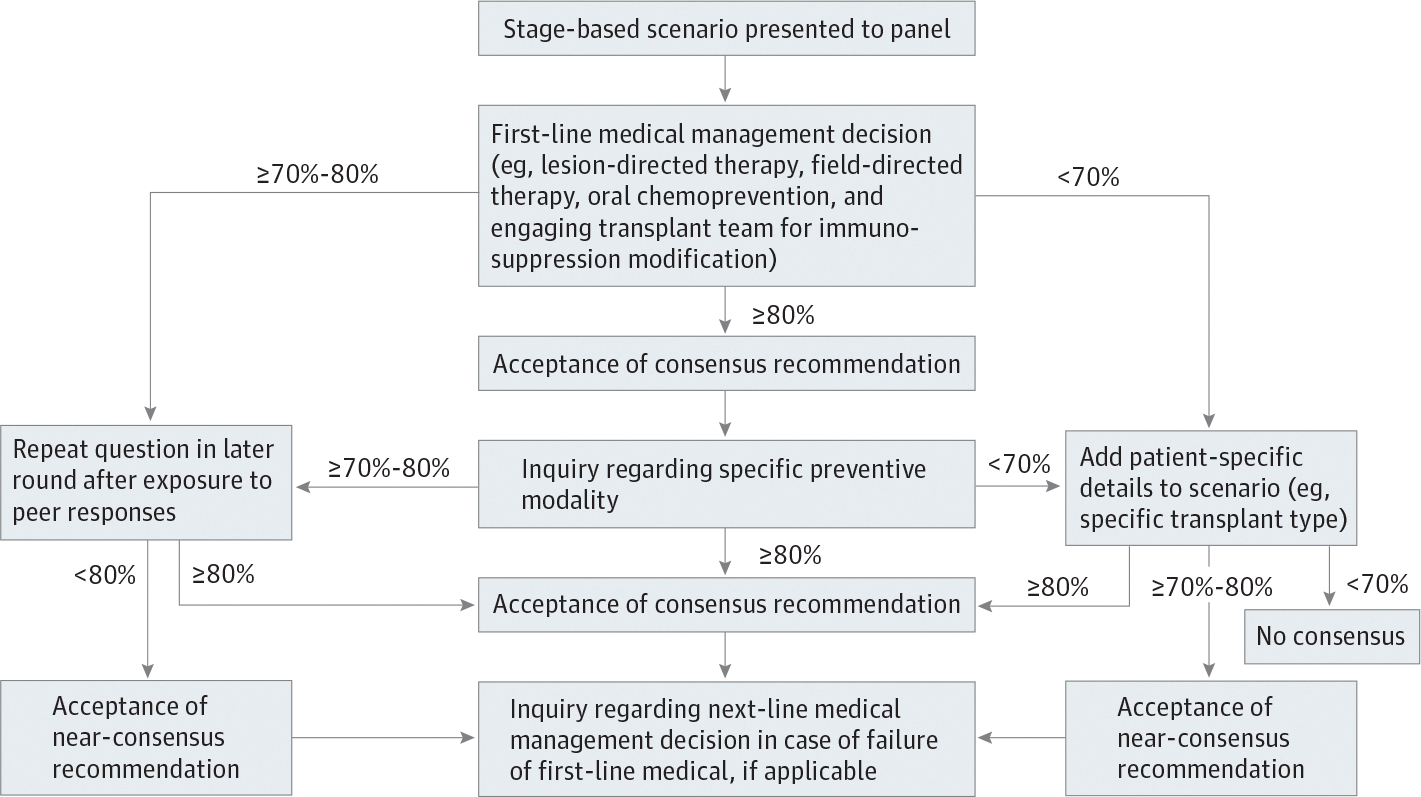
Evidence review: Dermatologists with more than 5 years' experience treating SOTRs were invited to participate. A novel actinic damage and skin cancer index (AD-SCI), consisting of 6 ordinal stages corresponding to an increasing burden of actinic damage and CSCC, was used to guide survey design. Three sequential web-based surveys were administered from January 1, 2019, to December 31, 2020. Pursuant to Delphi principles, respondents thoroughly reviewed all peer responses between rounds. Supplemental questions were also asked to better understand panelists' rationale for their responses.
Findings: The Delphi panel comprised 48 dermatologists. Respondents represented 13 countries, with 27 (56%) from the US. Twenty-nine respondents (60%) were Mohs surgeons. Consensus was reached with 80% or higher concordance among respondents when presented with a statement, question, or management strategy pertaining to prevention of CSCC in SOTRs. A near-consensus category of 70% to less than 80% concordance was also defined. The AD-SCI stage-based recommendations were established if consensus or near-consensus was achieved. The panel was able to make recommendations for 5 of 6 AD-SCI stages. Key recommendations include the following: cryotherapy for scattered actinic keratosis (AK); field therapy for AK when grouped in 1 anatomical area, unless AKs are thick in which case field therapy and cryotherapy were recommended; combination lesion directed and field therapy with fluorouracil for field cancerized skin; and initiation of acitretin therapy and discussion of immunosuppression reduction or modification for patients who develop multiple skin cancers at a high rate (10 CSCCs per year) or develop high-risk CSCC (defined by a tumor with approximately ≥20% risk of nodal metastasis). No consensus recommendation was achieved for SOTRs with a first low risk CSCC.
Conclusions and relevance: Physicians may consider implementation of panel recommendations for prevention of CSCC in SOTRs while awaiting high-level-of-evidence data. Additional clinical trials are needed in areas where consensus was not reached.
Conflict of interest statement
Figures
References
-
- Teutsch SM. A framework for assessing the effectiveness of disease and injury prevention. MMWR Recomm Rep. 1992;41(RR-3):1–12. - PubMed
-
- Brown VL, Atkins CL, Ghali L, Cerio R, Harwood CA, Proby CM. Safety and efficacy of 5% imiquimod cream for the treatment of skin dysplasia in high-risk renal transplant recipients: randomized, double-blind, placebo-controlled trial. Arch Dermatol. 2005;141(8):985–993. doi:10.1001/archderm.141.8.985 - DOI - PubMed
Publication types
MeSH terms
Grants and funding
LinkOut - more resources
Full Text Sources
Medical