


Determinants of outcomes following surgery for type A acute aortic dissection: the UK National Adult Cardiac Surgical Audit
- PMID: 34468733
- PMCID: PMC8720141
- DOI: 10.1093/eurheartj/ehab586
Determinants of outcomes following surgery for type A acute aortic dissection: the UK National Adult Cardiac Surgical Audit
Abstract
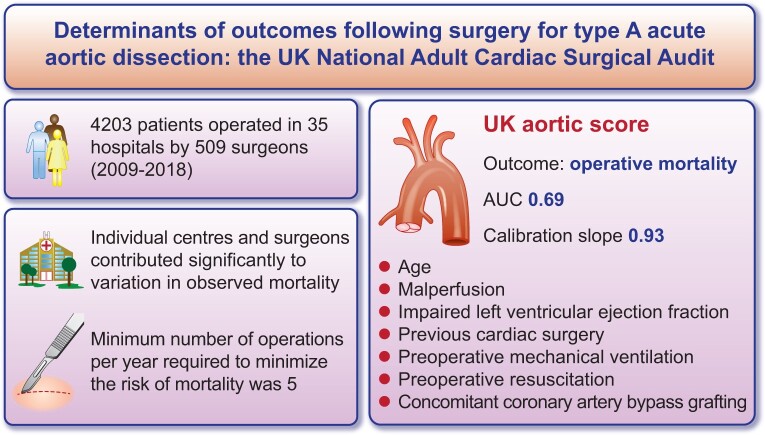
Aims: Operability of type A acute aortic dissections (TAAAD) is currently based on non-standardized decision-making process, and it lacks a disease-specific risk evaluation model that can predict mortality. We investigated patient, intraoperative data, surgeon, and centre-related variables for patients who underwent TAAAD in the UK.
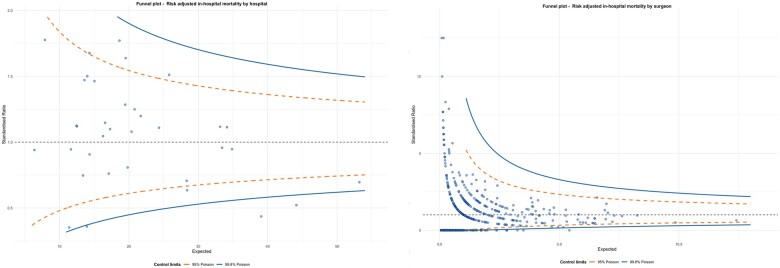
Methods and results: We identified 4203 patients undergoing TAAAD surgery in the UK (2009-18), who were enrolled into the UK National Adult Cardiac Surgical Audit dataset. The primary outcome was operative mortality. A multivariable logistic regression analysis was performed with fast backward elimination of variables and the bootstrap-based optimism-correction was adopted to assess model performance. Variation related to hospital or surgeon effects were quantified by a generalized mixed linear model and risk-adjusted funnel plots by displaying the individual standardized mortality ratio against expected deaths. Final variables retained in the model were: age [odds ratio (OR) 1.02, 95% confidence interval (CI) 1.02-1.03; P < 0.001]; malperfusion (OR 1.79, 95% CI 1.51-2.12; P < 0.001); left ventricular ejection fraction (moderate: OR 1.40, 95% CI 1.14-1.71; P = 0.001; poor: OR 2.83, 95% CI 1.90-4.21; P < 0.001); previous cardiac surgery (OR 2.29, 95% CI 1.71-3.07; P < 0.001); preoperative mechanical ventilation (OR 2.76, 95% CI 2.00-3.80; P < 0.001); preoperative resuscitation (OR 3.36, 95% CI 1.14-9.87; P = 0.028); and concomitant coronary artery bypass grafting (OR 2.29, 95% CI 1.86-2.83; P < 0.001). We found a significant inverse relationship between surgeons but not centre annual volume with outcomes.
Conclusions: Patient characteristics, intraoperative factors, cardiac centre, and high-volume surgeons are strong determinants of outcomes following TAAAD surgery. These findings may help refining clinical decision-making, supporting patient counselling and be used by policy makers for quality assurance and service provision improvement.
Keywords: Risk factors; Risk score; Type A aortic dissection; Volume–outcome relationship.
© The Author(s) 2021. Published by Oxford University Press on behalf of the European Society of Cardiology.
Figures
Comment in
-
Acute type A aortic dissection reconsidered: it's all about the location of the primary entry tear and the presence or absence of malperfusion.Eur Heart J. 2021 Dec 28;43(1):53-55. doi: 10.1093/eurheartj/ehab664. Eur Heart J. 2021. PMID: 34599594 No abstract available.
References
-
- Mahase E. Half of patients with acute aortic dissection in England die before reaching a specialist centre. BMJ 2020;368:m304. - PubMed
-
- Braverman AC. Acute aortic dissection: clinician update. Circulation 2010;122:184–188. - PubMed
-
- Evangelista A, Isselbacher EM, Bossone E, Gleason TG, Eusanio MD, Sechtem U, Ehrlich MP, Trimarchi S, Braverman AC, Myrmel T, Harris KM, Hutchinson S, O'Gara P, Suzuki T, Nienaber CA, Eagle KA; IRAD Investigators. Insights from the international registry of acute aortic dissection: a 20-year experience of collaborative clinical research. Circulation 2018;137:1846–1860. - PubMed
-
- Richens D, Briggs T. Cardiothoracic Surgery GIRFT Programme National Specialty Report GIRFT Is Delivered in Partnership with the Royal National Orthopaedic Hospital NHS Trust and NHS Improvement; 2018. (March).
