


Phytosterols and Cardiovascular Disease
- PMID: 34468867
- PMCID: PMC8410723
- DOI: 10.1007/s11883-021-00964-x
Phytosterols and Cardiovascular Disease
Abstract
Purpose of review: Coronary heart disease is the leading cause of mortality worldwide. Elevated blood cholesterol levels are not only the major but also the best modifiable cardiovascular risk factor. Lifestyle modifications which include a healthy diet are the cornerstone of lipid-lowering therapy. So-called functional foods supplemented with plant sterols lower blood cholesterol levels by about 10-15%.
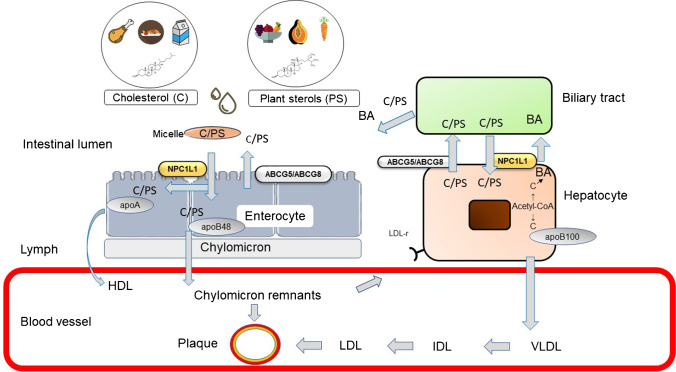
Recent findings: In the recent revision of the ESC/EAS dyslipidemia guideline 2019, plant sterols are recommended for the first time as an adjunct to lifestyle modification to lower blood cholesterol levels. However, the German Cardiac Society (DGK) is more critical of food supplementation with plant sterols and calls for randomized controlled trials investigating hard cardiovascular outcomes. An increasing body of evidence suggests that plant sterols per se are atherogenic. This review discusses this controversy based on findings from in vitro and in vivo studies, clinical trials, and genetic evidence.
Keywords: ABCG5/G8; Atherosclerosis; Cholesterol metabolism; NPC1L1; Phytosterols.
© 2021. The Author(s).
Conflict of interest statement
Oliver Weingärtner reports honoraria from Amgen, Novartis, Hexal, Fresenius, Sanofi-Aventis, Pfizer, and Akcea Therapeutics. The other authors declare that they have no conflict of interest.
Figures
References
-
- WHO. Cardiovascular diseases, fact sheet. 2017. https://www.who.int/news-room/fact-sheets/detail/cardiovascular-diseases...). Accessed 27 Mar 2011.
-
- Stamler J. Is relationship between serum cholesterol and risk of premature death from coronary heart disease continuous and graded?: findings in 356222 primary screenees of the multiple risk factor intervention trial (MRFIT) JAMA. 1986;256:2823. - PubMed
-
- Efficacy and safety of cholesterol-lowering treatment: prospective meta-analysis of data from 90056 participants in 14 randomised trials of statins. Lancet 2005;366:1267–1278. - PubMed
-
- Jacobson TA, Maki KC, Orringer CE, et al. National lipid association recommendations for patient-centered management of dyslipidemia: part 2. J Clin Lipidol. 2015;9:S1–S122.e1. - PubMed
-
- NICE. Cardiovascular disease: risk assessment and reduction, including lipid modification. 2014. https://www.nice.org.uk/guidance/cg181.
Publication types
MeSH terms
Substances
LinkOut - more resources
Full Text Sources
Medical
Research Materials
