Review
. 2023 Jun;64(3):239-261.
doi: 10.1007/s12016-021-08891-0. Epub 2021 Sep 1.

Therapeutic Approaches to Systemic Sclerosis: Recent Approvals and Future Candidate Therapies

Affiliations
Review

Therapeutic Approaches to Systemic Sclerosis: Recent Approvals and Future Candidate Therapies

Alain Lescoat et al. Clin Rev Allergy Immunol. 2023 Jun.

Abstract

Systemic sclerosis is the rheumatic disease with the highest individual mortality. The severity of the disease is determined by the extent of fibrotic changes to cutaneous and internal organ tissues, the most life-threatening visceral manifestations being interstitial lung disease, SSc-associated-pulmonary arterial hypertension and myocardial involvement. The heterogeneity of the disease has initially hindered the design of successful clinical trials, but considerations on classification criteria have improved patient selection in trials, allowing the identification of more homogeneous groups of patients based on progressive visceral manifestations or the extent of skin involvement with a focus of patients with early disease. Two major subsets of systemic sclerosis are classically described: limited cutaneous systemic sclerosis characterized by distal skin fibrosis and the diffuse subset with distal and proximal skin thickening. Beyond this dichotomic subgrouping of systemic sclerosis, new phenotypic considerations based on antibody subtypes have provided a better understanding of the heterogeneity of the disease, anti-Scl70 antibodies being associated with progressive interstitial lung disease regardless of cutaneous involvement. Two targeted therapies, tocilizumab (a monoclonal antibody targeting interleukin-6 receptors (IL-6R)) and nintedanib (a tyrosine kinase inhibitor), have recently been approved by the American Food & Drug Administration to limit the decline of lung function in patients with SSc-associated interstitial lung disease, demonstrating that such better understanding of the disease pathogenesis with the identification of key targets can lead to therapeutic advances in the management of some visceral manifestations of the disease. This review will provide a brief overview of the pathogenesis of SSc and will present a selection of therapies recently approved or evaluated in this context. Therapies evaluated and approved in SSc-ILD will be emphasized and a review of recent phase II trials in diffuse cutaneous systemic sclerosis will be proposed. We will also discuss selected therapeutic pathways currently under investigation in systemic sclerosis that still lack clinical data in this context but that may show promising results in the future based on preclinical data.

Keywords: Fibrosis; Interstitial lung disease; Nintedanib; Scleroderma; Systemic sclerosis; Tocilizumab.


Conflict of interest statement

Conflicts of interest/Competing interests

AL: Nothing to disclose

DR: Nothing to disclose

MK: Grant support from Boehringer-Ingelheim, Ono Pharmaceuticals, Consultant: AbbVie, Boehringer-Ingelheim, Corbus, Mochida, Kissei, Galapagos NV, Speaker bureau: Asahi Kasei Pharma, Astellas, Boehringer-Ingelheim, Chugai. GSK, Janssen. Mitsubishi-Tanabe, Nippon Shinyaku.

RL: has served as a consultant for Pfizer, Bristol Myers Squibb, Boehringer-Ingleheim, Formation, Sanofi, Boehringer-Mannheim, Merck and Genentech/Roche; holds or recently had research grants from Corbus, Formation, Moderna, Regeneron, Pfizer and Kiniksa and holds equity in Thirona Bio.

YA: Grant support from Alpine ImmunoSciences, Roche and Sanofi.. Consultant: Bayer, Boehringer Ingelheim, Genentech/Roche, Medsenic, Sanofi-Aventis

DK: Grant support from NIH, Immune Tolerance Network, Bayer, BMS, Horizon, Pfizer. Consultant: Acceleron, Actelion, Abbvie, Amgen, Bayer, Boehringer Ingelheim, CSL Behring, Corbus, Gilead, Galapagos, Genentech/Roche, GSK, Horizon, Merck, Mitsubishi Tanabe Pharma, Sanofi-Aventis, and United Therapeutics. Stocks: Eicos Sciences, Inc (less than 5%). Leadership/Equity position – Chief Medical Officer, CiviBioPharma/Eicos Sciences, Inc

Figures

Figure 1:
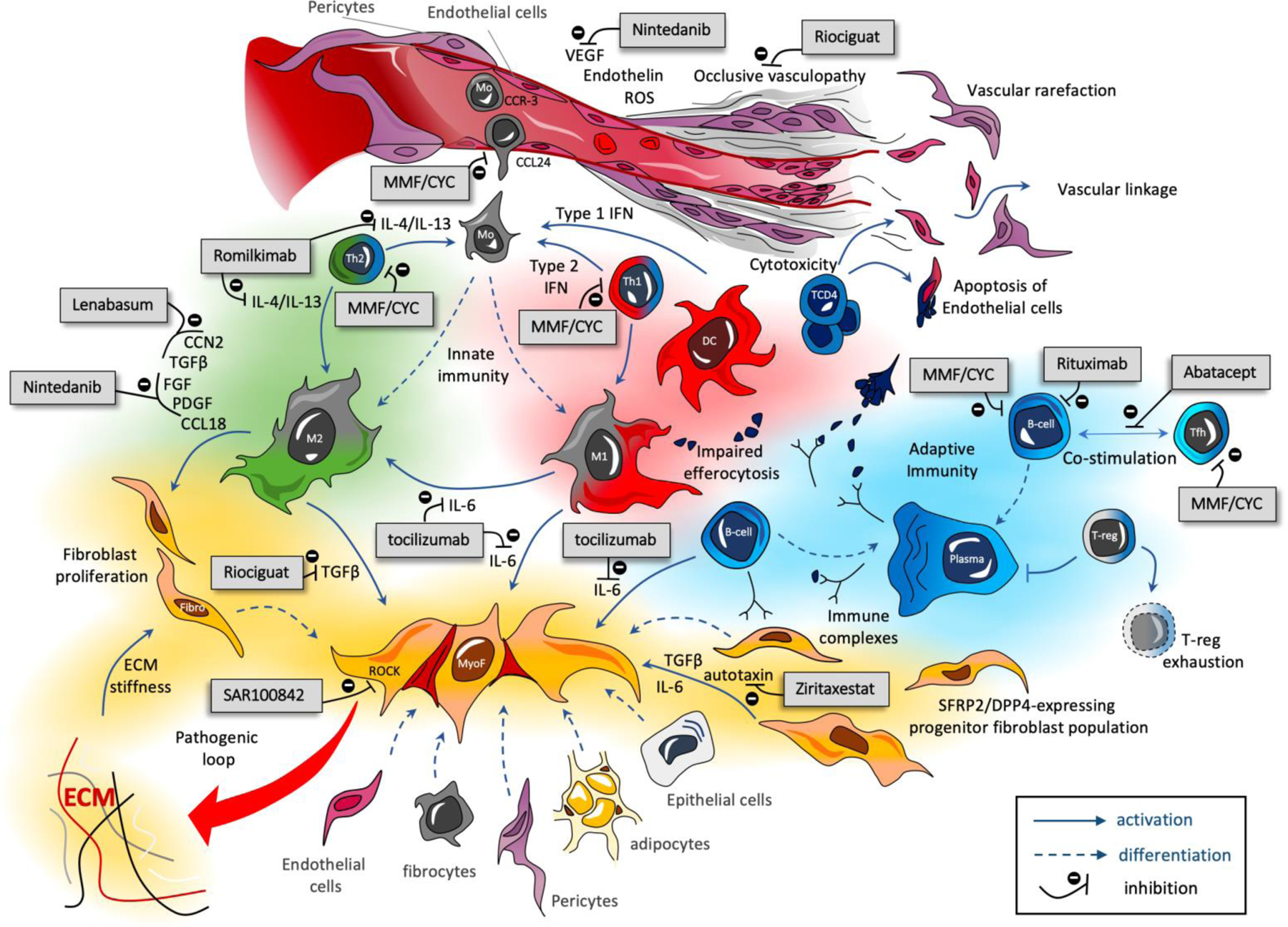
Figure 1:. Main pathogenic mechanisms and approved or recently evaluated therapies in Phase II/III trials with published results in SSc
The pathogenesis of SSc involves three main mechanisms: occlusive vasculopathy with endothelial dysfunction, early inflammatory processes and uncontrolled extra-cellular matrix (ECM) production with fibrosis. T-CD4 cells may directly participate to the endothelial damage by inducing cytotoxic dependent-apoptosis of endothelial cells; the impaired capacities of macrophages to phagocyte apoptotic cells (altered efferocytosis); the impact of immune complexes composed by autoantibodies and intra-nuclear proteins (topoisomerase, centromere proteins) that participate to macrophage and fibroblast activation; the over-activation of both M1 (pro-inflammatory) and M2 (pro-fibrotic) macrophages at the early stages of the disease. ECM stiffness also activate fibroblast and TGF-β signaling in a TLR4 and/or Integrin αV dependent manner, leading to a sustain autoactivation loop of myofibroblasts. Only the main mechanisms of action of the therapies recently evaluated are presented here.

References

    1. Denton CP, Khanna D (2017) Systemic sclerosis. The Lancet 390:1685–1699. 10.1016/S0140-6736(17)30933-9 - DOI - PubMed
    1. Allanore Y, Simms R, Distler O, et al. (2015) Systemic sclerosis. Nat Rev Dis Primers 1:15002. 10.1038/nrdp.2015.2 - DOI - PubMed
    1. Lescoat A, Coiffier G, de Carlan M, et al. (2018) Combination of Capillaroscopic and Ultrasonographic Evaluations in Systemic Sclerosis: Results of a Cross-Sectional Study. Arthritis Care Res (Hoboken) 70:938–943. 10.1002/acr.23413 - DOI - PubMed
    1. Denton CP, Lapadula G, Mouthon L, Müller-Ladner U (2009) Renal complications and scleroderma renal crisis. Rheumatology (Oxford) 48 Suppl 3:iii32–35. 10.1093/rheumatology/ken483 - DOI - PubMed
    1. Nihtyanova SI, Sari A, Harvey JC, et al. (2020) Using Autoantibodies and Cutaneous Subset to Develop Outcome‐Based Disease Classification in Systemic Sclerosis. Arthritis Rheumatol 72:465–476. 10.1002/art.41153 - DOI - PubMed

MeSH terms