. 2022 Jan;111(1):59-75.
doi: 10.1111/apa.16084. Epub 2021 Sep 12.

Birth outcomes between 22 and 26 weeks' gestation in national population-based cohorts from Sweden, England and France

Affiliations

Birth outcomes between 22 and 26 weeks' gestation in national population-based cohorts from Sweden, England and France

Andrei S Morgan et al. Acta Paediatr. 2022 Jan.

Abstract

Aim: We investigated the timing of survival differences and effects on morbidity for foetuses alive at maternal admission to hospital delivered at 22 to 26 weeks' gestational age (GA).

Methods: Data from the EXPRESS (Sweden, 2004-07), EPICure-2 (England, 2006) and EPIPAGE-2 (France, 2011) cohorts were harmonised. Survival, stratified by GA, was analysed to 112 days using Kaplan-Meier analyses and Cox regression adjusted for population and pregnancy characteristics; neonatal morbidities, survival to discharge and follow-up and outcomes at 2-3 years of age were compared.

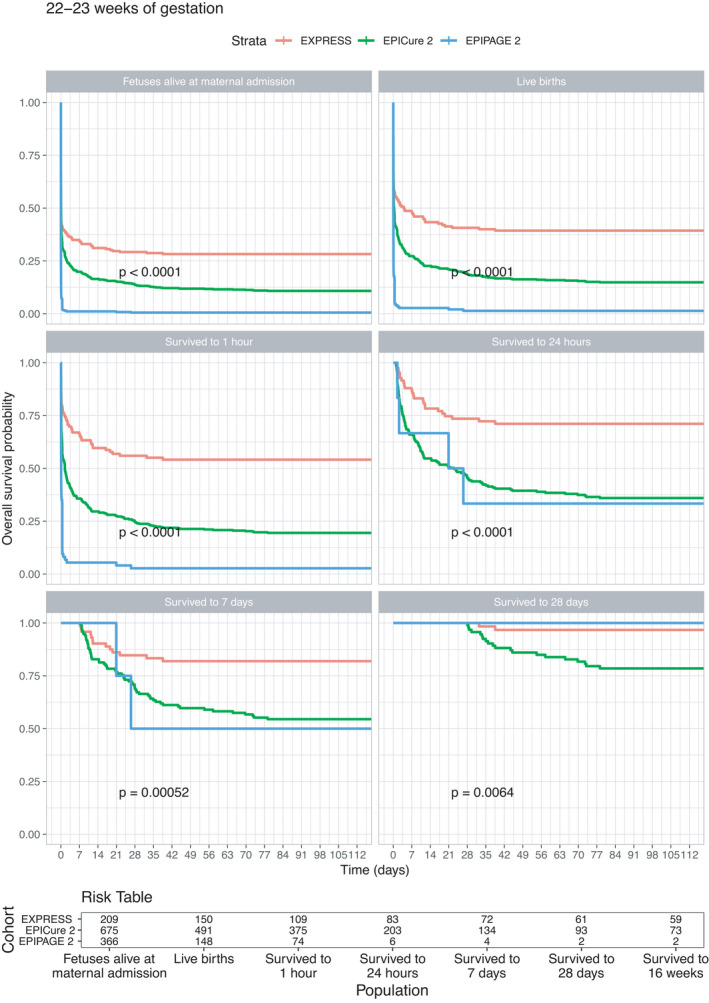
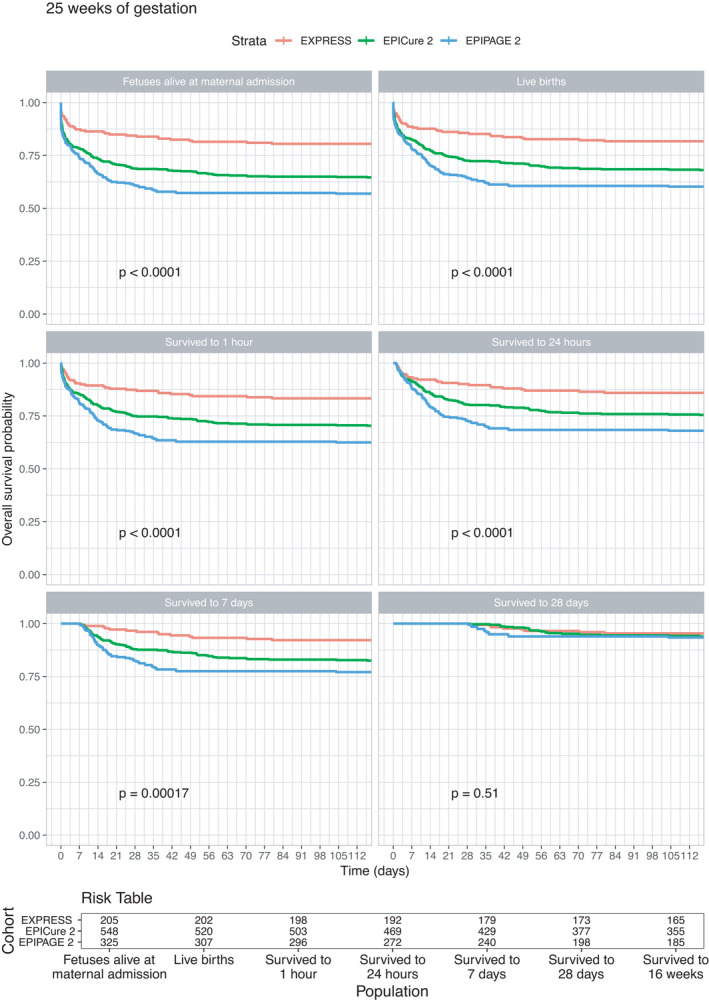
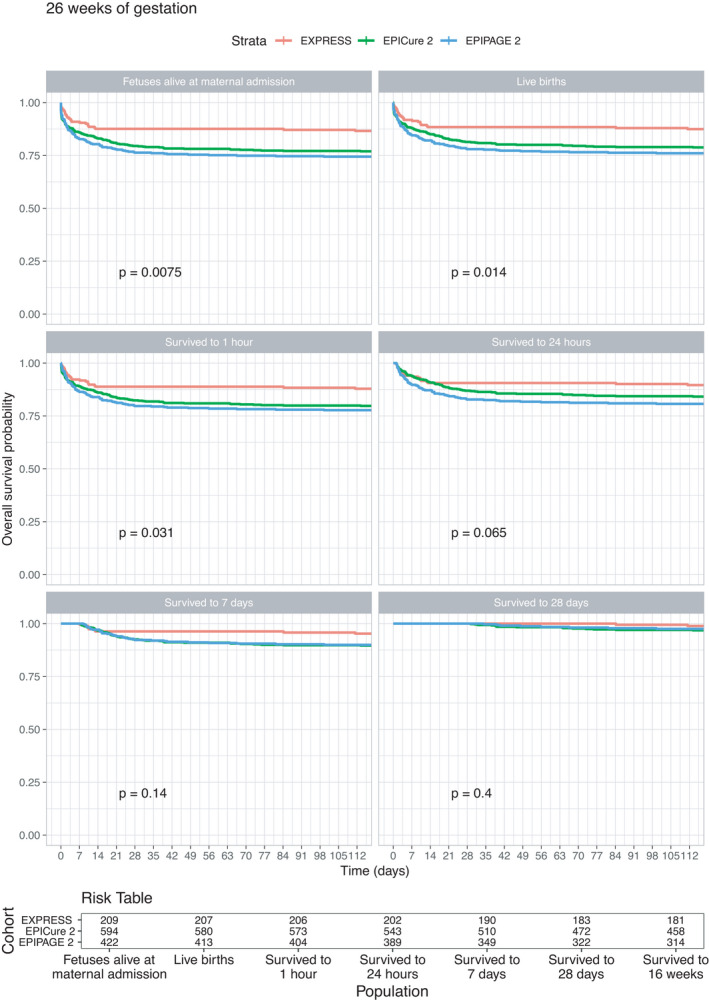
Results: Among 769 EXPRESS, 2310 EPICure-2 and 1359 EPIPAGE-2 foetuses, 112-day survival was, respectively, 28.2%, 10.8% and 0.5% at 22-23 weeks' GA; 68.5%, 40.0% and 23.6% at 24 weeks; 80.5%, 64.8% and 56.9% at 25 weeks; and 86.6%, 77.1% and 74.4% at 26 weeks. Deaths were most marked in EPIPAGE-2 before 1 day at 22-23 and 24 weeks GA. At 25 weeks, survival varied before 28 days; differences at 26 weeks were minimal. Cox analyses were consistent with the Kaplan-Meier analyses. Variations in morbidities were not clearly associated with survival.

Conclusion: Differences in survival and morbidity outcomes for extremely preterm births are evident despite adjustment for background characteristics. No clear relationship was identified between early mortality and later patterns of morbidity.

Keywords: epidemiology; extreme preterm birth; international comparisons; neonatal; perinatal; survival analysis.


Conflict of interest statement

All authors have completed ICMJE uniform disclosure form at www.icmje.org/coi_disclosure.pdf (available on request from the corresponding author). ASM, JZ, KK, ESD, SvB, SJ, VB, VP and PYA report grants from H2020/European Union during the conduct of this study; MN reports grants from Stockholm County Council and Karolinksa Institutet (ALF 2020‐0443) during the conduct of this study, and personal fees from AbbVie and Chiesi Pharma AB; and NM reports grants from the Medical Research Council during the conduct of the study, and personal fees from Novartis, Takeda and RSM Consulting outside the submitted work. All other authors report no financial relationships with any organisations that might have an interest in the submitted work in the previous 3 years.

Figures

FIGURE 1
FIGURE 1
Survival curves for the EXPRESS (Sweden, 2004–07), EPICure‐2 (England, 2006) and EPIPAGE‐2 (France, 2011) cohorts for foetuses born at 22–23 completed weeks of gestational age
FIGURE 2
FIGURE 2
Survival curves for the EXPRESS (Sweden, 2004–07), EPICure‐2 (England, 2006) and EPIPAGE‐2 (France, 2011) cohorts for foetuses born at 24 completed weeks of gestational age
FIGURE 3
FIGURE 3
Survival curves for the EXPRESS (Sweden, 2004–07), EPICure‐2 (England, 2006) and EPIPAGE‐2 (France, 2011) cohorts for foetuses born at 25 completed weeks of gestational age
FIGURE 4
FIGURE 4
Survival curves for the EXPRESS (Sweden, 2004–07), EPICure‐2 (England, 2006) and EPIPAGE‐2 (France, 2011) cohorts for foetuses born at 26 completed weeks of gestational age

Comment in

References

    1. Zeitlin J, Sentenac M, Morgan AS, et al. Priorities for collaborative research using very preterm birth cohorts, Archives of Disease in Childhood. Fetal Neonatal Ed. 2020;105(5):538‐544. 10.1136/archdischild-2019-317991 - DOI - PMC - PubMed
    1. Rysavy MA, Li L, Bell EF, et al. Between‐hospital variation in treatment and outcomes in extremely preterm infants. N Engl J Med. 2015;372(19):1801‐1811. 10.1056/NEJMoa1410689 - DOI - PMC - PubMed
    1. Serenius F, Blennow M, Marsal K, Sjors G, Kallen K. Intensity of perinatal care for extremely preterm infants: outcomes at 2.5 years. Pediatrics. 2015;135(5):e1163‐e1172. 10.1542/peds.2014-2988 - DOI - PubMed
    1. Morgan AS, Foix L’Helias L, Diguisto C, et al. Intensity of perinatal care, extreme prematurity and sensorimotor outcome at 2 years corrected age: evidence from the EPIPAGE‐2 cohort study. BMC Med. 2018;16(1):227. 10.1186/s12916-018-1206-4 - DOI - PMC - PubMed
    1. Larroque B, Breart G, Kaminski M, et al. Survival of very preterm infants: epipage, a population based cohort study, Archives of Disease in Childhood. Fetal Neonatal Ed. 2004;89(2):F139‐F144. - PMC - PubMed