


Identification of a Kupffer cell subset capable of reverting the T cell dysfunction induced by hepatocellular priming
- PMID: 34469774
- PMCID: PMC8459394
- DOI: 10.1016/j.immuni.2021.05.005
Identification of a Kupffer cell subset capable of reverting the T cell dysfunction induced by hepatocellular priming
Abstract
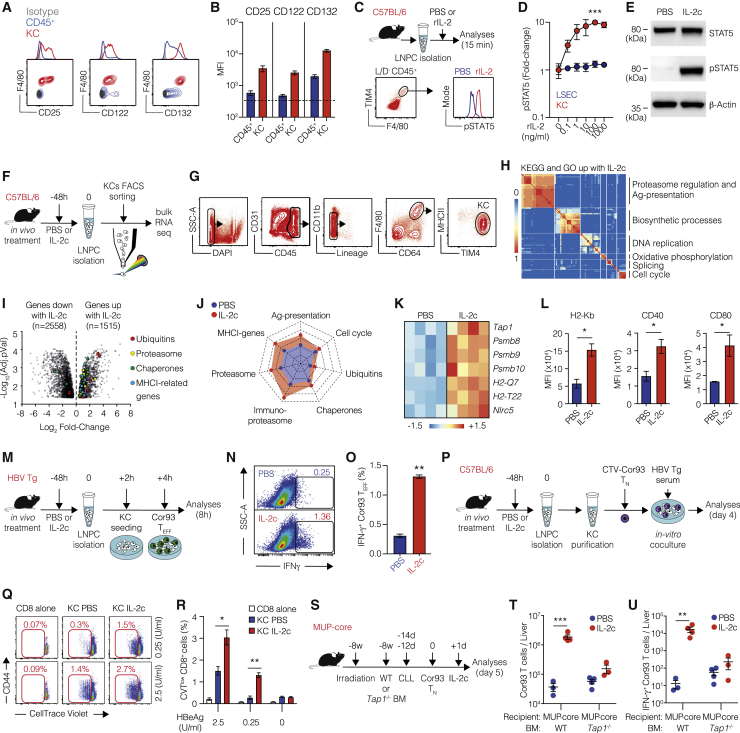
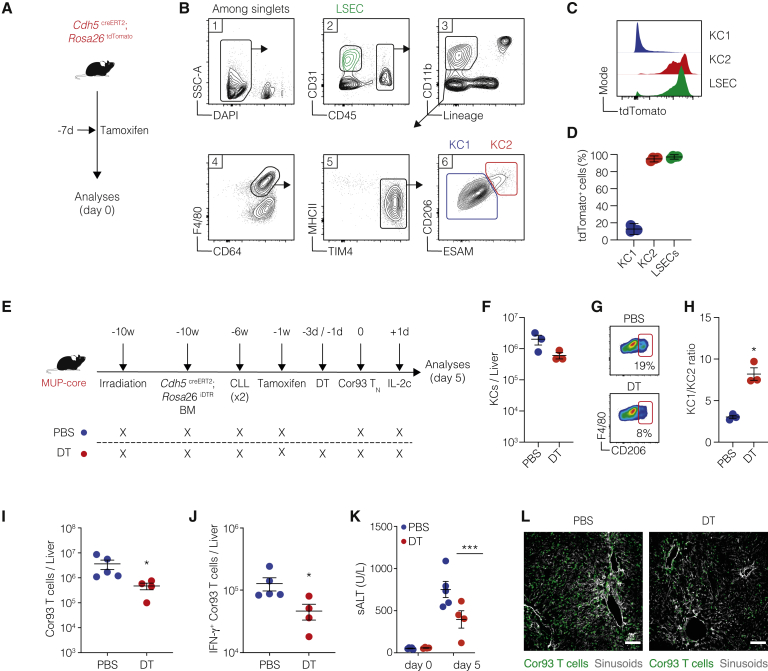
Kupffer cells (KCs) are highly abundant, intravascular, liver-resident macrophages known for their scavenger and phagocytic functions. KCs can also present antigens to CD8+ T cells and promote either tolerance or effector differentiation, but the mechanisms underlying these discrepant outcomes are poorly understood. Here, we used a mouse model of hepatitis B virus (HBV) infection, in which HBV-specific naive CD8+ T cells recognizing hepatocellular antigens are driven into a state of immune dysfunction, to identify a subset of KCs (referred to as KC2) that cross-presents hepatocellular antigens upon interleukin-2 (IL-2) administration, thus improving the antiviral function of T cells. Removing MHC-I from all KCs, including KC2, or selectively depleting KC2 impaired the capacity of IL-2 to revert the T cell dysfunction induced by intrahepatic priming. In summary, by sensing IL-2 and cross-presenting hepatocellular antigens, KC2 overcome the tolerogenic potential of the hepatic microenvironment, suggesting new strategies for boosting hepatic T cell immunity.
Keywords: CD8(+) T cells; Kupffer cells; T cell dysfunction; hepatitis B virus; imaging; interleukin-2; liver; scRNA-seq; single cell; tolerance.
Copyright © 2021 The Author(s). Published by Elsevier Inc. All rights reserved.
Conflict of interest statement
Declaration of interests M.I. participates in advisory boards and consultancies for Gilead Sciences, Roche, Third Rock Ventures, Amgen, and Allovir. L.G.G is a member of the board of directors at Genenta Science and Epsilon Bio and participates in advisory boards and consultancies for Gilead Sciences, Roche, and Arbutus Biopharma. M.I. and L.G.G. are inventors on patents filed, owned, and managed by San Raffaele Scientific Institute, Vita-Salute San Raffaele University, and the Telethon Foundation on technology related to work discussed in this manuscript (WO2020/016434, WO2020/016427, WO2020/030781, WO2020/234483, European Union [EU] patent applications 19211249.8 and 20156716.1, and U.K. patent application 1907493.9). F.G. is a member of the Immunity advisory board.
Figures




Comment in
-
Contamination of isolated mouse Kupffer cells with liver sinusoidal endothelial cells.Immunity. 2022 Jul 12;55(7):1139-1140. doi: 10.1016/j.immuni.2022.06.010. Immunity. 2022. PMID: 35830818 No abstract available.
-
Response to contamination of isolated mouse Kupffer cells with liver sinusoidal endothelial cells.Immunity. 2022 Jul 12;55(7):1141-1142. doi: 10.1016/j.immuni.2022.06.012. Immunity. 2022. PMID: 35830819 No abstract available.
References
-
- Becht E., McInnes L., Healy J., Dutertre C.-A., Kwok I.W.H., Ng L.G., Ginhoux F., Newell E.W. Dimensionality reduction for visualizing single-cell data using UMAP. Nat. Biotechnol. 2018;37:38–44. - PubMed
-
- Blattman J.N., Grayson J.M., Wherry E.J., Kaech S.M., Smith K.A., Ahmed R. Therapeutic use of IL-2 to enhance antiviral T-cell responses in vivo. Nat. Med. 2003;9:540–547. - PubMed
Publication types
MeSH terms
Substances
LinkOut - more resources
Full Text Sources
Other Literature Sources
Molecular Biology Databases
Research Materials
