


Sex-specific frontal-striatal connectivity differences among adolescents with externalizing disorders
- PMID: 34469847
- PMCID: PMC8405840
- DOI: 10.1016/j.nicl.2021.102789
Sex-specific frontal-striatal connectivity differences among adolescents with externalizing disorders
Abstract
Background: Sex-specific neurobiological underpinnings of impulsivity in youth with externalizing disorders have not been well studied. The only report of functional connectivity (FC) findings in this area demonstrated sex differences in fronto-subcortical connectivity in youth with attention-deficit/hyperactivity disorder (ADHD).
Methods: The current study used functional magnetic resonance imaging(fMRI) to examine sex differences in resting-state seed-based FC, self-rated impulsivity, and their interactions in 11-12-year-old boys (n = 43) and girls (n = 43) with externalizing disorders. Generalized linear models controlling for pubertal development were used. Seeds were chosen in the ventral striatum, medial prefrontal cortex, middle frontal gyrus and amygdala.
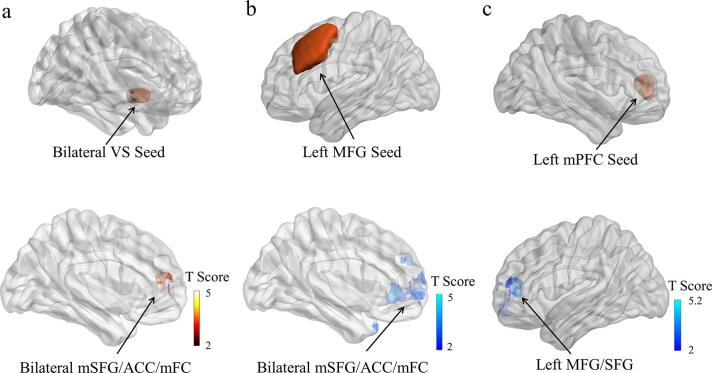
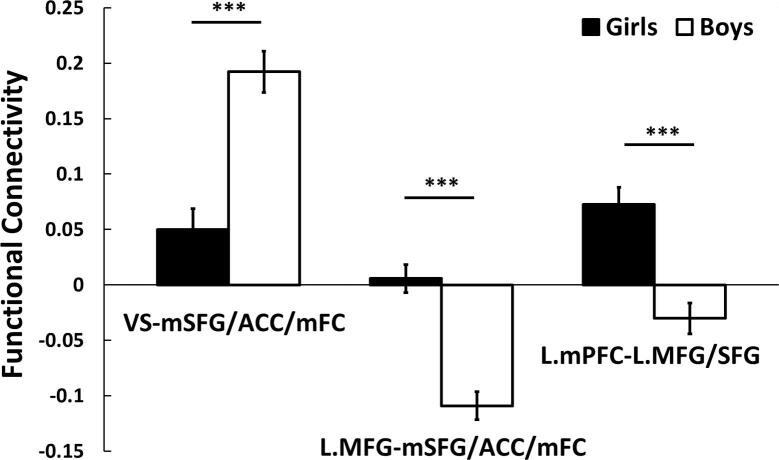
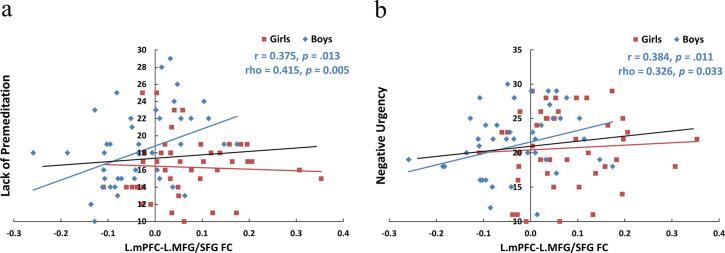
Results: Impulsivity scores were greater in boys than girls (p < 0.05). Boys showed greater positive connectivity within a ventromedial prefrontal-ventral striatal network. In addition, boys demonstrated weaker connectivity than girls within two medial-lateral prefrontal cortical networks. However, only boys showed greater medial-lateral prefrontal connectivity correlated with greater impulsivity.
Conclusions: The findings provide evidence supporting sex differences in both ventral striatal-ventromedial prefrontal and medial-lateral prefrontal functional networks in youth with externalizing disorders. These important networks are thought to be implicated in impulse control. Medial-lateral prefrontal connectivity may represent a male-specific biomarker of impulsivity.
Keywords: Adolescence; Externalizing disorders; Frontal-striatal Connectivity; Impulsivity; Resting-state Functional Connectivity; Sex Differences.
Copyright © 2021 The Authors. Published by Elsevier Inc. All rights reserved.
Conflict of interest statement
The authors declare that they have no known competing financial interests or personal relationships that could have appeared to influence the work reported in this paper.
Figures
References
-
- Axelrod B.N. Validity of the Wechsler abbreviated scale of intelligence and other very short forms of estimating intellectual functioning. Assessment. 2002;9:17–23. - PubMed
-
- Cao Z., Bennett M., Orr C., Icke I., Banaschewski T., Barker G.J., Bokde A.L.W., Bromberg U., Buchel C., Quinlan E.B., Desrivieres S., Flor H., Frouin V., Garavan H., Gowland P., Heinz A., Ittermann B., Martinot J.L., Nees F., Orfanos D.P., Paus T., Poustka L., Hohmann S., Frohner J.H., Smolka M.N., Walter H., Schumann G., Whelan R., Consortium I. Mapping adolescent reward anticipation, receipt, and prediction error during the monetary incentive delay task. Hum. Brain Mapp. 2019;40:262–283. - PMC - PubMed
Publication types
MeSH terms
Grants and funding
LinkOut - more resources
Full Text Sources
