


Data Sources for Understanding the Social Determinants of Health: Examples from Two Middle-Income Countries: the 3-D Commission
- PMID: 34472014
- PMCID: PMC8409472
- DOI: 10.1007/s11524-021-00558-7
Data Sources for Understanding the Social Determinants of Health: Examples from Two Middle-Income Countries: the 3-D Commission
Abstract
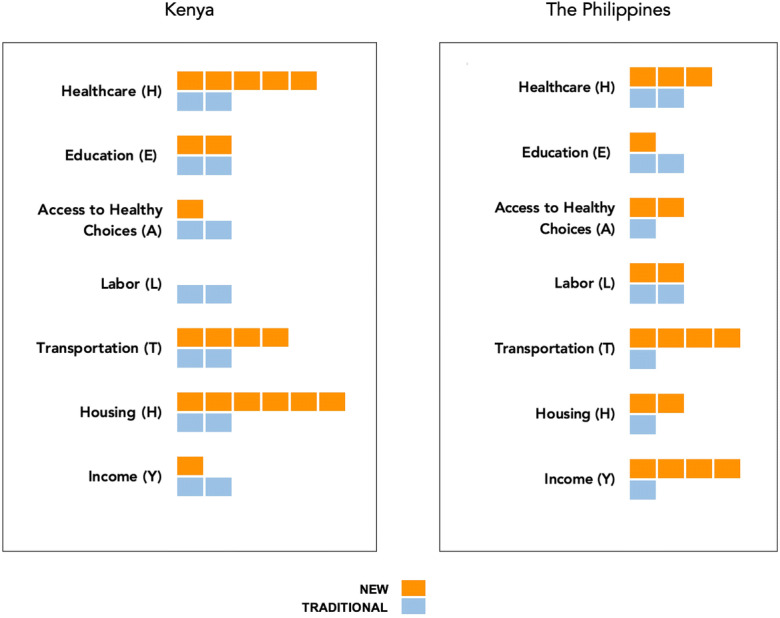
The expansion in the scope, scale, and sources of data on the wider social determinants of health (SDH) in the last decades could bridge gaps in information available for decision-making. However, challenges remain in making data widely available, accessible, and useful towards improving population health. While traditional, government-supported data sources and comparable data are most often used to characterize social determinants, there are still capacity and management constraints on data availability and use. Conversely, privately held data may not be shared. This study reviews and discusses the nature, sources, and uses of data on SDH, with illustrations from two middle-income countries: Kenya and the Philippines. The review highlights opportunities presented by new data sources, including the use of big data technologies, to capture data on social determinants that can be useful to inform population health. We conducted a search between October 2010 and September 2020 for grey and scientific publications on social determinants using a search strategy in PubMed and a manual snowball search. We assessed data sources and the data environment in both Kenya and the Philippines. We found limited evidence of the use of new sources of data to study the wider SDH, as most of the studies available used traditional sources. There was also no evidence of qualitative big data being used. Kenya has more publications using new data sources, except on the labor determinant, than the Philippines. The Philippines has a more consistent distribution of the use of new data sources across the HEALTHY determinants than Kenya, where there is greater variation of the number of publications across determinants. The results suggest that both countries use limited SDH data from new data sources. This limited use could be due to a number of factors including the absence of standardized indicators of SDH, inadequate trust and acceptability of data collection methods, and limited infrastructure to pool, analyze, and translate data.
Keywords: Big data; Data sources; Kenya; Philippines; Social determinants of health.
© 2021. The New York Academy of Medicine.
Figures
References
-
- Espelt A, Continente X, Domingo-Salvany A, Domínguez-Berjón MF, Fernández-Villa T, Monge S, Ruiz-Cantero MT, Perez G, Borrell C, Grupo de Determinantes Sociales de la Salud de la Sociedad Española de Epidemiologia La vigilancia de los determinantes sociales de la salud [Monitoring social determinants of health] Gac Sanit. 2016;30:38–44. doi: 10.1016/j.gaceta.2016.05.011. - DOI - PubMed
-
- Economic Commission for Latin America and the Caribbean (ECLAC) Data, algorithms and policies: redefining the digital world (LC/CMSI.6/4) Santiago: United Nations; 2018.
-
- Center for Open Data Enterprise (CODE) Leveraging data on the social determinants of health roundtable report. Washington: The Center for Open Data Enterprise (CODE); 2019.
-
- United Nations Organization. A world that counts.; 2014. https://www.undatarevolution.org/wp-content/uploads/2014/11/A-World-That.... Accessed May 16 2021.
-
- Davies T, Walker SB, Rubinstein M, Perini F, editors. The state of open data: histories and horizons. Cape Town and Ottawa: African Minds and International Development Research Centre; 2019.
