


Why do patients interrupt and return to antiretroviral therapy? Retention in HIV care from the patient's perspective in Johannesburg, South Africa
- PMID: 34473742
- PMCID: PMC8412245
- DOI: 10.1371/journal.pone.0256540
Why do patients interrupt and return to antiretroviral therapy? Retention in HIV care from the patient's perspective in Johannesburg, South Africa
Abstract
Background: Retention in care is required for optimal clinical outcomes in people living with HIV (PLHIV). Although most PLHIV in South Africa know their HIV status, only 70% are on antiretroviral therapy (ART). Improved retention in care is needed to get closer to sustained ART for all. In January 2019, Anova Health Institute conducted a campaign to encourage patients who had interrupted ART to return to care.
Methods: Data collection was conducted in one region of Johannesburg. This mixed methods study consisted of two components: 1) healthcare providers entered data into a structured tool for all patients re-initiating ART at nine clinics over a nine-month period, 2) Semi-structured interviews were conducted with a sub-set of patients. Responses to the tool were analysed descriptively, we report frequencies, and percentages. A thematic approach was used to analyse participant experiences in-depth.
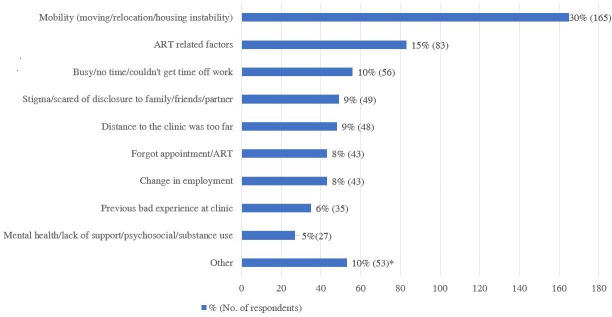
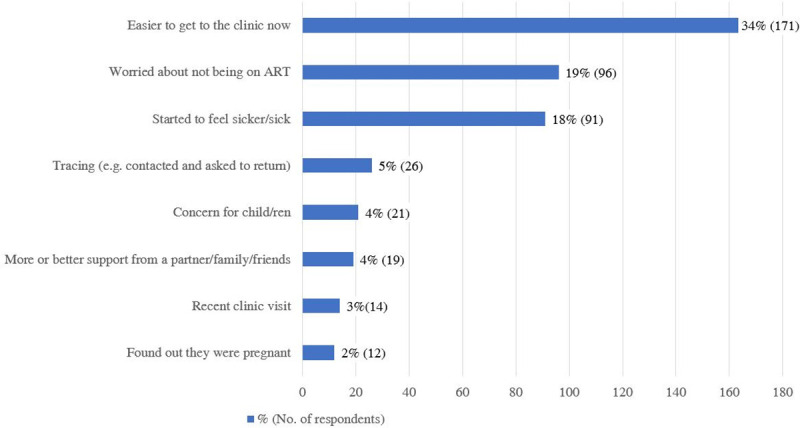
Results: 562 people re-initiated ART, 66% were women, 75% were 25-49 years old. The three most common reasons for disengagement from care were mobility (30%), ART related factors (15%), and time limitations due to work (10%). Reasons for returning included it becoming easier to attend the clinic (34%) and worry about not being on ART (19%). Mobile interview participants often forgot their medical files and expressed that managing their ART was difficult because they often needed a transfer letter to gain access to ART at another facility. On the other hand, clinics that had flexible and extended hours facilitated retention in care.
Conclusion: In both the quantitative data, and the qualitative analysis, changing life circumstances was the most prominent reason for disengagement from care. Health services were not perceived to be responsive to life changes or mobility, leading to disengagement. More client-centred and responsive health services should improve retention on ART.
Conflict of interest statement
The authors declare that no competing interests exist.
Figures
References
-
- Stern E, Colvin C, Gxabagxaba N, Schutz C, Burton R, Meintjes G. Conceptions of agency and constraint for HIV-positive patients and healthcare workers to support long-term engagement with antiretroviral therapy care in Khayelitsha, South Africa. African J AIDS Res. 2017;16(1):19–29. doi: 10.2989/16085906.2017.1285795 - DOI - PMC - PubMed
Publication types
MeSH terms
Substances
LinkOut - more resources
Full Text Sources
Medical
