


Incidence of Proliferative Diabetic Retinopathy and Other Neovascular Sequelae at 5 Years Following Diagnosis of Type 2 Diabetes
- PMID: 34475031
- PMCID: PMC8546279
- DOI: 10.2337/dc21-0228
Incidence of Proliferative Diabetic Retinopathy and Other Neovascular Sequelae at 5 Years Following Diagnosis of Type 2 Diabetes
Abstract
Objective: To determine the incidence and risk factors for developing proliferative diabetic retinopathy (PDR), tractional retinal detachment (TRD), and neovascular glaucoma (NVG) at 5 years after the initial diagnosis of type 2 diabetes.
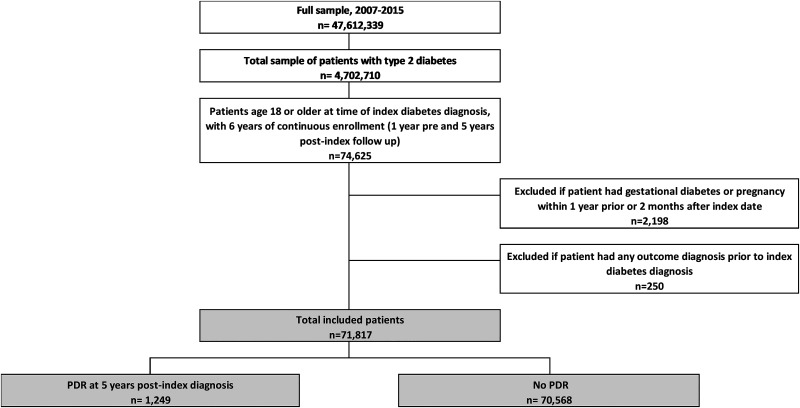
Research design and methods: Insured patients aged ≥18 years with newly diagnosed type 2 diabetes and 5 years of continuous enrollment were identified from a nationwide commercial claims database containing data from 2007 to 2015. The incidences of PDR, TRD, and NVG were computed at 5 years following the index diagnosis of type 2 diabetes. Associations between these outcomes and demographic, socioeconomic, and medical factors were tested with multivariable logistic regression.
Results: At 5 years following the initial diagnosis of type 2 diabetes, 1.74% (1,249 of 71,817) of patients had developed PDR, 0.25% of patients had developed TRD, and 0.14% of patients had developed NVG. Insulin use (odds ratio [OR] 3.59, 95% CI 3.16-4.08), maximum HbA1c >9% or >75 mmol/mol (OR 2.10, 95% CI 1.54-2.69), renal disease (OR 2.68, 95% CI 2.09-3.42), peripheral circulatory disorders (OR 1.88, 95% CI 1.25-2.83), neurological disease (OR 1.62, 95% CI 1.24-2.11), and older age (age 65-74 years) at diagnosis (OR 1.62, 95% CI 1.28-2.03) were identified as risk factors for development of PDR at 5 years. Young age (age 18-23 years) at diagnosis (OR 0.46, 95% CI 0.29-0.74), Medicare insurance (OR 0.60, 95% CI 0.70-0.76), morbid obesity (OR 0.72, 95% CI 0.59-0.87), and smoking (OR 0.84, 95% CI 0.70-1.00) were identified as protective factors.
Conclusions: A subset of patients with type 2 diabetes develop PDR and other neovascular sequelae within the first 5 years following the diagnosis with type 2 diabetes. These patients may benefit from increased efforts for screening and early intervention.
© 2021 by the American Diabetes Association.
Figures
Comment in
-
Response to Comment on Gange et al. Incidence of Proliferative Diabetic Retinopathy and Other Neovascular Sequelae at 5 Years Following Diagnosis of Type 2 Diabetes. Diabetes Care 2021;44:2518-2526.Diabetes Care. 2022 Mar 1;45(3):e61-e62. doi: 10.2337/dci21-0057. Diabetes Care. 2022. PMID: 35245351 Free PMC article. No abstract available.
-
Comment on Gange et al. Incidence of Proliferative Diabetic Retinopathy and Other Neovascular Sequelae at 5 Years Following Diagnosis of Type 2 Diabetes. Diabetes Care 2021;44:2518-2526.Diabetes Care. 2022 Mar 1;45(3):e60. doi: 10.2337/dc21-2254. Diabetes Care. 2022. PMID: 35245355 No abstract available.
References
-
- Centers for Disease Control and Prevention . National Diabetes Statistics Report 2020: Estimates of Diabetes and Its Burden in the United States. Accessed 4 August 2021. Available from: https://www.cdc.gov/diabetes/pdfs/data/statistics/national-diabetes-stat...
-
- Kempen JH, O’Colmain BJ, Leske MC, et al. .; Eye Diseases Prevalence Research Group . The prevalence of diabetic retinopathy among adults in the United States. Arch Ophthalmol 2004;122:552–563 - PubMed
-
- Klein R, Klein BE, Moss SE, Davis MD, DeMets DL. The Wisconsin Epidemiologic Study of Diabetic Retinopathy. III. Prevalence and risk of diabetic retinopathy when age at diagnosis is 30 or more years. Arch Ophthalmol 1984;102:527–532 - PubMed
Publication types
MeSH terms
Associated data
Grants and funding
LinkOut - more resources
Full Text Sources
Medical
Miscellaneous
