


Estimate of global human papillomavirus vaccination coverage: analysis of country-level indicators
- PMID: 34475188
- PMCID: PMC8413939
- DOI: 10.1136/bmjopen-2021-052016
Estimate of global human papillomavirus vaccination coverage: analysis of country-level indicators
Abstract
Background: Mortality rates from cervical cancer demonstrate deep inequality in health between richer and poorer populations. Over 310 000 women died of this preventable disease in 2018, mostly in low-income and middle-income countries (LMICs) where screening and treatment are beyond the capacity of health systems. Immunisation against human papillomavirus (HPV) offers a primary prevention strategy, but rates of vaccination uptake are unclear. Understanding coverage levels and factors affecting uptake can inform immunisation strategies.
Objectives: The aim of this study is to evaluate the status of HPV vaccination coverage from nationally reported indicators and to estimate global coverage in a single year cohort of vaccine-eligible girls.
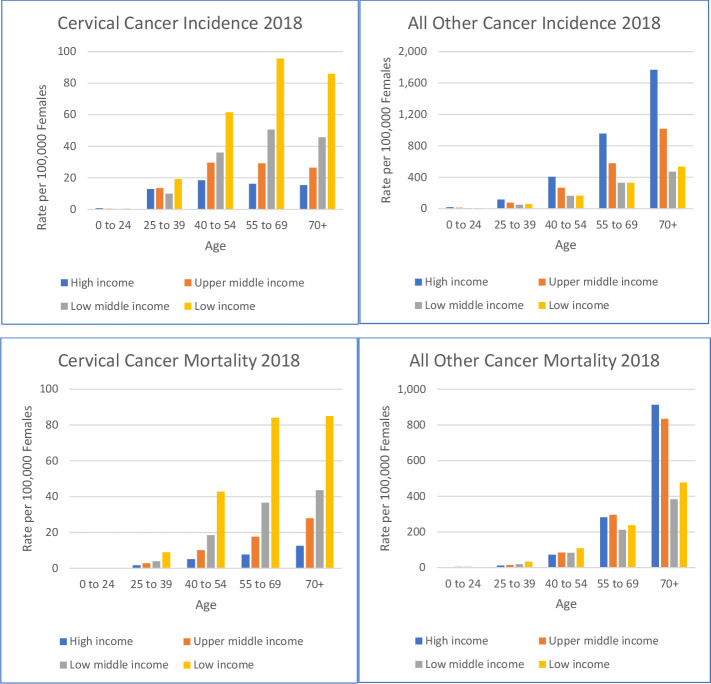
Design: This study provides quantitative population-level estimates of important global health indicators. Using data from the Global Cancer Observatory and WHO/UNICEF, incidence of and mortality from cervical cancer and HPV vaccination coverage are described for countries, categorised by income group. Characteristics of LMICs achieving high coverage are explored using selected development indicators from World Bank sources. Global HPV immunisation coverage is calculated and its impact on cervical cancer mortality estimated.
Results: Incidence and mortality for cervical cancer correlate with poverty. Whilst all WHO member states report high infant measles vaccination rates, fewer than half report on HPV vaccination. Even amongst high-income countries, coverage varies widely. In upper-middle-income countries, there is a trend for higher coverage with increased health spending per capita. Four LMICs report good coverage levels, all associated with external funding. Global HPV immunisation coverage for 2018 is estimated at 12.2%. Of the global cohort of 61 million 15-year-old girls in 2018, 7000 are likely to die from cervical cancer, almost all in LMICs.
Conclusions: Countries in all income groups must devise strategies to achieve and maintain higher levels of HPV immunisation. For all but the richest, affordability remains a barrier.
Keywords: gynaecological oncology; paediatric infectious disease & immunisation; preventive medicine; public health.
© Author(s) (or their employer(s)) 2021. Re-use permitted under CC BY-NC. No commercial re-use. See rights and permissions. Published by BMJ.
Conflict of interest statement
Competing interests: None declared.
Figures


References
-
- Ferlay J, Ervik M, Lam F. Global cancer Observatory: cancer today: international agency for research on cancer, 2018. Available: https://gco.iarc.fr/
MeSH terms
Substances
LinkOut - more resources
Full Text Sources
Medical
