. 2021 Sep 3;21(1):222.
doi: 10.1186/s12906-021-03389-w.

Molecular mechanism of Epicedium treatment for depression based on network pharmacology and molecular docking technology

Affiliations

Molecular mechanism of Epicedium treatment for depression based on network pharmacology and molecular docking technology

Yankai Dong et al. BMC Complement Med Ther. .

Abstract

Background: Increasing attention has been paid to the effect of Epimedium on the nervous system, particularly anti-depression function. In the present study, we applied network pharmacology to introduce a testable hypothesis on the multi-target mechanisms of Epicedium against depression.

Methods: By reconstructing the network of protein-protein interaction and drug-component-target, we predicted the key protein targets of Epicedium for the treatment of depression. Then, through molecular docking, the interaction of the main active components of Epicedium and predicted candidate targets were verified.

Results: Nineteen active compounds were selected from Epicedium. There were 200 targets associated with Epicedium and 537 targets related to depression. The key targets of Epicedium for treating depression were IL6, VEGFA, AKT1, and EGF. According to gene ontology functional enrichment analysis, 22 items of biological process (BP), 13 items of cell composition (CC) and 9 items of molecular function (MF) were obtained. A total of 56 signaling pathways (P < 0.05) were identified by Kyoto Encyclopedia of Genes and Genomes analysis, mainly involving depression-related pathways such as dopaminergic synapse, TNF signaling pathway, and prolactin signaling pathway. The results of molecular docking showed that the most important activity components, including luteoklin, quercetin and kaempferol, were well combined with the key targets.

Conclusions: Luteoklin, quercetin, kaempferol and other active compounds in Epicedium can regulate multiple signaling pathways and targets such as IL6, AKT1, and EGF, therefore playing therapeutic roles in depression.

Keywords: Epimedium; depression; molecular docking; network pharmacology; pathway analysis.


Conflict of interest statement

The authors declare that there are no competing of interest.

Figures
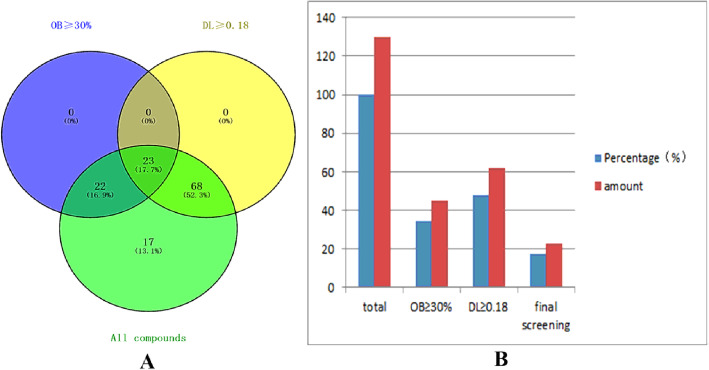
Fig. 1
Fig. 1
Epimedium screening of bioactive compounds. (A) Venn diagram: 130 components (green section) and 23 bioactive components screened by two ADME-related models (blue section stands for the components of OB≥30%, yellow section stands for DL≥ 0.18). (B) Distributions of components in Epimedium
Fig. 2
Fig. 2
Common-target network. (A). Mapping of Epimedium- and depression-related targets and the 53 common targets. (B). Construction of Epimedium component-target visual network. Blue node stands for Epimedium, yellow nodes stand for bioactive components, and red nodes stand for predicted targets. (C). Interaction network of Epimedium-related target proteins. The dark blue nodes represent the big hub nodes. The node size was proportional to the target degree in the network. (D). Interaction network of proteins related to the treatment of depression by Epimedium. The green nodes represent the big hub nodes. The node size was proportional to the target degree in the network
Fig. 3
Fig. 3
Enrichment of gene ontology (GO) and KEGG pathway of Epimedium in the treatment of depression. (A).Enriched GO terms for biological process (BP) of potential antidepressant targets from main active ingredients of Epimedium. (B). Enriched GO terms for the cellular component of potential antidepressant targets from main active ingredients of Epimedium.(C). Enriched GO terms for molecular function of potential antidepressant targets from main active ingredients of Epimedium. (D). Enriched KEGG pathways of potential antidepressant targets from main active ingredients of Epimedium
Fig. 4
Fig. 4
2D and 3D structures of ligands. (A) 2D structure of kaempferol. (B) 2D structure of luteolin. (C) 2D structure of quercetin. (D) 3D structure of kaempferol. (E) 3D structure of luteolin. (F) 3D structure of quercetin
Fig. 5
Fig. 5
Binding mode of protein and different ligands.(A) Binding mode of IL6 with luteolin, quercetin, and kaempferol.(B) Binding mode of VEGFA with luteolin, quercetin, and kaempferol. (C) Binding mode of AKT1 with luteolin, quercetin, and kaempferol. (D) Binding mode of EGF with luteolin, quercetin, and kaempferol. Pink represents the amino acids that form electrostatic force, and green represents the amino acids that form van der Waals force

References

    1. Scangos KW, Makhoul GS, Sugrue LP, Chang EF, Krystal AD. State-dependent responses to intracranial brain stimulation in a patient with depression. Nature Medicine. Feb 2021;27(2):229-+. - PMC - PubMed
    1. Wigner P, Czarny P, Galecki P, Su K-P, Sliwinski T. The molecular aspects of oxidative & nitrosative stress and the tryptophan catabolites pathway (TRYCATs) as potential causes of depression. Psychiatry Research. 2018;262:566–574. doi: 10.1016/j.psychres.2017.09.045. - DOI - PubMed
    1. Cui Y, Cao K, Lin H, et al. Early-Life Stress Induces Depression-Like Behavior and Synaptic-Plasticity Changes in a Maternal Separation Rat Model: Gender Difference and Metabolomics Study. Frontiers in Pharmacology. Feb 26 2020;11. - PMC - PubMed
    1. Qu S-Y, Li X-Y, Heng X, et al. Analysis of Antidepressant Activity of Huang-Lian Jie-Du Decoction Through Network Pharmacology and Metabolomics. Frontiers in Pharmacology. Mar 4 2021;12. - PMC - PubMed
    1. Wang C, Lin H, Yang N, et al. Effects of Platycodins Folium on Depression in Mice Based on a UPLC-Q/TOF-MS Serum Assay and Hippocampus Metabolomics. Molecules. May 1 2019;24(9). - PMC - PubMed

MeSH terms

Substances
