Review
. 2021 Nov:100:108071.
doi: 10.1016/j.intimp.2021.108071. Epub 2021 Aug 18.

Prediction and analysis of microRNAs involved in COVID-19 inflammatory processes associated with the NF-kB and JAK/STAT signaling pathways

Affiliations
Review

Prediction and analysis of microRNAs involved in COVID-19 inflammatory processes associated with the NF-kB and JAK/STAT signaling pathways

Zeinab Amini-Farsani et al. Int Immunopharmacol. 2021 Nov.

Abstract

COVID-19 is the cause of a pandemic associated with substantial morbidity and mortality. As yet, there is no available approved drug to eradicate the virus. In this review article, we present an alternative study area that may contribute to the development of therapeutic targets for COVID-19. Growing evidence is revealing further pathophysiological mechanisms of COVID-19 related to the disregulation of inflammation pathways that seem to play a critical role toward COVID-19 complications. The NF-kB and JAK/STAT signaling pathways are highly activated in acute inflammation, and the excessive activity of these pathways in COVID-19 patients likely exacerbates the inflammatory responses of the host. A group of non-coding RNAs (miRNAs) manage certain features of the inflammatory process. In this study, we discuss recent advances in our understanding of miRNAs and their connection to inflammatory responses. Additionally, we consider the link between perturbations in miRNA levels and the onset of COVID-19 disease. Furthermore, previous studies published in the online databases, namely web of science, MEDLINE (PubMed), and Scopus, were reviewed for the potential role of miRNAs in the inflammatory manifestations of COVID-19. Moreover, we disclosed the interactions of inflammatory genes using STRING DB and designed interactions between miRNAs and target genes using Cityscape software. Several miRNAs, particularly miR-9, miR-98, miR-223, and miR-214, play crucial roles in the regulation of NF-kB and JAK-STAT signaling pathways as inflammatory regulators. Therefore, this group of miRNAs that mitigate inflammatory pathways can be further regarded as potential targets for far-reaching-therapeutic strategies in COVID-19 diseases.

Keywords: COVID-19; Inflammation; JAK/STAT; NF-kB; miRNA.


Conflict of interest statement

The authors declare that they have no known competing financial interests or personal relationships that could have appeared to influence the work reported in this paper.

Figures
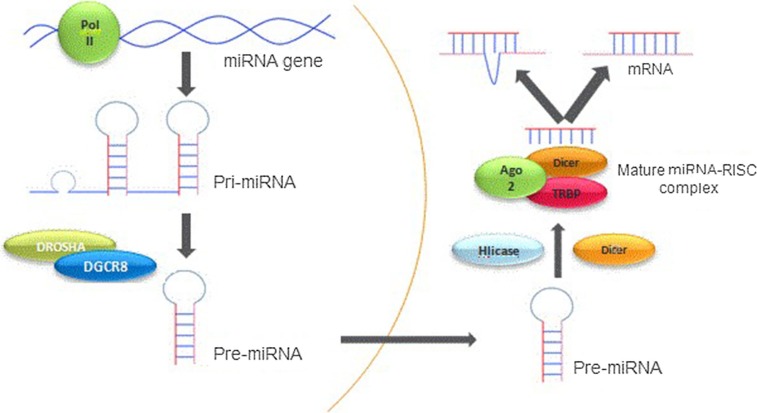
Fig. 1
Fig. 1
MiRNA biogenesis. The biogenesis of miRNAs begins with the production of the pri-miRNA transcript. The microprocessor complex which is consisted of Drosha and DiGeorge Syndrome Critical Region 8 (DGCR8), generates the pre-miRNA via cleaving the pri-miRNA. The pre-miRNA is exported to the cytoplasm in an Exportin5/RanGTP-dependent manner and processed to form the mature miRNA duplex. Eventually, either the 5p or 3p strands of the mature miRNA duplex is loaded into the Argonaute (AGO) family of proteins to form a miRNA-induced silencing complex (miRISC) and regulates gene expression .
Fig. 2
Fig. 2
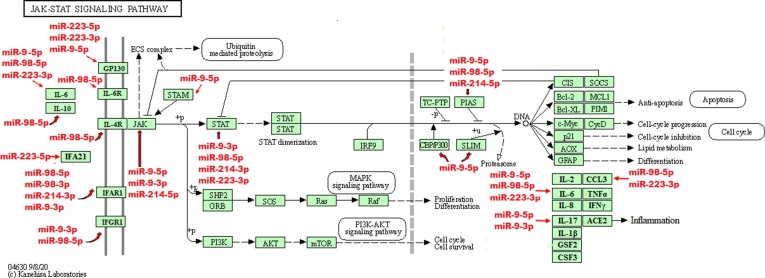
Potential targets of miR-223, miR-98, miR-9, and miR-214 in JAK/STAT pathway. The JAK/STAT signaling pathway is a transducer of a wide variety of signals for development and homeostasis in animals from humans to flies. In mammals, this pathway is the main mechanism of signal transduction from growth factors and cytokines. Following the binding of a cytokine to a receptor, the JAK tyrosine kinase activates STAT. Upon the activation of STAT, it is dimerized and transferred to the nucleus, leading to the regulation of the transcription of target genes. The targets of the miR-223, miR-98, miR-9, and miR-214 in these pathway are shown using red arrows (KEGG PATHWAY database). (For interpretation of the references to colour in this figure legend, the reader is referred to the web version of this article.)
Fig. 3
Fig. 3
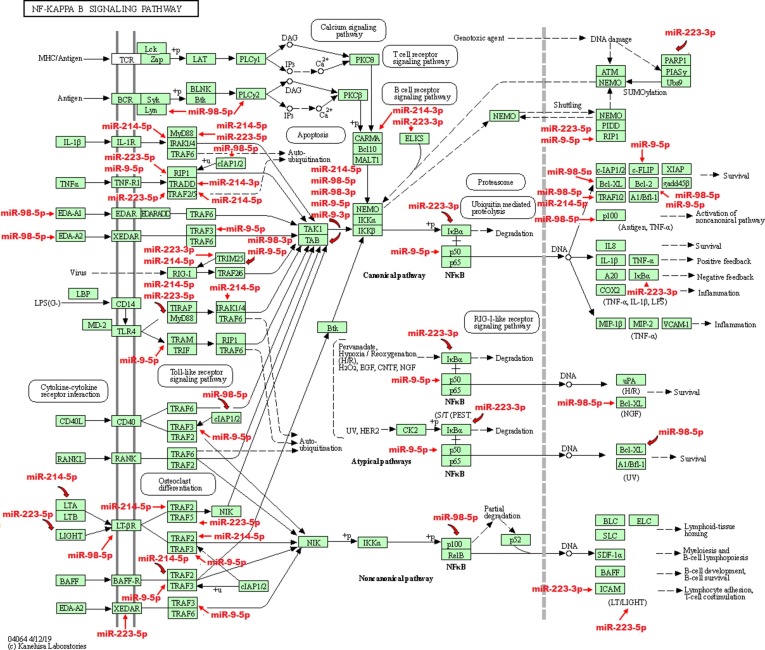
Potential targets of miR-223, miR-98, miR-9, and miR-214 in NFκB pathway. Nuclear factor-kappa B (NF-kappa B) regulates genes played important roles in immunity, inflammation and cell survival. There are several pathways resulting in NF-kappa B-activation. The canonical pathway is induced by TNF-α, IL-1 or byproducts of bacterial and viral infections. This pathway depends on IKK- mediated IkappaB-alpha phosphorylation on Ser32 and 36, leading to its degradation, which allows the p50/p65 NF-kappa B dimer to enter the nucleus and activate gene transcription. The targets of the miR-223, miR-98, miR-9, and miR-214 in these pathway are shown using red arrows (KEGG PATHWAY database). (For interpretation of the references to colour in this figure legend, the reader is referred to the web version of this article.)
Fig. 4
Fig. 4
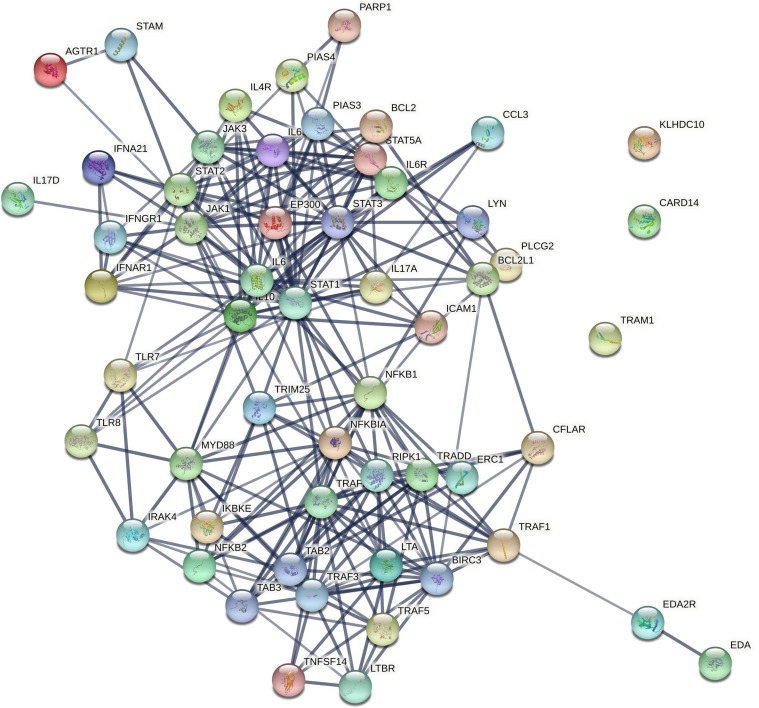
Potential interactions between genes involved in the JAK/STAT and NFκB pathways are depicted using the STRING database (string-db.org).
Fig. 5
Fig. 5
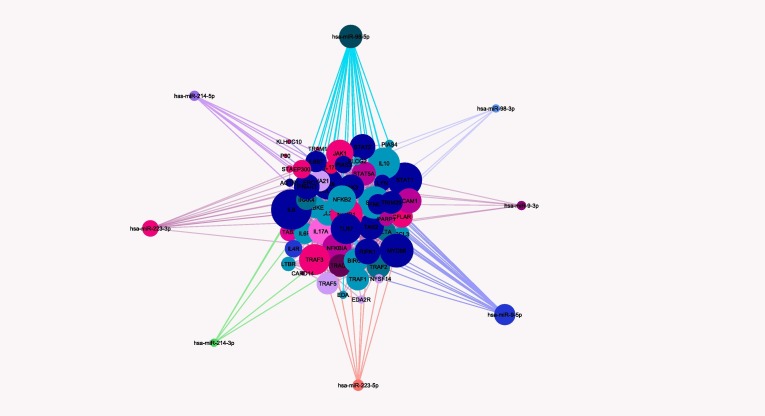
Potential interactions between genes involved in the JAK/STAT and NFκB pathways and miR-223, miR-98, miR-9, and miR-214 (extracted from databases of KEGG, WikiPathways, MiRTarBase, and Target scan). Potential target genes of miR-9-5p (pink), miR-9-3p (light pink), miR-98-5p (light blue), miR-98-3p (medium blue), miR-214-5p (green), miR-214-3p (dark purple), and miR-223-3p (medium purple), and miR-223-5p (light purple) are shown in the picture. MiRNAs with more interactions are illustrates with larger sizes. Potential interactions between genes with each other and miRNAs of interest were depicted via Cytoscape software. (For interpretation of the references to colour in this figure legend, the reader is referred to the web version of this article.)

References

    1. Abedi F., Rezaee R., Hayes A.W., Nasiripour S., Karimi G. MicroRNAs and SARS-CoV-2 life cycle, pathogenesis, and mutations: biomarkers or therapeutic agents? Cell Cycle. 2021;20(2):143–153. doi: 10.1080/15384101.2020.1867792. - DOI - PMC - PubMed
    1. Abu-Izneid T., AlHajri N., Ibrahim A.M., Javed M.N., Salem K.M., Pottoo F.H., Kamal M.A. Micro-RNAs in the regulation of immune response against SARS CoV-2 and other viral infections. J. Adv. Res. 2021;30:133–145. doi: 10.1016/j.jare.2020.11.013. - DOI - PMC - PubMed
    1. Adrian Recinos I.I.I., LeJeune W.S., Sun H., Lee C.Y., Tieu B.C., Muping L.u., Hou T., Boldogh I., Tilton R.G., Brasiera A.R. Angiotensin II induces IL-6 expression and the Jak-STAT3 pathway in aortic adventitia of LDL receptor-deficient mice. Atherosclerosis. 2007;23(1):1–7. - PMC - PubMed
    1. Al-Hazmi A. Challenges presented by MERS corona virus, and SARS corona virus to global health. Saudi J. Biol. Sci. 2016;23(4):507–511. doi: 10.1016/j.sjbs.2016.02.019. - DOI - PMC - PubMed
    1. Ali H.R.S.M., McLellan A.D. Implications of SARS-CoV-2 mutations for genomic RNA structure and host microRNA targeting. BioRxiv. 2020 doi: 10.1101/2020.05.15.098947. - DOI - PMC - PubMed