Incidental Ultrasound Diagnosis of Neonatal Intussusception Secondary to Meckel's Diverticulum in a Neurologically Impaired Child
- PMID: 34482359
- PMCID: PMC8428622
- DOI: 10.12659/AJCR.932280
Incidental Ultrasound Diagnosis of Neonatal Intussusception Secondary to Meckel's Diverticulum in a Neurologically Impaired Child
Abstract
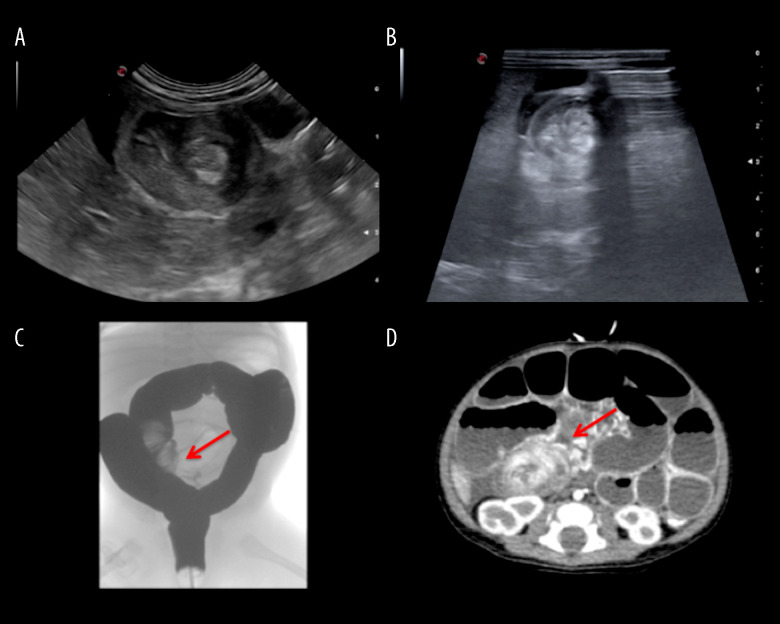
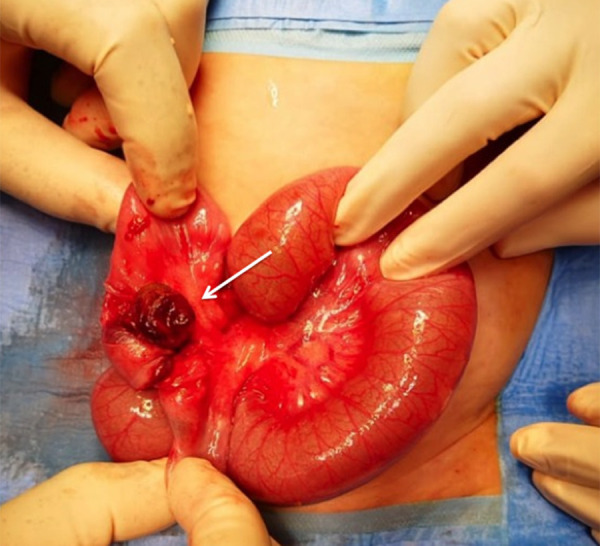
BACKGROUND Intussusception is the most common cause of intestinal obstruction in children, with a peak incidence usually before the second year of age, while in neonates it is a rare entity. We describe a delayed and incidental diagnosis of neonatal intussusception secondary to Meckel's diverticulum in a neonate with shaken baby syndrome (SBS). This is, to the best of our knowledge, the first reported case of a neonatal intussusception with a Meckel's diverticulum as a lead point in a neurologically impaired child. CASE REPORT A term baby presented at 22 days of age at our Emergency Department in severe conditions due to a suspected SBS. Eight days following hospitalization in the Intensive Care Unit, an isolated episode of rectal bleeding occurred, without any worsening of general conditions or abdominal distension. The ultrasonography showed a "doughnut sign" with high suspicion of ileocecal intussusception. A rectal barium contrast enema was performed but was not resolutive. At exploratory laparotomy an ileocecal intussusception with Meckel's diverticulum acting as a lead point was identified and an intestinal resection was needed due to the ischemic condition of the ileum. The post-operative course was uneventful and the baby recovered well; the residual neurological impairment needed long-term follow-up. CONCLUSIONS Intussusception is a rare entity in neonates and, when severe neurological impairment is present, the diagnosis can be missed because of the compromised condition of the baby and the paucity of gastrointestinal manifestations. In addition, due to the high incidence of lead point in neonatal cases, we recommend reserving non-operative treatment only for selected cases.
Conflict of interest statement
None declared.
Figures
References
-
- Loukas M, Pellerin M, Kimball Z, et al. Intussusception: An anatomical perspective with review of the literature. Clin Anat. 2011;24(5):552–61. - PubMed
-
- Samad L, Marven S, Bashir H, et al. Prospective surveillance study of the management of intussusception in UK and Irish infants. Br J Surg. 2012;99(3):411–15. - PubMed
-
- Slam K, Teitelbaum D. Multiple sequential intussusceptions causing bowel obstruction in a preterm neonate. J Pediatr Surg. 2007;42(7):1279–81. - PubMed
Publication types
MeSH terms
LinkOut - more resources
Full Text Sources
Medical