. 2021 Sep 4;11(1):456.
doi: 10.1038/s41398-021-01587-1.

Kynurenines increase MRS metabolites in basal ganglia and decrease resting-state connectivity in frontostriatal reward circuitry in depression

Affiliations

Kynurenines increase MRS metabolites in basal ganglia and decrease resting-state connectivity in frontostriatal reward circuitry in depression

Xiangchuan Chen et al. Transl Psychiatry. .

Abstract

Inflammation is associated with the development of anhedonia in major depression (MD), but the pathway by which inflammatory molecules gain access to the brain and lead to anhedonia is not clear. Molecules of the kynurenine pathway (KP), which is activated by inflammation, readily influx into the brain and generate end products that alter brain chemistry, disrupt circuit functioning, and result in the expression of inflammatory behaviors such as anhedonia. We examined the impact of plasma and CSF KP metabolites on brain chemistry and neural function using multimodal neuroimaging in 49 depressed subjects. We measured markers of glial dysfunction and distress including glutamate (Glu) and myo-inositol in the left basal ganglia using magnetic resonance spectroscopy (MRS); metrics of local activity coherence (regional homogeneity, ReHo) and functional connectivity from resting-state functional MRI measures; and anhedonia from the Inventory for Depressive Symptoms-Self Report Version (IDS-SR). Plasma kynurenine/tryptophan (KYN/TRP) ratio and cerebrospinal fluid (CSF) 3-hydroxykynurenine (3HK) were associated with increases in left basal ganglia myo-inositol. Plasma kynurenic acid (KYNA) and KYNA/QA were associated with decreases and quinolinic acid (QA) with increases in left basal ganglia Glu. Plasma and CSF KP were associated with decreases in ReHo in the basal ganglia and dorsomedial prefrontal regions (DMPFC) and impaired functional connectivity between these two regions. DMPFC-basal ganglia mediated the effect of plasma and CSF KP on anhedonia. These findings highlight the pathological impact of KP system dysregulation in mediating inflammatory behaviors such as anhedonia.


Conflict of interest statement

Dr. Miller is a paid consultant to Boehringer Ingelheim. The remaining authors declare no competing interests.

Figures
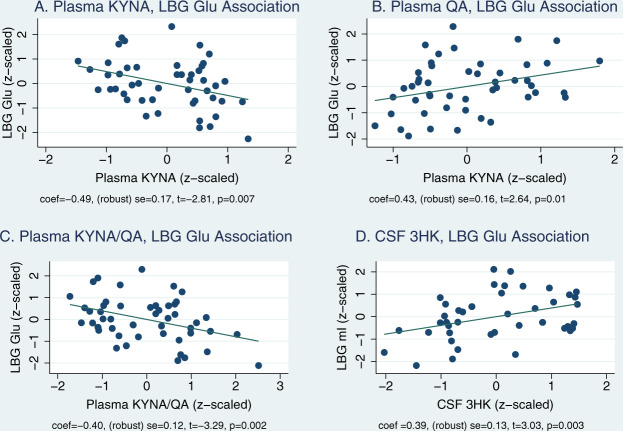
Fig. 1
Fig. 1. KP-MRS associations.
The figure represents the partial (A, B) and simple regression plots (C, D) demonstrating the association between kynurenine pathway (KP) metabolites on the x-axis and magnetic resonance spectroscopy (MRS)–based markers in the left basal ganglia on the y-axis. All values were normalized (using Box-Cox Power Transform) and z-scaled. These are simplified least squares models compared with the more complex lasso regression used in the text. A represents the association between plasma kynurenic acid (KYNA) and left basal ganglia (LBG) glutamate (LBG Glu), B between plasma quinolinic acid (QA) and LBG glutamate (Glu), C between plasma KYNA/QA ratio and LBG Glu, and D between cerebrospinal fluid (CSF) 3-hydroxykynurenine (3HK) and LBG myo-inositol (LBG mI). The individual coefficients and their significance values are indicated under each graphlet. The voxel used for MRS acquisition (MRS-LBG-VOI) is demonstrated as an inset in Fig. 2A.
Fig. 2
Fig. 2. KP-resting fMRI associations.
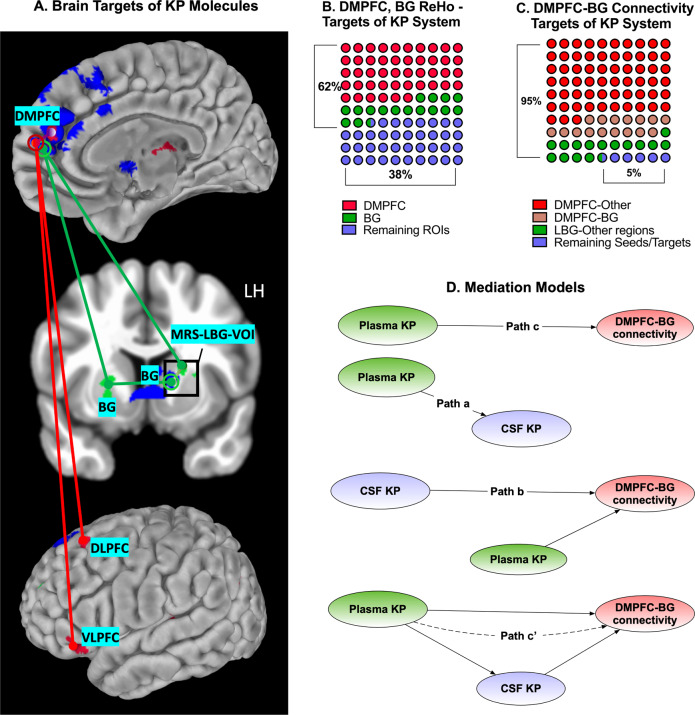
A presents the primary resting-state functional magnetic resonance imaging (rsMRI) targets of kynurenine pathway (KP) metabolites identified using voxel-based analysis. The areas shaded in deep blue represent the regions of interest (ROI) that demonstrated altered regional homogeneity (ReHo) associated with plasma or cerebrospinal fluid (CSF) KP. Identification of ROIs was based on the correlation between kynurenine (KYN) or 3-hydroxykynurenine (3HK) in either the plasma or CSF. A detailed description of all ReHo seed-ROIs thus derived (total = 12 seeds) is presented in Supplementary Information 4. ROIs correlated with plasma KP are illustrated using red circles and CSF KP-related ROIs are illustrated using green circles. These ROIs were also set as the seeds in seed-to-whole-brain connectivity analysis. The red or green lines and the red or green uncircled dots represent the connectivity and targets, respectively. Connectivity z-scores correlated with plasma and CSF KP measures were derived after controlling for multiple comparisons (threshold = voxel p < 0.001, cluster p < 0.05). B presents a 10 × 10 dot plot depicting the region-wise distribution of voxels (measured using voxel volume = 1 cubic millimeter/voxel), demonstrating ReHo decreases. As is evident, 62% of voxels demonstrating decreased ReHo were located either in the dorsomedial prefrontal cortex (DMPFC), left (LBG), or right basal ganglia (RBG) regions, respectively. C demonstrates a similar dot plot demonstrating the distribution of KP-correlated connectivity disruptions between ReHo seed regions and other brain regions. As is evident, 95% of whole-brain connectivity decreases were associated with DMPFC-BG regions. D represents the overall plan of the path/mediation analyses. Plasma and CSF KP latent factors represent the individual contribution of kynurenine (KYN), 3-hydroxykynurenine (3HK) to each of these factors. DMPFC-basal ganglia (BG) latent factor comprises four different connectivities (DMPFC-LBG, DMPFC-RBG, LBG-LBG, and LBG-RBG). Path c examines the relationship between plasma KP and DMPFC-BG connectivity and Path a examines the association between plasma and CSF KP to each other. Path b examines if plasma KP impacts the association between CSF KP and DMPFC-BG connectivity. Path c′ presents the model testing mediation by CSF KP of the relationship between plasma KP on DMPFC-BG connectivity.
Fig. 3
Fig. 3. Anhedonia–HCA clustering.
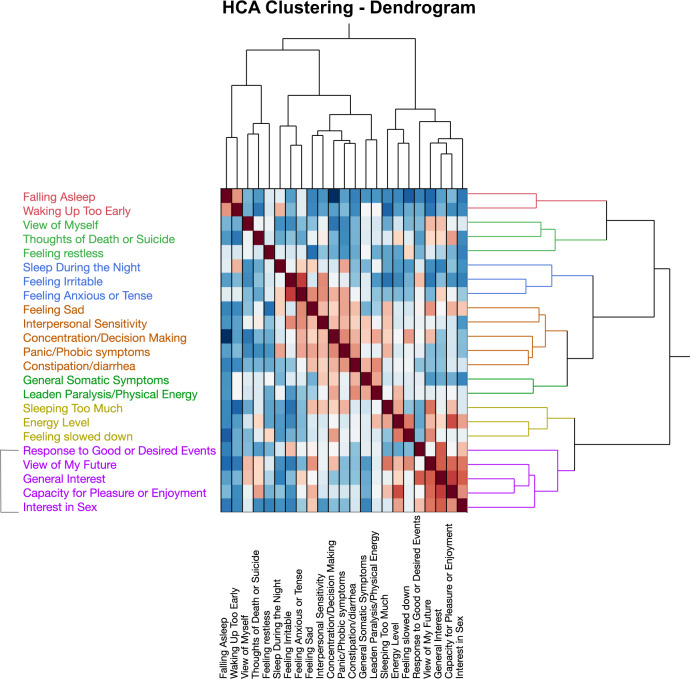
The figure depicts the dendrogram from hierarchical clustering of individual items on Inventory for Depressive Symptoms-Self Rated Version (IDS-SR). After removing items with ambiguous and unreliable scoring on IDS-SR (details in text), the remaining 23 items were clustered using hierarchical clustering with Ward’s agglomerative method. As noted, anhedonia items on IDS-SR (items #8, 17, 18, 19, and 22) clustered tightly together and were combined into an “Anhedonia” factor. Item #18: Capacity for Pleasure or Enjoyment was removed during redundancy analysis, as it failed to load adequately onto its latent factor.
Fig. 4
Fig. 4. Connectivity-anhedonia associations.
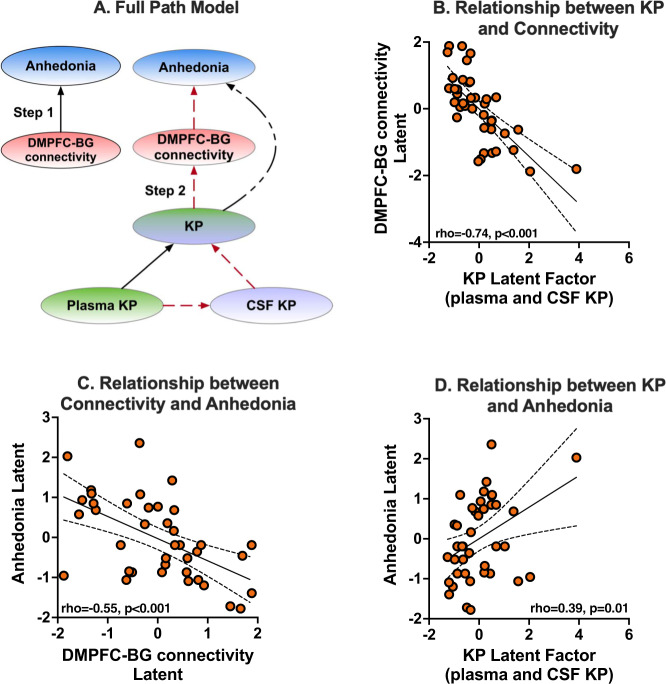
A presents the overall scheme of the path model between all the latent factors within a single, reflective, multilevel path model. Briefly, kynurenine (KYN) and 3-hydroxykynurenine (3HK) in plasma and CSF were loaded onto their respective plasma and CSF kynurenine pathway (KP) factors that loaded further onto a combined KP factor. The KP factor was then related to the dorsomedial prefrontal (DMPFC)-basal ganglia (BG) latent factor that was further linked to the anhedonia latent factor described earlier. DMPFC-BG latent factor was composed of both plasma and CSF connectivities selected based on factor loadings (loading coefficient > 0.7). Three of 4 of the above connectivities, DMPFC-DMPFC (right to left DMPFC), DMPFC-left ventrolateral prefrontal region (LVLPFC), DMPFC-left dorsolateral prefrontal region (DLPFC), were correlated with plasma KYN, and 1/4, i.e., DMPFC-left basal ganglia (LBG) was correlated with CSF 3HK. The red-colored broken lines represent direct paths that combined to create an indirect or mediation effect. Step 1 (A) examined a direct relationship between functional connectivity and anhedonia. BD represents linear associations between the latent factor scores, with the relationship expressed as Spearman rho values. B represents the direct association between KP and DMPFC-BG connectivity (rho = 0.74, p < 0.001), and C presents the direct association between DMPFC-BG connectivity and anhedonia (rho = 0.55, p < 0.001). D represents the indirect association between KP and anhedonia mediated by DMPFC-BG connectivity (rho = 0.39, p < 0.01). A mediation effect of the link between KP and anhedonia by connectivity and the relationship between plasma KP and anhedonia by CSF KP and connectivity was significant (details in text).

References

    1. Haroon E, Woolwine BJ, Chen X, Pace TW, Parekh S, Spivey JR, et al. IFN-alpha-induced cortical and subcortical glutamate changes assessed by magnetic resonance spectroscopy. Neuropsychopharmacology. 2014;39:1777–85. doi: 10.1038/npp.2014.25. - DOI - PMC - PubMed
    1. Haroon E, Felger JC, Woolwine BJ, Chen X, Parekh S, Spivey JR, et al. Age-related increases in basal ganglia glutamate are associated with TNF, reduced motivation and decreased psychomotor speed during IFN-alpha treatment: preliminary findings. Brain Behav Immun. 2015;46:17–22. doi: 10.1016/j.bbi.2014.12.004. - DOI - PMC - PubMed
    1. Haroon E, Fleischer CC, Felger JC, Chen X, Woolwine BJ, Patel T, et al. Conceptual convergence: increased inflammation is associated with increased basal ganglia glutamate in patients with major depression. Mol Psychiatry. 2016;21:1351–7. doi: 10.1038/mp.2015.206. - DOI - PMC - PubMed
    1. Attwells S, Setiawan E, Rusjan PM, Xu C, Hutton C, Rafiei D, et al. Translocator protein distribution volume predicts reduction of symptoms during open-label trial of celecoxib in major depressive disorder. Biol Psychiatry. 2020;88:649–56. doi: 10.1016/j.biopsych.2020.03.007. - DOI - PMC - PubMed
    1. Dantzer R. Role of the kynurenine metabolism pathway in inflammation-induced depression: preclinical approaches. Curr Top Behav Neurosci. 2017;31:117–38. doi: 10.1007/7854_2016_6. - DOI - PMC - PubMed

Publication types