Review
. 2021 Oct 25;376(1836):20200239.
doi: 10.1098/rstb.2020.0239. Epub 2021 Sep 6.

Cross-species parallels in babbling: animals and algorithms

Affiliations
Review

Cross-species parallels in babbling: animals and algorithms

Sita M Ter Haar et al. Philos Trans R Soc Lond B Biol Sci. .

Abstract

A key feature of vocal ontogeny in a variety of taxa with extensive vocal repertoires is a developmental pattern in which vocal exploration is followed by a period of category formation that results in a mature species-specific repertoire. Vocal development preceding the adult repertoire is often called 'babbling', a term used to describe aspects of vocal development in species of vocal-learning birds, some marine mammals, some New World monkeys, some bats and humans. The paper summarizes the results of research on babbling in examples from five taxa and proposes a unifying definition facilitating their comparison. There are notable similarities across these species in the developmental pattern of vocalizations, suggesting that vocal production learning might require babbling. However, the current state of the literature is insufficient to confirm this suggestion. We suggest directions for future research to elucidate this issue, emphasizing the importance of (i) expanding the descriptive data and seeking species with complex mature repertoires where babbling may not occur or may occur only to a minimal extent; (ii) (quasi-)experimental research to tease apart possible mechanisms of acquisition and/or self-organizing development; and (iii) computational modelling as a methodology to test hypotheses about the origins and functions of babbling. This article is part of the theme issue 'Vocal learning in animals and humans'.

Keywords: babbling; comparative vocal ontogeny; evolution of vocal communication; vocal exploration; vocal learning; vocal play.


Figures
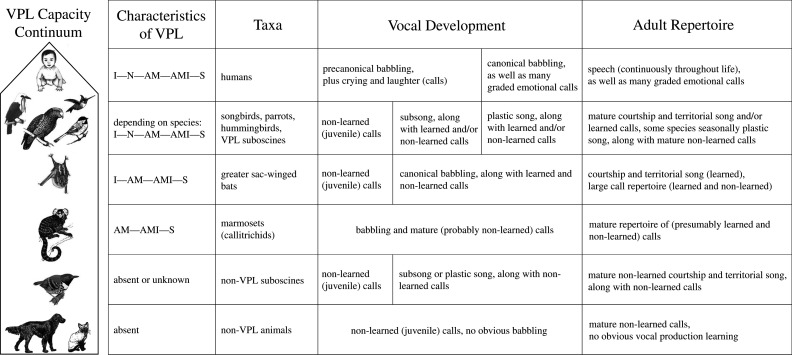
Figure 1.
Figure 1.
A hypothesized comparative summary of relations between babbling and vocal production learning (VPL) in selected taxa. The top four rows represent taxa for which at least some form of vocal learning is known. The first column represents known vocal-learning characteristics. I, imitation; N, incorporation of novel sounds; AM, acoustic modification; AMI, auditory–motor integration; S, social feedback. Columns represent crude developmental stages (width is arbitrary). All vocal learners show a stage of babbling as well as calls, but babbling onset may differ. Although vast numbers of vertebrates produce vocalizations communicatively, many have never been reported to show VPL or babbling. The term ‘calls’ in the figure refers to vocalizations that are communicative already at developmental onset (in contrast to song), with varying amounts of VPL. Calls may or may not be part of babbling depending on the call and the species. Song in songbirds, hummingbirds and greater sac-winged bats is shaped by VPL. The figure summarizes data from a variety of species that appear to support the working hypothesis that babbling or some form of precursor vocalization in infancy may be a requirement for VPL, which often results in complex mature vocal repertoires.

References

    1. Janik VM, Knörnschild M. 2021. Vocal production learning in mammals revisited. Phil. Trans. R. Soc. B 376, 20200244. (10.1098/rstb.2020.0244) - DOI - PMC - PubMed
    1. Goldstein MH, King AP, West MJ. 2003. Social interaction shapes babbling: testing parallels between birdsong and speech. Proc. Natl Acad. Sci. USA 100, 8030-8035. (10.1073/pnas.1332441100) - DOI - PMC - PubMed
    1. Lipkind D, Geambasu A, Levelt CC. 2019. The development of structured vocalizations in songbirds and humans: a comparative analysis. Top. Cogn. Sci. 12, 894-909. (10.1111/tops.12414) - DOI - PubMed
    1. Oller DK, Eilers RE. 1988. The role of audition in infant babbling. Child Dev. 59, 441-449. (10.2307/1130323) - DOI - PubMed
    1. Wöhr M, Schwarting RKW. 2008. Maternal care, isolation-induced infant ultrasonic calling, and their relations to adult anxiety-related behavior in the rat. Behav. Neurosci. 122, 310-330. (10.1037/0735-7044.122.2.310) - DOI - PubMed

Publication types