. 2021 Aug 21:27:41-48.
doi: 10.1016/j.jor.2021.08.009. eCollection 2021 Sep-Oct.

Low dislocation rates with the use of patient specific "Safe zones" in total hip arthroplasty

Affiliations

Low dislocation rates with the use of patient specific "Safe zones" in total hip arthroplasty

Abhinav K Sharma et al. J Orthop. .

Abstract

Introduction: The purpose of this study was to compare patient-specific acetabular cup target orientation using functional simulation to the Lewinnek Safe Zone (LSZ) and determine associated rates of postoperative dislocation.

Methods: A retrospective review of 1500 consecutive primary THAs was performed. Inclination, anteversion, pelvic tilt, pelvic incidence, lumbar flexion, and dislocation rates were recorded.

Results: 56% of dynamically planned cups were within LSZ (p < 0.05). 6/1500 (0.4%) of these cups dislocated at two year follow-up, and all were within LSZ.

Conclusion: Optimal acetabular cup positioning using dynamic imaging differs significantly from historical target parameters but results in low rates of dislocation.

Level of evidence: Level III: Retrospective.

Keywords: Cup positioning; Dislocation; Dynamic imaging; Patient-specific components; Technology; Total hip arthroplasty.


Conflict of interest statement

Abhinav K. Sharma, M.D., declares that he has no conflict of interest. Zlatan Cizmic, M.D., declares that he has no conflict of interest. Douglas A. Dennis, M.D., reports receiving personal fees from Depuy Synthes and 10.13039/100012341Corin Group, stock options in Joint Vue, research support from Depuy Synthes, 10.13039/100012341Corin Group, Porter Adventist Hospital, royalties from Wolters Kluwer publishing, and being a board members for Joint Vue. Stefan W. Kreuzer, M.D., reports receiving personal fees from 10.13039/100012341Corin Group, 10.13039/100009026Smith and Nephew, Medtronic, Pacira, Brain Lab, Intellijoint Surgical, Swift Path, Think Surgical, Shukla, 10.13039/100006338Zimmer/10.13039/100008450Biomet, and Pulse, stock options in Innovative Orthopedic Technologies, INOV8 Orthopedics, INOV8 Surgical, INOV8 Healthcare, K and S Solutions, Orthosensor, Argentum Medical (Silverlon), First Street Surgical Hospital, Texo-Venture, Employers Direct, Alpoza, research support from 10.13039/100012341Corin Group, 10.13039/100009026Smith and Nephew, Depuy, Think Surgical, being a medical/orthopaedic publications governing board member for Journal of Arthroplasty, and being a board member for ISTA, ICJR, Memorial Bone & Joint Research Foundation, Surgical Care Affiliates (Medical Advisory Board), Employers Direct (Medical Advisory Board). Michael A. Miranda, D.O., reports receiving personal fees from 10.13039/100012341Corin Group. Jonathan M. Vigdorchik, M.D., reports receiving personal fees from 10.13039/100012341Corin Group and has received research funding from 10.13039/100012341Corin Group.

Figures

Fig. 1
Fig. 1
Standing lateral radiograph demonstrating spinopelvic measurements. The pelvic incidence (PI) measurement is obtained by drawing a line from the center point of the femoral heads to the center of the superior endplate of S1, with another line drawn perpendicular to the S1 endplate. PI is a constant value, reflective of body morphology after skeletal maturity is reached. The lumbar lordosis (LL) measurement is obtained by measuring the Cobb angle between the superior endplate of L1 and superior endplate of S1. Pelvic tilt (PT) is measured by taking the angle between the two anterior superior iliac spines (or horizontal midpoint between the two if rotated) and the pubic symphysis and a vertical reference line. Lumbar flexion (LF) is calculated by the difference between standing versus flex-seated lumbar lordosis.
Fig. 2
Fig. 2
(a) The nine black points on the Functional Hip Analysis (FHA) report represent the nine supine cup orientation as presented to the arthroplasty surgeon during preoperative evaluation. These orientation options are equivalent to cup orientations of 40° ± 5° inclination and 25° ± 5° anteversion referenced to the coronal plane when standing. The surgeon can toggle between these nine supine cup orientations using interactive buttons on the FHA report to view functional cup orientations during activities hip flexion and extension. Callanan et al.’s safe zone of 30–45° inclination and 5–25° anteversion is displayed within the background of the FHA plot, to be utilized as a reference for target cup orientation. It is not recommended to directly apply this zone when considering cup orientations during flexion and extension. Furthermore, surgeon discretion should always be used with determining target cup orientation as it is possible that some of the nine supine cup orientations may fall outside of Callanan's recommendation. It is prudent for surgeons to use this FHA plot in conjunction with other clinical information in order to determine a prescribed cup orientation. The final decision on target angles should be made by the operating surgeon after thorough consideration of all potential factors that influence cup orientation. (b) Lateral x-rays obtained in functional positions (standing, flexed seated, step-up) can be utilized to analyze patient-specific spinopelvic mobility through the evaluation and measurement of pelvic tilt, sacral slope, and lumbar lordotic angle.
Fig. 3
Fig. 3
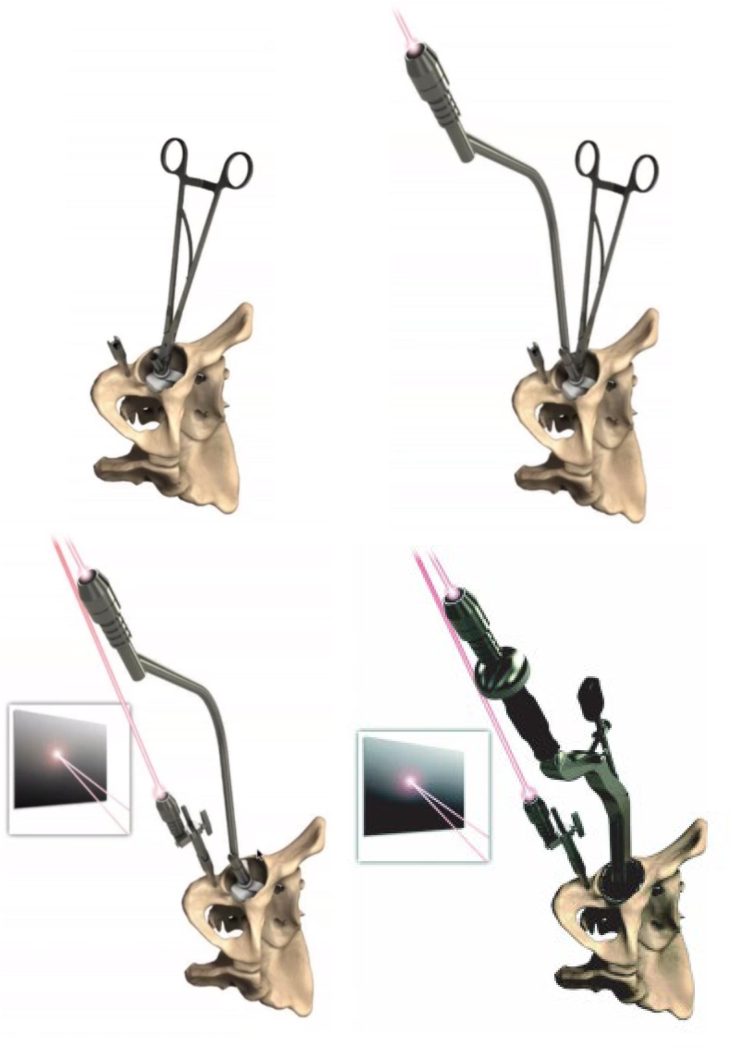
Intraoperatively, a sterile, patient-specific surgical guide is placed within the acetabulum to define the target acetabular orientation and an adjacent pin is placed in the pelvis (either on the ischium or just above the acetabulum) for placement of the pelvic reference laser. A laser is mounted on the guide within the acetabulum and then, a second laser guide is placed on the pelvis. Two laser marks will be visible on the operating room wall or ceiling and the marks are focused until coincident. Once the lasers are aligned, the acetabular guide and laser are removed and acetabular preparation and implantation is performed with the pelvic laser still in place, to be used as a reference. Following cup implantation, a laser is reintroduced and placed on the cup. The laser mark originating from the cup is compared with that from the pelvis to ensure orientation is correct.
Fig. 4
Fig. 4
The distribution of inclination and anteversion of the planned OPS™ Acetabular Cups in comparison to the Lewinnek Safe Zone (LSZ). 56% of the dynamically planned acetabular cups were within the LSZ.

References

    1. Lewinnek G.E., Lewis J.L., Tarr R., Compere C.L., Zimmerman J.R. Dislocations after total hip-replacement arthroplasties. J Bone Joint Surg Am. 1978;60(2):217–220. - PubMed
    1. Abdel M.P., Roth P von, Jennings M.T., Hanssen A.D., Pagnano M.W. What safe zone? The vast majority of dislocated THAs are within the Lewinnek safe zone for acetabular component position. Clin Orthop Relat Res. 2016;474(2):386–391. - PMC - PubMed
    1. Bozic K.J., Katz P., Cisternas M., Ono L., Ries M.D., Showstack J. Hospital resource utilization for primary and revision total hip arthroplasty. J Bone Joint Surg Am. 2005;87(3):570–576. - PubMed
    1. Callanan M.C., Jarrett B., Bragdon C.R. The John Charnley Award: risk factors for cup malpositioning: quality improvement through a joint registry at a tertiary hospital. Clin Orthop Relat Res. 2011;469(2):319–329. - PMC - PubMed
    1. DelSole E.M., Vigdorchik J.M., Schwarzkopf R., Errico T.J., Buckland A.J. Total hip arthroplasty in the spinal deformity population: does degree of sagittal deformity affect rates of safe zone placement, instability, or revision? J Arthroplasty. 2017;32(6):1910–1917. - PubMed