. 2021 Aug 13:15:689675.
doi: 10.3389/fninf.2021.689675. eCollection 2021.

Clinica: An Open-Source Software Platform for Reproducible Clinical Neuroscience Studies

Affiliations

Clinica: An Open-Source Software Platform for Reproducible Clinical Neuroscience Studies

Alexandre Routier et al. Front Neuroinform. .

Abstract

We present Clinica (www.clinica.run), an open-source software platform designed to make clinical neuroscience studies easier and more reproducible. Clinica aims for researchers to (i) spend less time on data management and processing, (ii) perform reproducible evaluations of their methods, and (iii) easily share data and results within their institution and with external collaborators. The core of Clinica is a set of automatic pipelines for processing and analysis of multimodal neuroimaging data (currently, T1-weighted MRI, diffusion MRI, and PET data), as well as tools for statistics, machine learning, and deep learning. It relies on the brain imaging data structure (BIDS) for the organization of raw neuroimaging datasets and on established tools written by the community to build its pipelines. It also provides converters of public neuroimaging datasets to BIDS (currently ADNI, AIBL, OASIS, and NIFD). Processed data include image-valued scalar fields (e.g., tissue probability maps), meshes, surface-based scalar fields (e.g., cortical thickness maps), or scalar outputs (e.g., regional averages). These data follow the ClinicA Processed Structure (CAPS) format which shares the same philosophy as BIDS. Consistent organization of raw and processed neuroimaging files facilitates the execution of single pipelines and of sequences of pipelines, as well as the integration of processed data into statistics or machine learning frameworks. The target audience of Clinica is neuroscientists or clinicians conducting clinical neuroscience studies involving multimodal imaging, and researchers developing advanced machine learning algorithms applied to neuroimaging data.

Keywords: data processing and analysis; machine learning; multimodal neuroimaging data; neuroimaging; pipeline; software.


Conflict of interest statement

The authors declare that the research was conducted in the absence of any commercial or financial relationships that could be construed as a potential conflict of interest.

Figures
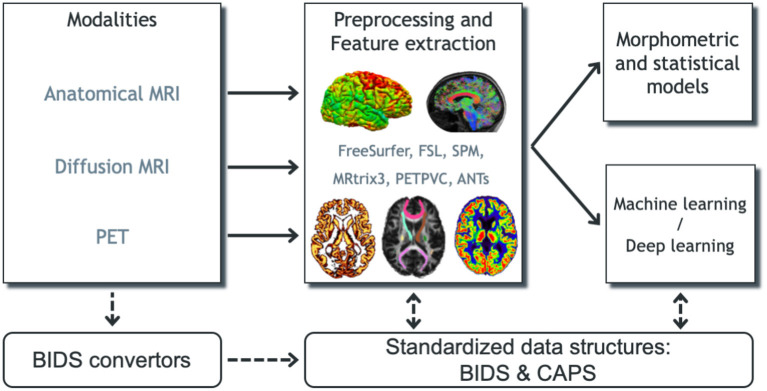
Figure 1
Figure 1
Overview of Clinica's functionalities. Clinica provides processing pipelines for MRI and PET images that involve the combination of different software packages, and whose outputs can be used for statistical or machine learning analysis. Clinica expects data to follow the Brain Imaging Data Structure (BIDS) and provides tools to convert public neuroimaging datasets into the BIDS format. Output data are stored using the ClinicA Processed Structure (CAPS).
Figure 2
Figure 2
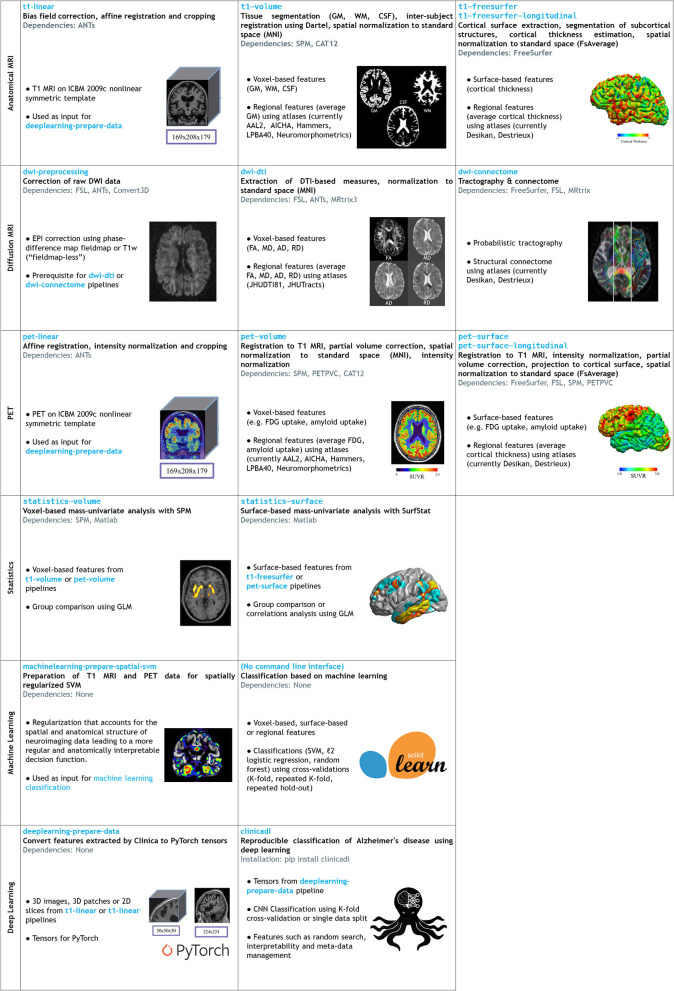
List of the pipelines currently available in Clinica with their dependencies and outputs. Explanations regarding the atlases can be found in section List of Atlases Available in Clinica. GM, gray matter; CSF, cerebrospinal fluid; WM, white matter; FA, fractional anisotropy; MD, mean diffusivity; AD, axial diffusivity; RD, radial diffusivity, SVM, Support Vector Machine; ICBM, International Consortium for Brain Mapping.
Figure 3
Figure 3
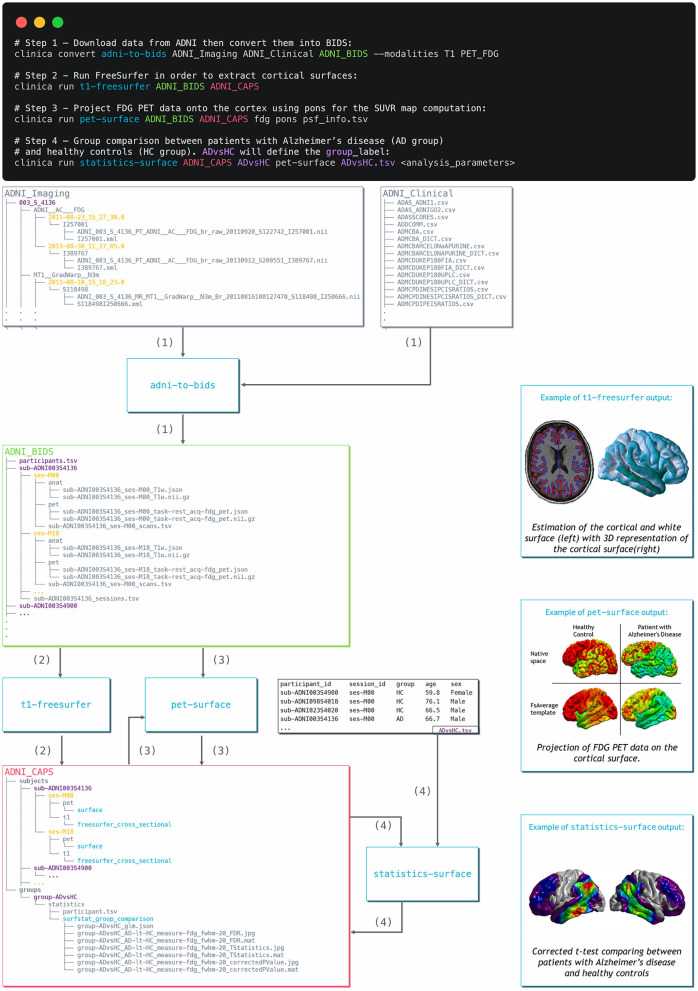
Diagram illustrating the Clinica pipelines involved when performing a group comparison of FDG PET data projected on the cortical surface between patients with Alzheimer's disease and healthy controls from the ADNI database. First, clinical and neuroimaging data are downloaded from the ADNI website and data are converted into BIDS with the adni-to-bids tool from Clinica (1). Estimation of the cortical and white surface is then produced by the t1-freesurfer pipeline in a single command line (2). Afterwards, FDG PET data can be projected on the subject's cortical surface and normalized to the FsAverage template from FreeSurfer using the pet-surface pipeline (3). Finally, a TSV file with demographic information of the population studied is given to the statistics-surface pipeline to generate the results of the group comparison between patients with Alzheimer's disease and healthy controls (4).

References

    1. Abraham A., Pedregosa F., Eickenberg M., Gervais P., Mueller A., Kossaifi J., et al. (2014). Machine learning for neuroimaging with scikit-learn. Front. Neuroinform. 8:14. 10.3389/fninf.2014.00014 - DOI - PMC - PubMed
    1. Andersson J. L. R., Graham M. S., Zsoldos E., Sotiropoulos S. N. (2016). Incorporating outlier detection and replacement into a non-parametric framework for movement and distortion correction of diffusion MR images. Neuroimage 141, 556–572. 10.1016/j.neuroimage.2016.06.058 - DOI - PubMed
    1. Andersson J. L. R., Sotiropoulos S. N. (2016). An integrated approach to correction for off-resonance effects and subject movement in diffusion MR imaging. Neuroimage 125, 1063–1078. 10.1016/j.neuroimage.2015.10.019 - DOI - PMC - PubMed
    1. Ashburner J. (2007). A fast diffeomorphic image registration algorithm. Neuroimage 38, 95–113. 10.1016/j.neuroimage.2007.07.007 - DOI - PubMed
    1. Ashburner J. (2012). SPM: a history. Neuroimage 62, 791–800. 10.1016/j.neuroimage.2011.10.025 - DOI - PMC - PubMed