Review
. 2021 Aug 13:9:683459.
doi: 10.3389/fcell.2021.683459. eCollection 2021.

The Ageing Brain: Molecular and Cellular Basis of Neurodegeneration

Affiliations
Review

The Ageing Brain: Molecular and Cellular Basis of Neurodegeneration

Shofiul Azam et al. Front Cell Dev Biol. .

Abstract

Ageing is an inevitable event in the lifecycle of all organisms, characterized by progressive physiological deterioration and increased vulnerability to death. Ageing has also been described as the primary risk factor of most neurodegenerative diseases, including Alzheimer's disease (AD), Parkinson's disease (PD), Huntington's disease (HD), and frontotemporal lobar dementia (FTD). These neurodegenerative diseases occur more prevalently in the aged populations. Few effective treatments have been identified to treat these epidemic neurological crises. Neurodegenerative diseases are associated with enormous socioeconomic and personal costs. Here, the pathogenesis of AD, PD, and other neurodegenerative diseases has been presented, including a summary of their known associations with the biological hallmarks of ageing: genomic instability, telomere attrition, epigenetic alterations, loss of proteostasis, mitochondrial dysfunction, cellular senescence, deregulated nutrient sensing, stem cell exhaustion, and altered intercellular communications. Understanding the central biological mechanisms that underlie ageing is important for identifying novel therapeutic targets for neurodegenerative diseases. Potential therapeutic strategies, including the use of NAD+ precursors, mitophagy inducers, and inhibitors of cellular senescence, has also been discussed.

Keywords: NAD+; aggregation; inflammation; mitophagy; neurodegenerative diseases.


Conflict of interest statement

The authors declare that the research was conducted in the absence of any commercial or financial relationships that could be construed as a potential conflict of interest.

Figures

FIGURE 1
FIGURE 1
Brain ageing hallmarks and neurological diseases. Ageing represents the combined disruption of several homeostatic processes, including protein aggregation, DNA damage, mitochondrial dysfunction, lysosomal dysfunction, and changes in epigenetic regulation. These changes might be dependent on different cell types and result in the development of various diseases depending on their origins in different brain locations and the pattern of propagation (Created with BioRender.com).
FIGURE 2
FIGURE 2
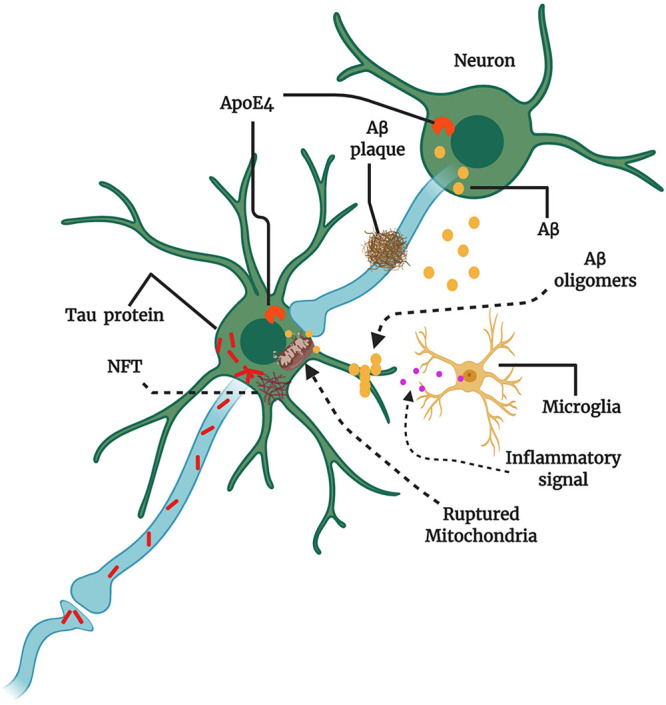
Key players and therapeutic targets in AD pathogenesis. The production of amyloid-beta (Aβ) instead of clearance can cause Aβ oligomerization. Aβ oligomers transmit through synapses, and Aβ plaque formation may hinder synaptic plasticity and transmission. The abundant intracellular Aβ can surround mitochondria and impair mitochondrial function, resulting in the release of reactive oxygen species (ROS), the activation of microglia, and the production of inflammatory signals. Microglial activation can be both beneficial and detrimental depending on the engaged signaling cascade. The protein tau also may aggregate and form large intraneuronal pathogenic aggregates known as neurofibrillary tangles (NFTs). Therapies might target amyloid precursor protein (APP) in the neuronal membrane to reduce Aβ production, increase Aβ clearance from synapses, and reduce Aβ oligomer formation. Apolipoprotein E4 (ApoE4) and tau can also promote Aβ production. Misfolded tau within neurons aggregate into NFTs, and misfolded tau can be transmitted through the synapse to affect other neurons. Therapies could be designed to reduce tau aggregation or misfolding. Multiple factors are involved at various stages of AD progression, damaging neuronal circuits and causing neuronal loss and neurological decline (Conceptualized from 58, Created with BioRender.com).
FIGURE 3
FIGURE 3
Cellular and molecular activities associated with the pathogenesis of PD. Multiple genes have been implicated, either as direct genetic causes of familial Parkinson’s Disease (PD) or as polymorphisms that have been identified as risk factors for the development of sporadic PD. The gene products highlighted here are key to the progress and pathogenesis of PD, although this figure is not exhaustive (Created with BioRender.com).
FIGURE 4
FIGURE 4
Relationship between microglial activation and neuroinflammatory diseases Microglia become activated due to ageing, exogenous or endogenous infection, oxidative stress, and genetic factors, which can lead to neuroinflammation and neurodegeneration. Activated microglia produce excessive reactive oxygen species (ROS) during ageing, triggering the activation of the nuclear factor (NF)-κB signaling cascade. Activated microglia trigger neuroinflammation to promote neuronal damage and cell death. The prevention of microglial activation and the normalization of mitochondrial function represent potential therapeutic strategies (Created with BioRender.com).

References

    1. Agostini F., Dotti C. G., Pérez-Cañamás A., Ledesma M. D., Benetti F., Legname G. (2013). Prion protein accumulation in lipid rafts of mouse aging brain. PLoS One 8:e74244. 10.1371/journal.pone.0074244 - DOI - PMC - PubMed
    1. Aguzzi A., Rajendran L. (2009). The transcellular spread of cytosolic amyloids, prions, and prionoids. Neuron 64 783–790. 10.1016/j.neuron.2009.12.016 - DOI - PubMed
    1. Aliev G., Smith M. A., Seyidov D., Neal M. L., Lamb B. T., Nunomura A., et al. (2002). The role of oxidative stress in the pathophysiology of cerebrovascular lesions in Alzheimer’s disease. Brain Pathol. 12 21–35. 10.1111/j.1750-3639.2002.tb00419.x - DOI - PMC - PubMed
    1. Amor S., Woodroofe M. N. (2014). Innate and adaptive immune responses in neurodegeneration and repair. Immunology 141 287–291. 10.1111/imm.12134 - DOI - PMC - PubMed
    1. Appleby-Mallinder C., Schaber E., Kirby J., Shaw P. J., Cooper-Knock J., Heath P. R., et al. (2021). TDP43 proteinopathy is associated with aberrant DNA methylation in human amyotrophic lateral sclerosis. Neuropathol. Appl. Neurobiol. 47 61–72. 10.1111/nan.12625 - DOI - PubMed

LinkOut - more resources