. 2021 Sep 21;2(9):100405.
doi: 10.1016/j.xcrm.2021.100405. Epub 2021 Aug 31.

Fab and Fc contribute to maximal protection against SARS-CoV-2 following NVX-CoV2373 subunit vaccine with Matrix-M vaccination

Affiliations

Fab and Fc contribute to maximal protection against SARS-CoV-2 following NVX-CoV2373 subunit vaccine with Matrix-M vaccination

Matthew J Gorman et al. Cell Rep Med. .

Abstract

Recently approved vaccines have shown remarkable efficacy in limiting SARS-CoV-2-associated disease. However, with the variety of vaccines, immunization strategies, and waning antibody titers, defining the correlates of immunity across a spectrum of antibody titers is urgently required. Thus, we profiled the humoral immune response in a cohort of non-human primates immunized with a recombinant SARS-CoV-2 spike glycoprotein (NVX-CoV2373) at two doses, administered as a single- or two-dose regimen. Both antigen dose and boosting significantly altered neutralization titers and Fc-effector profiles, driving unique vaccine-induced antibody fingerprints. Combined differences in antibody effector functions and neutralization were associated with distinct levels of protection in the upper and lower respiratory tract. Moreover, NVX-CoV2373 elicited antibodies that functionally targeted emerging SARS-CoV-2 variants. Collectively, the data presented here suggest that a single dose may prevent disease via combined Fc/Fab functions but that two doses may be essential to block further transmission of SARS-CoV-2 and emerging variants.

Keywords: COVID-19; Fc-function; Fc-receptors; SARS-CoV-2; antibodies; correlates; neutralization; prime-boost; vaccination.


Conflict of interest statement

N.P., M.G.-X., J.-H.T., B.Z., S.M., A.M.G., M.J.M., A.D.P., G.G., G.S., and L.E. are current or past employees of Novavax, Inc. and have stock options in the company. G.A. is the founder of SeromYx Systems, Inc. A.L.Z. is a current employee of Moderna, Inc. but conducted this work before employment. The Icahn School of Medicine at Mount Sinai has filed patent applications relating to SARS-CoV-2 serological assays and NDV-based SARS-CoV-2 vaccines, which list F.K. as co-inventor. F.A. is also listed on the serological assay patent application as a co-inventor. Mount Sinai has spun out a company, Kantaro, to market serological tests for SARS-CoV-2. F.K. has consulted for Merck and Pfizer (before 2020) and is currently consulting for Pfizer, Seqirus, and Avimex. The Krammer laboratory is also collaborating with Pfizer on animal models of SARS-CoV-2. Any opinion, findings, and conclusions or recommendations expressed in this material are those of the author(s) and do not necessarily reflect the views of the National Science Foundation. Y.G.-G., R.C., M.J.G., C.A., K.M.P., C.L., D.Y., K.A.B., M.E.M., J.L., D.M., C.M., S.S., F.A., E.O.S, D.L., and M.B.F. declare no competing interest.

Figures
None
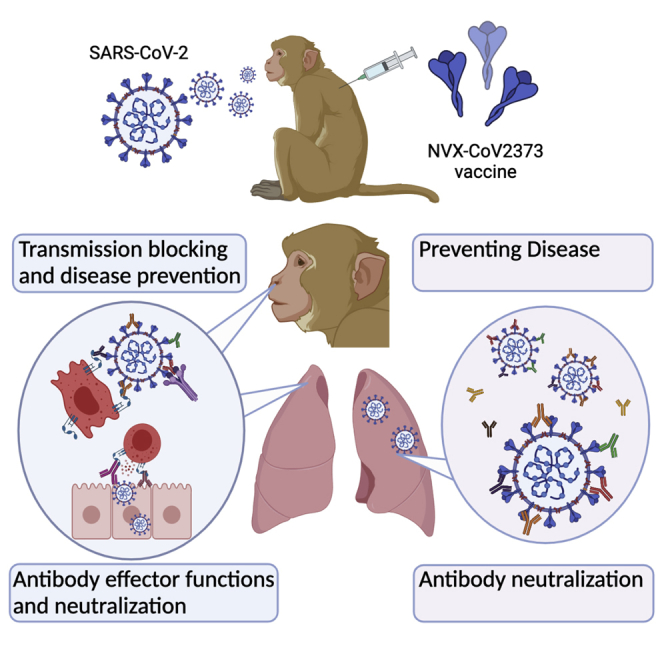
Graphical abstract
Figure 1
Figure 1
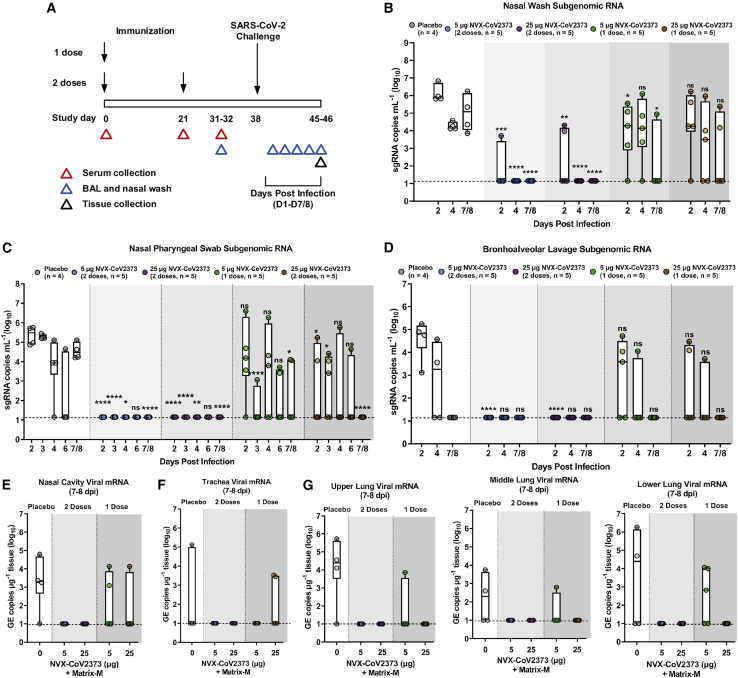
Subgenomic RNA and viral RNA in upper and lower respiratory tract of NVX-CoV2373 immunized rhesus macaques (A) Groups of adult rhesus macaques (n = 4–5/group) were immunized with a single priming dose (study day 0) or a prime/boost regimen (study days 0 and 21) of 5 μg or 25 μg of NVX-CoV2373 with 50-μg of the Matrix-M adjuvant (0.5 mL; intramuscular [IM]). A separate group (n = 4) received formulation buffer (placebo). Immunized and placebo animals were transferred to an animal biosafety level 3 (ABSL-3) containment facility (study day 31/32) and acclimated for 7 days before challenge with a total of 1.05 × 106 plaque-forming units (pfu) of SARS-CoV-2 (USA-WA1/2020 isolate) in 500 μL, divided between the intranasal (IN) and intra-tracheal (IT) routes. Animals were monitored daily for up to 7/8 days post-infection (1–7/8 dpi). Serum sample collection days are indicated by the red triangles. Bronchoalveolar lavage (BAL) sample collection days are indicated by the blue triangles. Necropsy and tissue collection is indicated by the black triangle. Quantitative RT-PCR was used to measure the replicating subgenomic (sg) envelope (E) RNA in nasal washes, nasopharyngeal swabs, and BAL samples collected for up to 7–8 dpi. (B) Nasal washes. (C) Nasopharyngeal swabs. (D) BAL aspirates. (E) SARS-CoV-2 gRNA virus load in the nasal cavity. (F) Trachea virus load. (G) Upper, middle, and lower lobes of the lungs of immunized and placebo-treated animals. In the bar-and-whisker plots, the median is indicated by a horizontal line, the top and bottom of the box indicate the interquartile ranges, and the whiskers indicate the minimum and maximum values. Individual animal values are indicated by the colored symbols. Dashed horizontal lines indicate the limits of detection (LODs). GE copies mL−1, genomic equivalent copies. Significant differences between the placebo group and the immunized groups were determined by the Student’s t test (two-tailed, unpaired). ns, not significant, ∗p ≤ 0.05, ∗∗p ≤ 0.01, ∗∗∗p ≤ 0.001, ∗∗∗∗p ≤ 0.0001.
Figure 2
Figure 2
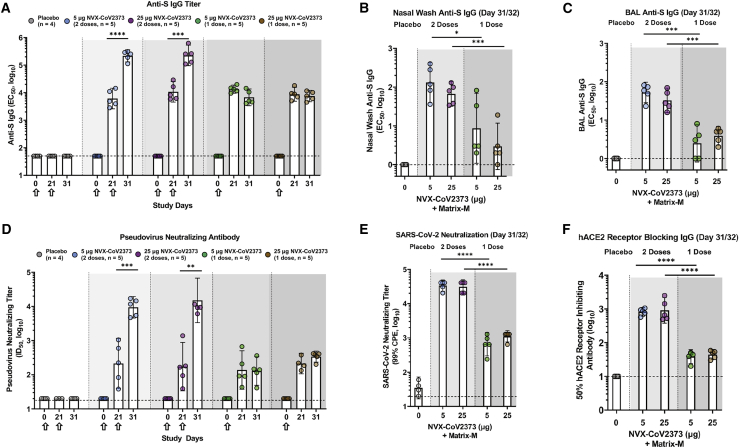
Immunogenicity of NVX-CoV2373 vaccine in rhesus macaques (A–C) Serum anti-spike (S) IgG titer (A), nasal wash (B), and bronchoalveolar lavage (BAL) (C) samples were collected 31/32 days after the first immunization and before challenge and analyzed for S-specific mucosal IgG (n = 4–5/group). (D) Pseudovirus-neutralizing titer (ID50). (E) SARS-CoV-2 neutralizing-antibody titer (99% inhibition of cytopathic effect [99% CPE]) study day 31/32. (F) hACE2 receptor-blocking antibody titer (study day 31/32). The geometric mean titers (GMTs) are indicated by the white bars. Hollow arrows indicate prime/boosting with NVX-CoV2373. The error bars indicate the 95% confidence interval (95% CI). Individual animal values are indicated by colored symbols. A Student’s t test (unpaired, two-tailed) was used to compare antibody levels between groups immunized with one and two doses. ∗p ≤ 0.05, ∗∗p ≤ 0.01, ∗∗∗p ≤ 0.001, ∗∗∗∗p ≤ 0.0001. The horizontal dashed lines indicate the LODs for each assay.
Figure 3
Figure 3
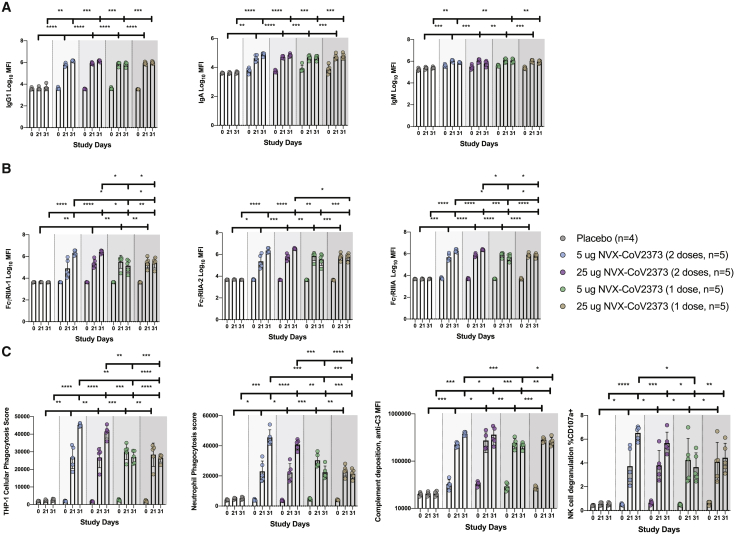
System serology profiling of NVX-CoV2373 immunized rhesus macaques Serum was collected day 21 and day 31/32 after the first dose of NVX-CoV2373 and was profiled for the anti-NVX-CoV2373 antibody response (n = 4–5/group). (A and B) Luminex was used to quantify the (A) antibody isotypes (IgG1, IgA, and IgM) and (B) FcR binding (FcγRIIA-1, FcγRIIA-2, and FcγRIIIA) for the anti-NVX-CoV2373 antibody response. (C) The functional anti-NVX-CoV2373-specific antibody responses for antibody-dependent cellular phagocytosis, antibody-dependent neutrophil phagocytosis, antibody-dependent complement deposition, and antibody-dependent NK degranulation (measured by percentage of CD107). The bars represent the means, and the error bars indicate the SD. Individual animal values are indicated by colored symbols. A two-way ANOVA with Tukey correction for multiple comparisons was used to compare antibody levels between groups. ns, not significant, ∗p ≤ 0.05, ∗∗p ≤ 0.01, ∗∗∗p ≤ 0.001, ∗∗∗∗p ≤ 0.0001.
Figure 4
Figure 4
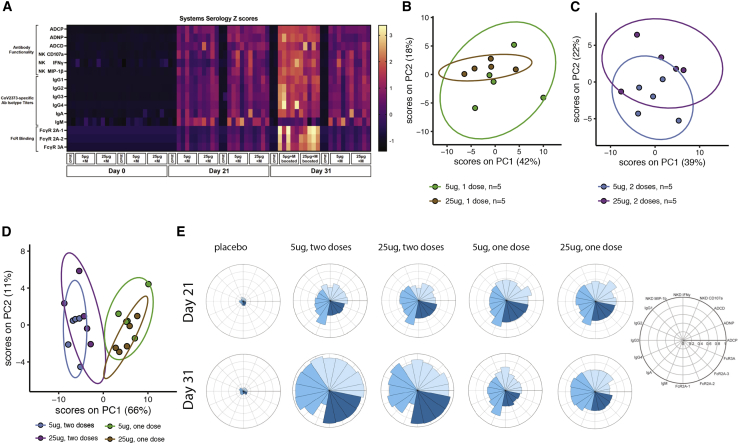
Unique humoral profile of vaccine regimens Multivariate analysis was performed to distinguish the humoral response between the various vaccine regimens (n = 5/group). (A) Heatmap of the humoral response to the SARS-CoV-2 spike. Each column is one NHP and one time point. Each row was Z scored across itself for the entire cohort. (B) Principal component analysis (PCA) of antibody features at day 31/32 showing NHPs that received one 5-μg dose (light blue) or one 25-μg dose (dark blue). Ellipses indicate 90% confidence regions assuming a multivariate t distribution. (C) PCA of antibody features at day 31/32 showing NHPs that received two 5-μg doses (light pink) or two 25-μg doses (dark pink). (D) PCA of antibody features at day 31/32 showing NHPs that received one 5-μg dose (light pink), one 25-μg dose (dark pink), two 5-μg doses (light blue), or two 25-μg doses (dark blue). (E) The radar plots show the median percentile for antibody titer, FcR binding, and antibody function (legend on right) for NHPs treated with placebo, two 5-μg doses, two 25-μg doses, one 5-μg dose, or one 25-μg dose in serum collected on day 21 (top row) and day 31/32 (bottom row).
Figure 5
Figure 5
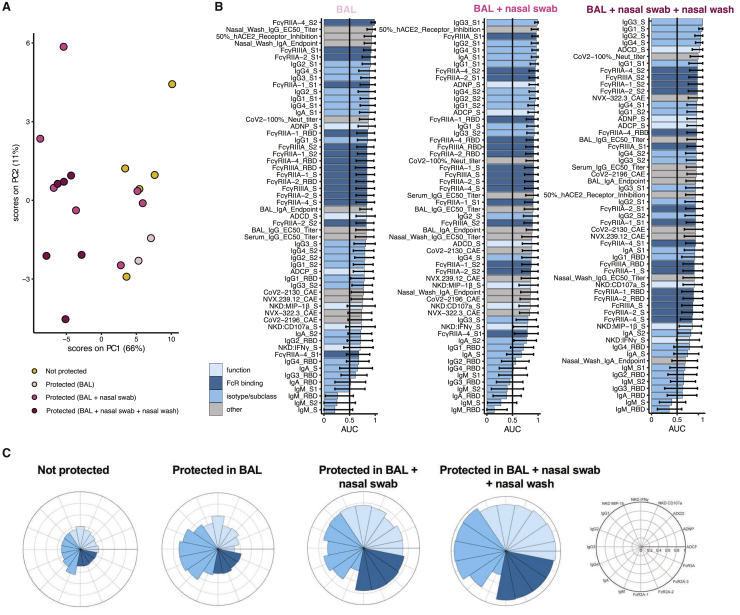
Immune correlates of protection from viral replication Multivariate analysis was performed to identify the features of a protective humoral response. (A) PCA for the immunized NHPs (n = 20, no placebos included) indicating protected (blue) NHPs with no detectable virus in BAL, BAL + nasopharyngeal swab, BAL + nasopharyngeal swab + nasal wash versus non-protected (yellow) NHPs. Ellipses indicate 90% confidence regions, assuming a multivariate t distribution, and are shown for protected and non-protected NHPs. (B) Correlates of protection for BAL (n = 20), nasopharyngeal swab (n = 20), or nasal wash (n = 19) at day 31/32. The area under the curve (AUC) for the receiver operator characteristic (ROC) curve is shown. Error bars indicate the 95% confidence intervals (95% CI) for each antibody feature. (C) The radar plots show the median percentile for antibody titer, FcR binding, and antibody function (legend on right) for non-protected, protected in BAL, protected in BAL + nasopharyngeal swab, or protected in BAL + nasopharyngeal swab + nasal wash NHPs.
Figure 6
Figure 6
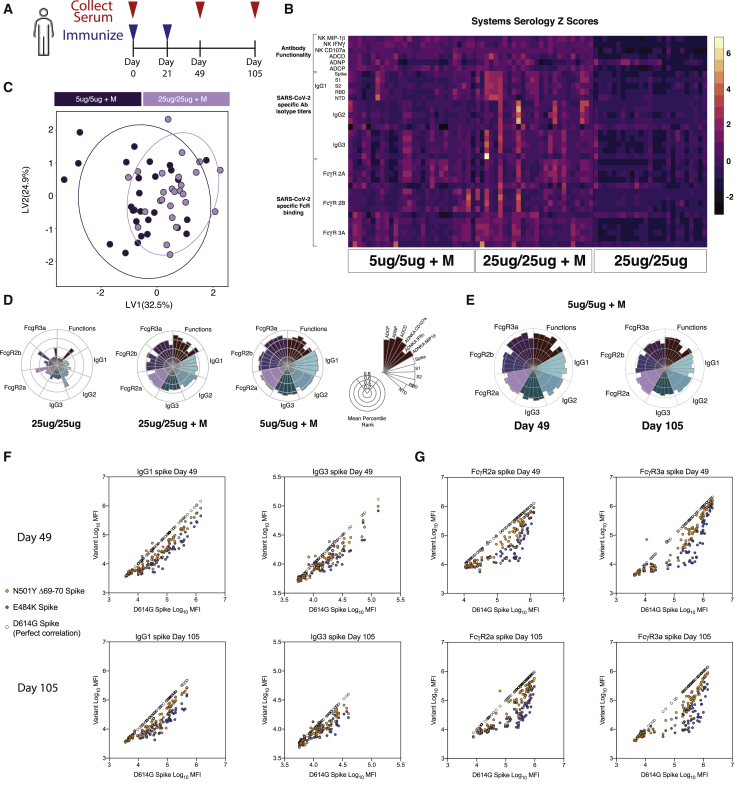
Antibody binding and functionality of human vaccine response against WT and variant SARS-CoV-2 (A) Humans were vaccinated with 25 μg or 5 μg of NVX-CoV2373 with or without adjuvant on days 0 and 21, and serum was collected days 0, 49, and 105; 25 μg/25 μg, n = 25; 25 μg/25 μg + M, n = 26; 5 μg/5 μg + M, n = 28. (B) Heatmap of the humoral response to SARS-CoV-2 spike, S1, S2, receptor-binding domain, and N-terminal domain protein on day 49. Luminex was used to quantify the antibody isotypes (IgG1, IgG2, and IgG3) and FcR (FcγRIIA, FcγRIIB, and FcγRIIIA) binding profiles. Functional responses were quantified against Spike protein. Each column represents an individual, and each row represents one humoral feature Z scored across the row. (C) Partial least-squares discriminant analysis (PLS-DA) plot depicts the multivariate antibody profiles classified by dose in vaccine + adjuvant immunized individuals on day 49. The mean AUC score after 100 trials of 5-fold cross-validation is 0.75. (D) The nightingale rose plots show the median percentile for antibody titer, FcR binding, and antibody function (legend on right) for humans immunized with 25 μg or 5 μg of NVX-CoV2373 with or without adjuvant on day 49. (E) The nightingale rose plots show the median for antibody titer, FcR binding, and antibody function (legend on right) for humans immunized with 5 μg of NVX-CoV2373 + Matrix-M adjuvant on days 49 and 105. (F and G) Luminex was used to quantify the antibody isotypes (IgG1 and IgG3) (F) and FcR binding (FcγRIIA and FcγRIIIA) (G) to the dominant circulating strain (D614G) and to variant N501YΔ69-70 (mutations found in B.1.1.7) and E484K (mutation found in B.1.351) SARS-CoV-2 spike proteins. D614G spike is correlated to itself, generating a perfect correlation (clear circle) to provide a visual reference for theoretically equivalent binding.

Update of

References

    1. Dong E., Du H., Gardner L. An interactive web-based dashboard to track COVID-19 in real time. Lancet Infect. Dis. 2020;20:533–534. - PMC - PubMed
    1. Huff H.V., Singh A. Asymptomatic transmission during the coronavirus disease 2019 pandemic and implications for public health strategies. Clin. Infect. Dis. 2020;71:2752–2756. - PMC - PubMed
    1. Day M. Covid-19: identifying and isolating asymptomatic people helped eliminate virus in Italian village. BMJ. 2020;368:m1165. - PubMed
    1. Meng L., Qiu H., Wan L., Ai Y., Xue Z., Guo Q., Deshpande R., Zhang L., Meng J., Tong C. Intubation and ventilation amid the COVID-19 outbreak: Wuhan’s experience. Anesthesiology. 2020;132:1317–1332. - PMC - PubMed
    1. Polack F.P., Thomas S.J., Kitchin N., Absalon J., Gurtman A., Lockhart S., Perez J.L., Pérez Marc G., Moreira E.D., Zerbini C., C4591001 Clinical Trial Group Safety and efficacy of the BNT162b2 mRNA COVID-19 vaccine. N. Engl. J. Med. 2020;383:2603–2615. - PMC - PubMed

Publication types

MeSH terms

Supplementary concepts