


The ecosystem of apps and software integrated with certified health information technology
- PMID: 34486675
- PMCID: PMC8510286
- DOI: 10.1093/jamia/ocab171
The ecosystem of apps and software integrated with certified health information technology
Abstract
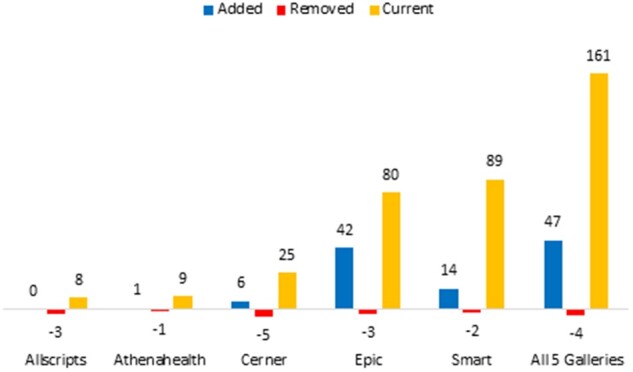
Objective: This study: 1) characterized the app market by EHR app gallery and type of app; 2) tracked changes in the EHR app galleries from the end of 2019 through 2020; and 3) examined how apps connect to EHR data systems, and if the apps support the HL7 FHIR standard.
Materials and methods: We developed a program that gathered data from the public app galleries hosted by Allscripts, athenahealth, Cerner Corporation, Epic Systems Corporation, and SMART. Data collection for this study began in December 2019 and ended December 2020. The program was run 11 times during this period, and the data collected were used to generate the findings and trends observed in this study.
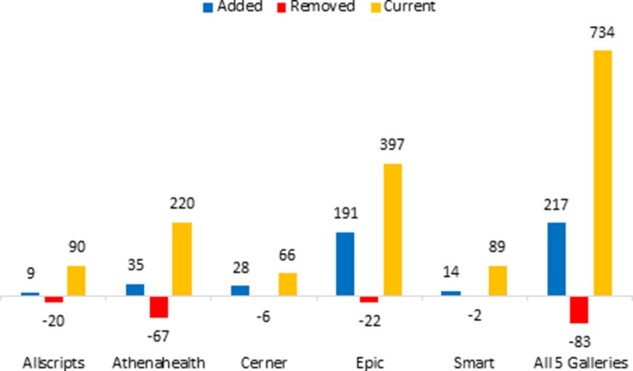
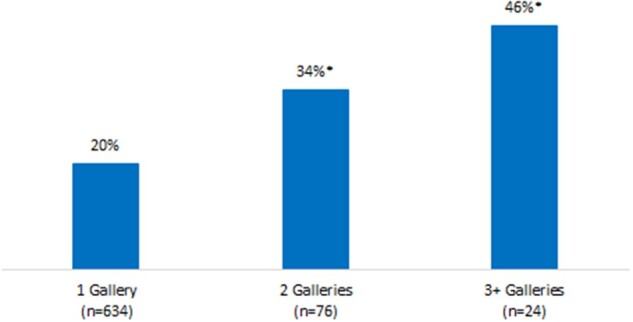
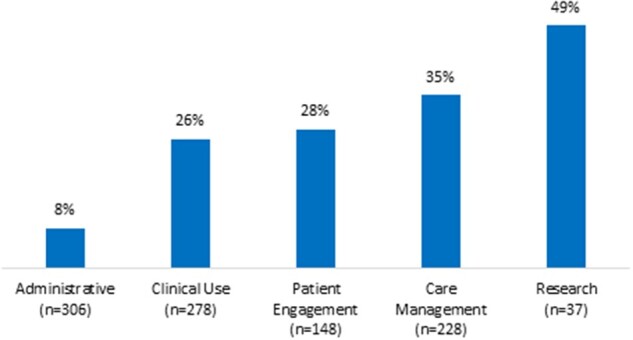
Results: The total number of unique apps increased from 600 to 734 during the study period. The most common types of apps marketed were intended for administrative (42%) and clinical use (38%). About 1 in 5 apps (22%) described support for the FHIR standard. Support for FHIR varied by intended functionality and gallery.
Discussion: This study provides early insights into the number of third-party apps that are connecting to EHRs, what services they provide, and if these connections use standards-based application programming interfaces (APIs).
Conclusion: It is a federal government priority to improve the access and use of electronic health information, including third-party apps that can introduce competition as well as best-of-breed functions and user experiences. This study shows that there is room for growth, and variation exists among some of the largest EHR developers.
Keywords: APIs; FHIR; apps; health IT; interoperability.
Published by Oxford University Press on behalf of the American Medical Informatics Association 2021.
Figures
References
-
- Office of the National Coordinator for Health IT. Accelerating Application Programing Interfaces for Scientific Discovery: Research Perspectives; March 2021. https://www.healthit.gov/sites/default/files/page/2021-03/Accelerating-A...Accessed July 21, 2021
-
- 21st Century Cures Act, section 4006. https://www.gpo.gov/fdsys/pkg/PLAW-114publ255/pdf/PLAW-114publ255.pdfAccessed February 19, 2021
-
- 21st Century Cures Act: Interoperability, Information Blocking, and the ONC Health IT Certification Program. 85 FR 25642. https://www.federalregister.gov/documents/2020/05/01/2020-07419/21st-cen...Accessed February 19, 2021
-
- Posnack S, Barker W. Heat Wave: The US is Poised to Catch FHIR in 2019; October 1, 2018. https://www.healthit.gov/buzz-blog/interoperability/heat-wave-the-u-s-is...Accessed February 19, 2021
-
- The MITRE Corporation. A Robust Health Data Infrastructure. AHRQ Publication No. 14-0041-EF; April 2014. https://www.healthit.gov/sites/default/files/ptp13-700hhs_white.pdfAccessed February 19, 2021
