


Risk, demand, capacity and outcomes in adult specialist eating disorder services in South-East of England before and since COVID-19
- PMID: 34486966
- PMCID: PMC9074142
- DOI: 10.1192/bjb.2021.73
Risk, demand, capacity and outcomes in adult specialist eating disorder services in South-East of England before and since COVID-19
Abstract
Aims and method: This is a longitudinal cohort study describing the demand, capacity and outcomes of adult specialist eating disorder in-patient services covering a population of 3.5 million in a South-East England provider collaborative before and since the COVID-19 pandemic, between July 2018 and March 2021.
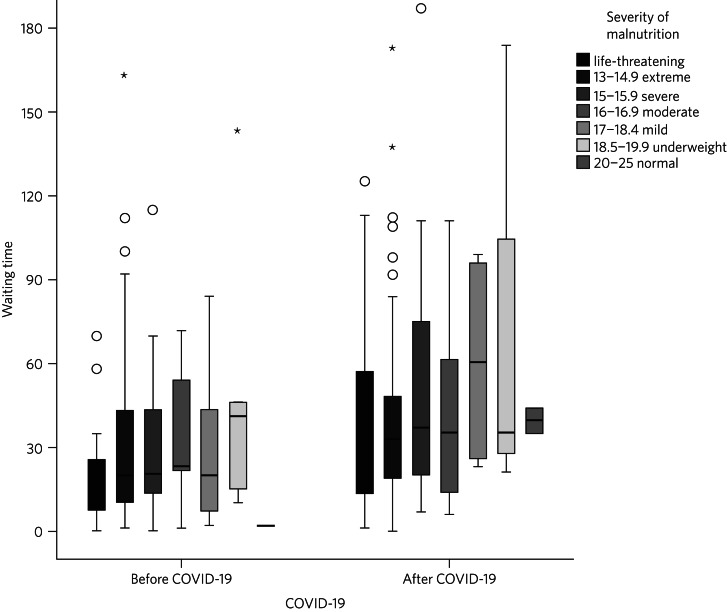
Results: There were 351 referrals for admission; 97% were female, 95% had a diagnosis of anorexia nervosa and 19% had a body mass index (BMI) <13. Referrals have increased by 21% since the start of pandemic, coinciding with reduced capacity. Waiting times have increased from 33 to 46 days. There were significant differences in outcomes between providers. A novel, integrated enhanced cognitive behaviour theapy treatment model showed a 25% reduction in length of stay and improved BMI on discharge (50% v. 16% BMI >19), compared with traditional eclectic in-patient treatment.
Clinical implications: Integrated enhanced cognitive behaviour theapy reduced length of stay and improved outcomes, and can offer more effective use of healthcare resources.
Keywords: Anorexia nervosa; COVID-19; access and waiting times; eating disorders; in-patient treatment.
Conflict of interest statement
None.
Figures
References
-
- NHS Digital. Health Survey for England, 2019: Data Tables. NHS Digital, 2020 (https://digital.nhs.uk/data-and-information/publications/statistical/hea...).
-
- McManus SM, Howard ., Brugha T, Bebbington P, Jenkins R. Adult Psychiatric Morbidity in England, 2007: Results of a Household Survey. The Health and Social Care Information Centre, 2007. (https://digital.nhs.uk/data-and-information/publications/statistical/adu...).
-
- Galmiche M, Dechelotte P, Lambert G, Tavolacci MP. Prevalence of eating disorders over the 2000–2018 period: a systematic literature review. Am J Clin Nutr 2019; 109(5): 1402–13. - PubMed
-
- NHS Digital. Finished Admission Episodes (FAEs) with a Primary or Secondary Diagnosis of Eating Disorder. NHS Digital, 2018 (https://digital.nhs.uk/data-and-information/find-data-and-publications/s...).
-
- Ayton A. Investment in training, evidence based treatment, and research are necessary to prevent future deaths in eating disorders. BMJ 2020; 371: m4689. - PubMed
LinkOut - more resources
Full Text Sources
