. 2021 Sep 6;11(1):126.
doi: 10.1186/s13568-021-01289-3.

Potential of Variovorax paradoxus isolate BFB1_13 for bioremediation of BTEX contaminated sites

Affiliations

Potential of Variovorax paradoxus isolate BFB1_13 for bioremediation of BTEX contaminated sites

Tibor Benedek et al. AMB Express. .

Abstract

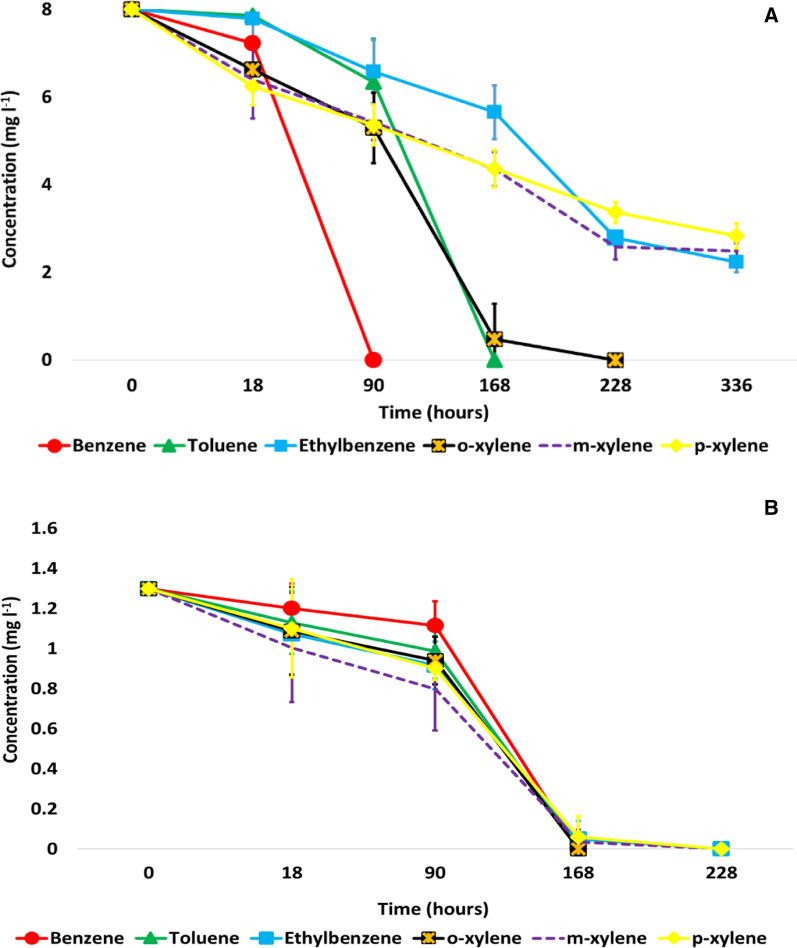
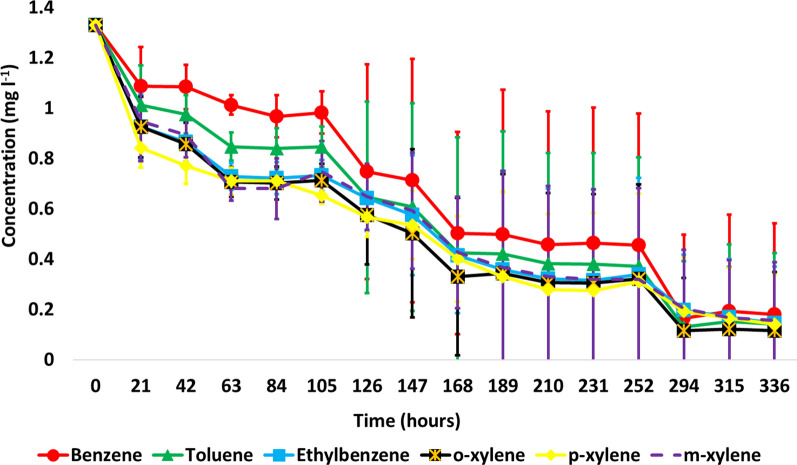
Here, we report and discuss the applicability of Variovorax paradoxus strain BFB1_13 in the bioremediation of BTEX contaminated sites. Strain BFB1_13 was capable of degrading all the six BTEX-compounds under both aerobic (O2 conc. 8 mg l-1) and micro-aerobic/oxygen-limited (O2 conc. 0.5 mg l-1) conditions using either individual (8 mg‧l-1) or a mixture of compounds (~ 1.3 mg‧l-1 of each BTEX compound). The BTEX biodegradation capability of SBP-encapsulated cultures (SBP-Small Bioreactor Platform) was also assessed. The fastest degradation rate was observed in the case of aerobic benzene biodegradation (8 mg l-1 per 90 h). Complete biodegradation of other BTEX occurred after at least 168 h of incubation, irrespective of the oxygenation and encapsulation. No statistically significant difference was observed between aerobic and microaerobic BTEX biodegradation. Genes involved in BTEX biodegradation were annotated and degradation pathways were predicted based on whole-genome shotgun sequencing and metabolic analysis. We conclude that V. paradoxus strain BFB1_13 could be used for the development of reactive biobarriers for the containment and in situ decontamination of BTEX contaminated groundwater plumes. Our results suggest that V. paradoxus strain BFB1_13-alone or in co-culture with other BTEX degrading bacterial isolates-can be a new and efficient commercial bioremediation agent for BTEX contaminated sites.

Keywords: BTEX; Biobarrier; SBP encapsulation; Variovorax paradoxus; WGS.


Conflict of interest statement

The authors declare that they have no conflict of interest.

Figures
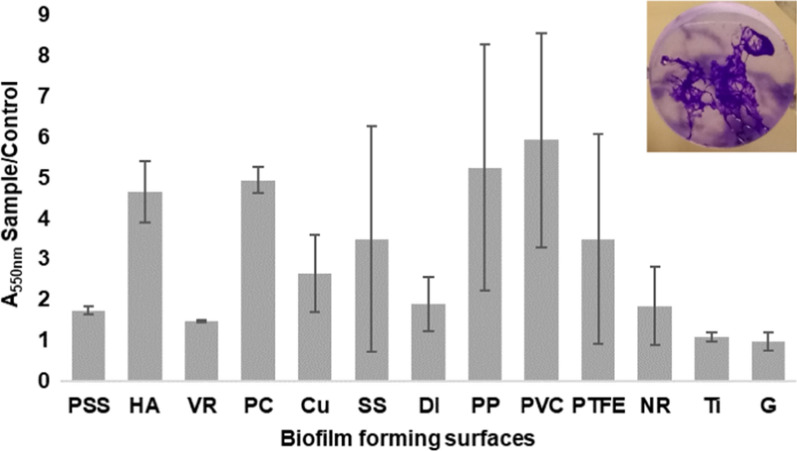
Fig. 1
Fig. 1
Biofilm forming ability of V. paradoxus strain BFB1_13 on polished stainless steel (PSS), hydroxyapatite (HA), viton rubber (VR), polycarbonate (PC), copper (Cu), stainless steel (SS), ductile iron (DI), polypropylene (PP), polyvinyl chloride (PVC), polytetrafluoroethylene (PTFE), natural rubber (NR), titanium (Ti) and glass (G). The ratio of absorbance values obtained at 550 nm (A550nm) of biofilm containing coupons (Sample) and abiotic control coupons (Control) is shown. A crystal-violet stained biofilm of strain BFB1_13, developed on polycarbonate surface is shown in the top right-hand corner. The average of three replicates is shown, error bars represent standard deviations (STD)
Fig. 2
Fig. 2
Individual (A) and BTEX mixture (B) degradation ability of V. paradoxus strain BFB1_13 under aerobic conditions
Fig. 3
Fig. 3
Fitted models of the degradation processes of the six BTEX compounds in the aerobic and micro-aerobic systems. Parameters of the models are displayed in Additional file 1: Table S2
Fig. 4
Fig. 4
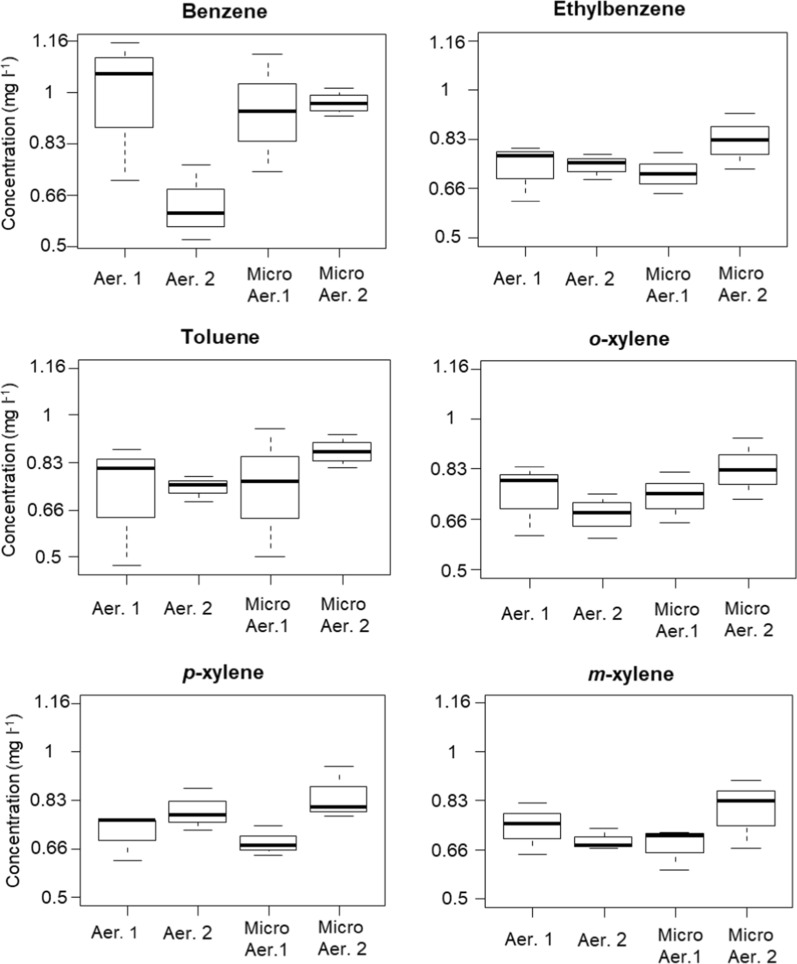
Boxplots showing median BTEX concentrations measured at the 168th hour of the first and second aerobic and micro-aerobic BTEX degradation experiments. Aer 1 and Micro Aer 1 median BTEX concentration values from the first aerobic and micro-aerobic experiments (microcosm experiment No 2); Aer 2 and Micro Aer 2 median BTEX concentration values from the second experiment (microcosm experiment No 3)
Fig. 5
Fig. 5
BTEX mixture biodegradation capacity of the SBP-encapsulated V. paradoxus strain BFB1_13
Fig. 6
Fig. 6
Physical map of the complete toluene 4-monooxygenase (T4MO) and the first phenol-2-hydroxylase (I. P2H) encoding gene clusters followed by genes involved in the “lower”-pathway of toluene/p-xylene metabolism. The putative functions of enzymes encoded by the genes were predicted as follows: orf1 T4MO subunit tmoF, orf2 T4MO subunit tmoE, orf3 T4MO subunit tmoD, orf4 T4MO subunit tmoC, orf5 T4MO subunit tmoB, orf6 T4MO subunit tmoA; orf7 hypothetical protein, orf8 2-hydroxy-muconate tautomerase, orf9 4-oxalocrotonate decarboxylase, orf10 2-hydroxy-2-oxovalerate aldolase, orf11 acetaldehyde-CoA dehydrogenase, orf12 oxidoreductase, short chain dehydrogenase, orf13 2-keto-4-pentenoate hydratase, orf14 2-hydroxymuconic semialdehyde dehydrogenase, orf15 uncharacterized protein, orf16 catechol 2,3-dioxygenase (xylE), orf17 P2H P5 protein (dmpP), orf18 P2H P4 protein (dmpO), orf19 P2H P3 protein (dmpN), orf20 P2H P2 protein (dmpM), orf21 P2H P1 protein (dmpL), orf22 P2H P0 protein (dmpK)

References

    1. Abumaizar RJ, Kocher W, Smith EH. Biofiltration of BTEX contaminated air streams using compost-activated carbon filter media. J Hazard Mater. 1998;60:111–126. doi: 10.1016/S0304-3894(97)00046-0. - DOI
    1. Al-Sabahi J, Bora T, Al-Abri M, Dutta J. Efficient visible light photocatalysis of benzene, toluene, ethylbenzene and xylene (BTEX) in aqueous solutions using supported zinc oxide nanorods. PLoS ONE. 2017 doi: 10.1371/journal.pone.0189276. - DOI - PMC - PubMed
    1. Andreoni V, Gianfreda L. Bioremediation and monitoring of aromatic-polluted habitats. Appl Microbiol Biotechnol. 2007;76:287–308. doi: 10.1007/s00253-007-1018-5. - DOI - PubMed
    1. Atlas RM, Philp J (2005) Bioremediation: applied microbial solutions for real-world environmental cleanup. Edited by Atlas RM, Philp J. ASM Press, Washington
    1. Azaizeh H, Kurzbaum E, Said O, Jaradat H, Menashe O. The potential of autochthonous microbial culture encapsulation in a confined environment for phenol biodegradation. Environ Sci Pollut Res. 2015;22:15179–15187. doi: 10.1007/s11356-015-4981-x. - DOI - PubMed

LinkOut - more resources