


Economic impact of tuberculosis mortality in 120 countries and the cost of not achieving the Sustainable Development Goals tuberculosis targets: a full-income analysis
- PMID: 34487685
- PMCID: PMC8415897
- DOI: 10.1016/S2214-109X(21)00299-0
Economic impact of tuberculosis mortality in 120 countries and the cost of not achieving the Sustainable Development Goals tuberculosis targets: a full-income analysis
Erratum in
-
Correction to Lancet Glob Health 2021; 9: e1372-79.Lancet Glob Health. 2021 Nov;9(11):e1507. doi: 10.1016/S2214-109X(21)00445-9. Epub 2021 Sep 21. Lancet Glob Health. 2021. PMID: 34559994 Free PMC article. No abstract available.
Abstract
Background: The tuberculosis targets for the UN Sustainable Development Goals (SDGs) call for a 90% reduction in tuberculosis deaths by 2030, compared with 2015, but meeting this target now seems highly improbable. To assess the economic impact of not meeting the target until 2045, we estimated full-income losses in 120 countries, including those due to excess deaths resulting from COVID-19-related disruptions to tuberculosis services, for the period 2020-50.
Methods: Annual mortality risk changes at each age in each year from 2020 to 2050 were estimated for 120 countries. This risk change was then converted to full-income risk by calculating a population-level mortality risk change and multiplying it by the value of a statistical life-year in each country and year. As a comparator, we assumed that current rates of tuberculosis continue to decline through the period of analysis. We calculated the full-income losses, and mean life expectancy losses per person, at birth and at age 35 years, under scenarios in which the SDG targets are met in 2030 and in 2045. We defined the cost of inaction as the difference in full-income losses and tuberculosis mortality between these two scenarios.
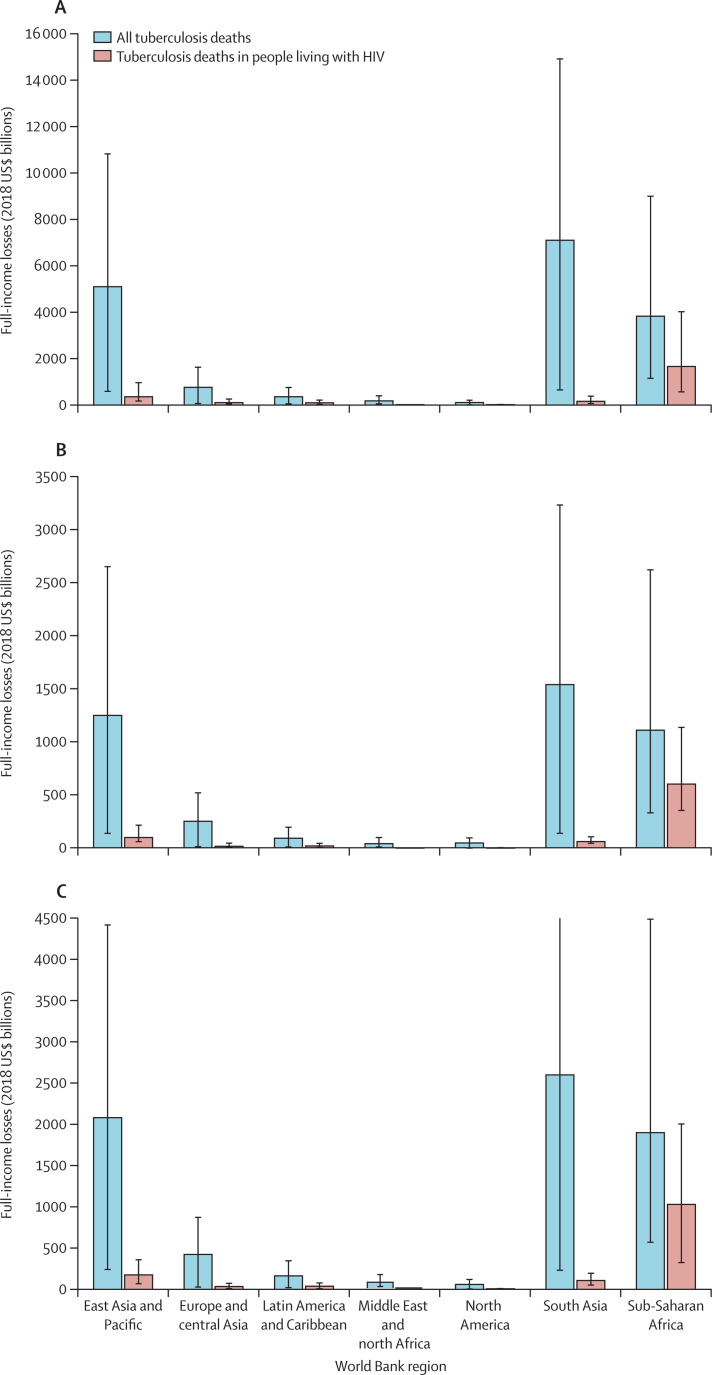
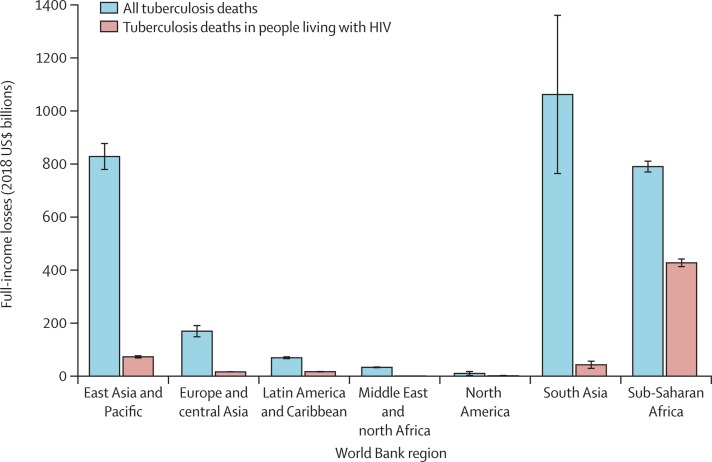
Findings: From 2020 to 2050, based on the current annual decrease in tuberculosis deaths of 2%, 31·8 million tuberculosis deaths (95% uncertainty interval 25·2 million-39·5 million) are estimated to occur, corresponding to an economic loss of US$17·5 trillion (14·9 trillion-20·4 trillion). If the SDG tuberculosis mortality target is met in 2030, 23·8 million tuberculosis deaths (18·9 million-29·5 million) and $13·1 trillion (11·2 trillion-15·3 trillion) in economic losses can be avoided. If the target is met in 2045, 18·1 million tuberculosis deaths (14·3 million-22·4 million) and $10·2 trillion (8·7 trillion-11·8 trillion) can be avoided. The cost of inaction of not meeting the SDG tuberculosis mortality target until 2045 (vs 2030) is, therefore, 5·7 million tuberculosis deaths (5·1 million-8·1 million) and $3·0 trillion (2·5 trillion-3·5 trillion) in economic losses. COVID-19-related disruptions add $290·3 billion (260·2 billion-570·1 billion) to this cost.
Interpretation: Failure to achieve the SDG tuberculosis mortality target by 2030 will lead to profound economic and health losses. The effects of delay will be greatest in sub-Saharan Africa. Affected countries, donor nations, and the private sector should redouble efforts to finance tuberculosis programmes and research because the economic dividend of such strategies is likely to be substantial.
Funding: None.
Copyright © 2021 The Author(s). Published by Elsevier Ltd. This is an Open Access article under the CC BY 4.0 license. Published by Elsevier Ltd.. All rights reserved.
Conflict of interest statement
Declaration of interests We declare no competing interests.
Figures
Comment in
-
The incalculable costs of tuberculosis.Lancet Glob Health. 2021 Oct;9(10):e1337-e1338. doi: 10.1016/S2214-109X(21)00345-4. Epub 2021 Sep 3. Lancet Glob Health. 2021. PMID: 34487684 Free PMC article. No abstract available.
-
The COVID pandemic must lead to tuberculosis vaccines.Nature. 2021 Oct;598(7882):540. doi: 10.1038/d41586-021-02892-x. Nature. 2021. PMID: 34707314 No abstract available.
References
-
- Reid MJA, Arinaminpathy N, Bloom A. Building a tuberculosis-free world: the Lancet Commission on tuberculosis. Lancet. 2019;393:1331–1384. - PubMed
MeSH terms
Grants and funding
LinkOut - more resources
Full Text Sources
Medical
Research Materials
Miscellaneous
