


Norovirus transmission mitigation strategies during simulated produce harvest and packing
- PMID: 34488004
- PMCID: PMC8510003
- DOI: 10.1016/j.ijfoodmicro.2021.109365
Norovirus transmission mitigation strategies during simulated produce harvest and packing
Abstract
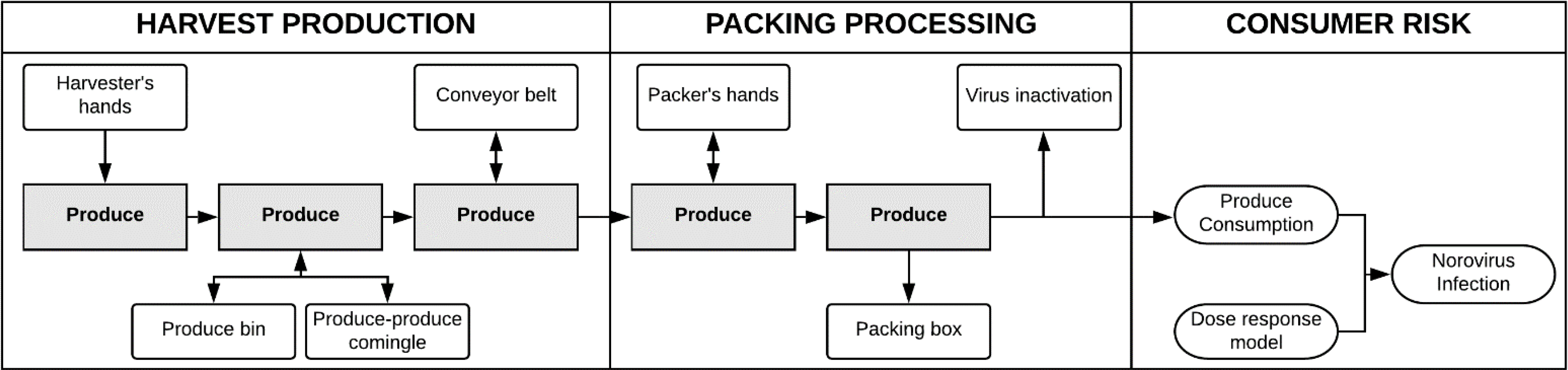
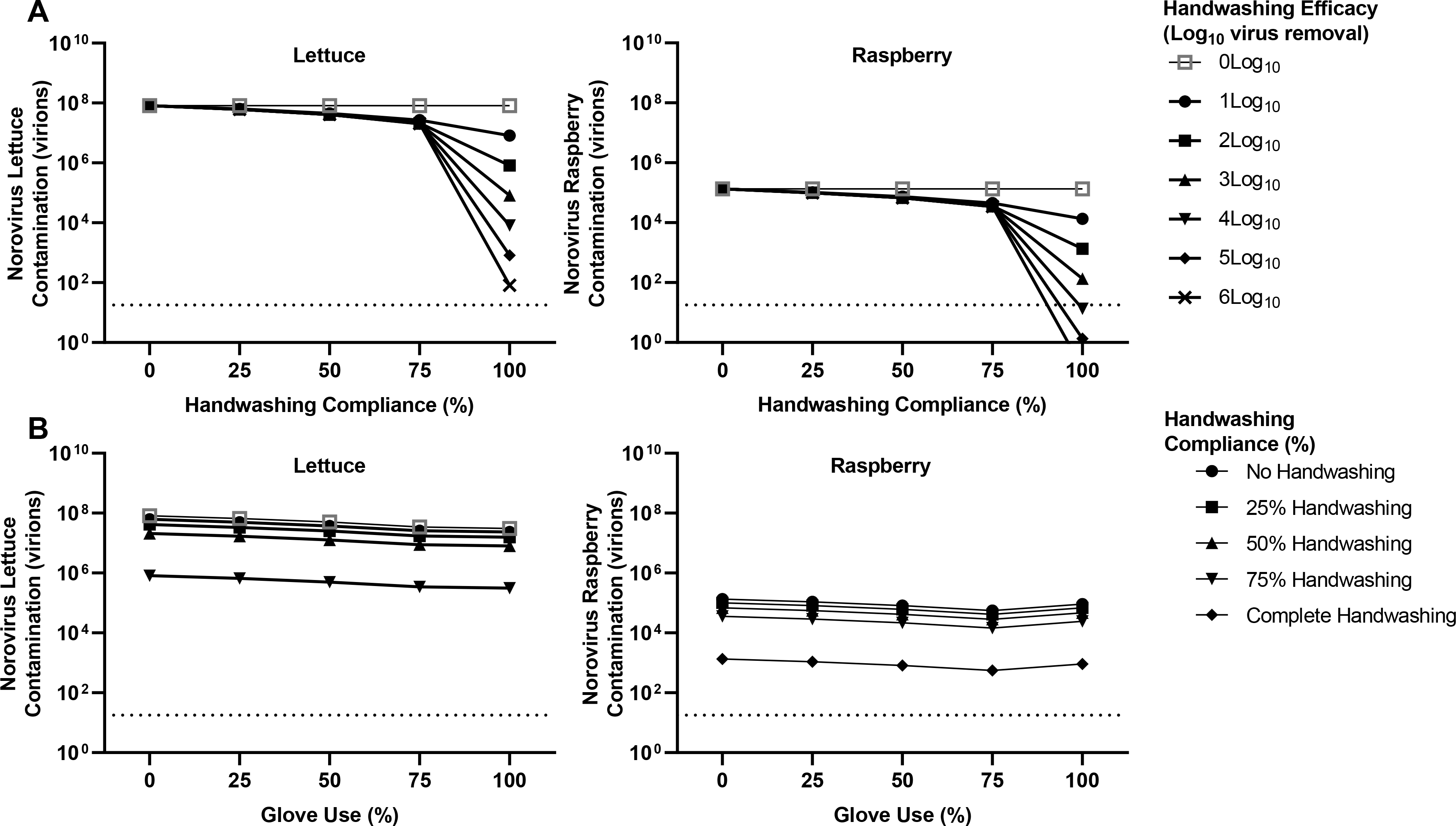
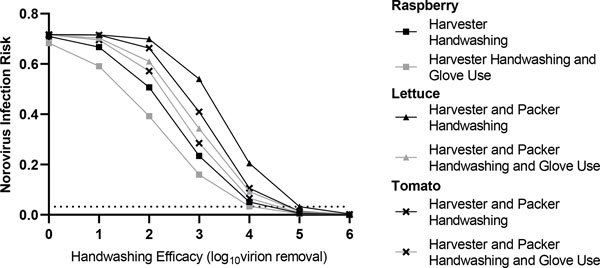
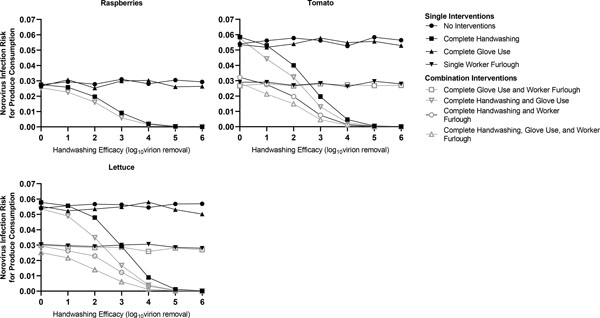
In the agricultural setting, core global food safety elements, such as hand hygiene and worker furlough, should reduce the risk of norovirus contamination on fresh produce. However, the effect of these practices has not been characterized. Using a quantitative microbial risk model, we evaluated the individual and combined effect of farm-based hand hygiene and worker furlough practices on the maximum risk of norovirus infection from three produce commodities (open leaf lettuce, vine tomatoes, and raspberries). Specifically, we tested two scenarios where a harvester's and packer's norovirus infection status was: 1) assumed positive; or 2) assigned based on community norovirus prevalence estimates. In the first scenario with a norovirus-positive harvester and packer, none of the individual interventions modeled reduced produce contamination to below the norovirus infectious dose. However, combined interventions, particularly high handwashing compliance (100%) and efficacy (6 log10 virus removal achieved using soap and water for 30 s), reduced produce contamination to <1-82 residual virus. Translating produce contamination to maximum consumer infection risk, 100% handwashing with a 5 log10 virus removal was necessary to achieve an infection risk below the threshold of 0.032 infections per consumption event. When community-based norovirus prevalence estimates were applied to the harvester and packer, the single interventions of 100% handwashing with 3 log10 virus removal (average 0.02 infection risk per consumption event) or furlough of the packer (average 0.03 infection risk per consumption event) reduced maximum infection risk to below the 0.032 threshold for all commodities. Bundled interventions (worker furlough, 100% glove compliance, and 100% handwashing with 1-log10 virus reduction) resulted in a maximum risk of 0.02 per consumption event across all commodities. These results advance the evidence-base for global produce safety standards as effective norovirus contamination and risk mitigation strategies.
Keywords: Foodborne illness; Hand hygiene; Produce microbial safety; Quantitative microbial risk model.
Copyright © 2021 Elsevier B.V. All rights reserved.
Conflict of interest statement
Declaration of interests
The authors declare that they have no known competing financial interests or personal relationships that could have appeared to influence the work reported in this paper.
Figures
References
-
- Ailes EC, Leon JS, Jaykus LA, Johnston LM, Clayton HA, Blanding S, Kleinbaum DG, Backer LC, Moe CL, 2008. Microbial concentrations on fresh produce are affected by postharvest processing, importation, and season. J Food Prot 71, 2389–2397. - PubMed
-
- Barker J, Vipond IB, Bloomfield SF, 2004. Effects of cleaning and disinfection in reducing the spread of Norovirus contamination via environmental surfaces. Journal of Hospital Infection 58, 42–49. - PubMed
MeSH terms
Grants and funding
LinkOut - more resources
Full Text Sources
Medical
