. 2021 Sep 6;19(1):265.
doi: 10.1186/s12951-021-01003-2.

NIR-II-driven and glutathione depletion-enhanced hypoxia-irrelevant free radical nanogenerator for combined cancer therapy

Affiliations

NIR-II-driven and glutathione depletion-enhanced hypoxia-irrelevant free radical nanogenerator for combined cancer therapy

Li Zhang et al. J Nanobiotechnology. .

Abstract

Background: Though the combination of photodynamic therapy (PDT) and chemodynamic therapy (CDT) appears to be very attractive in cancer treatment, hypoxia and overproduced glutathione (GSH) in the tumor microenvironment (TME) limit their efficacy for further application.

Results: In this work, a smart hypoxia-irrelevant free radical nanogenerator (AIPH/PDA@CuS/ZIF-8, denoted as APCZ) was synthesized in situ via coating copper sulphide (CuS)-embedded zeolitic imidazolate framework-8 (ZIF-8) on the free radical initiator 2,2'-azobis[2-(2-imidazolin-2-yl)propane]-dihydrochloride (AIPH)-loaded polydopamine (PDA). APCZ showed promising GSH-depleting ability and near-infrared (NIR)-II photothermal performance for combined cancer therapy. Once internalized by 4T1 cells, the outer ZIF-8 was rapidly degraded to trigger the release of CuS nanoparticles (NPs), which could react with local GSH and sequentially hydrogen peroxide (H2O2) to form hydroxyl radical (·OH) for CDT. More importantly, the hyperthermia generated by APCZ upon 1064 nm laser excitation not only permitted NIR-II photothermal therapy (PTT) and promoted CDT, but also triggered the decomposition of AIPH to give toxic alkyl radical (·R) for oxygen-independent PDT. Besides, the PDA together with CuS greatly decreased the GSH level and resulted in significantly enhanced PDT/CDT in both normoxic and hypoxic conditions. The tumors could be completely eradicated after 14 days of treatment due to the prominent therapeutic effects of PTT/PDT/CDT. Additionally, the feasibility of APCZ as a photoacoustic (PA) imaging contrast agent was also demonstrated.

Conclusions: The novel APCZ could realize the cooperative amplification effect of free radicals-based therapies by NIR-II light excitation and GSH consumption, and act as a contrast agent to improve PA imaging, holding tremendous potential for efficient diagnosis and treatment of deep-seated and hypoxic tumors.

Keywords: Alkyl radical; Glutathione-depleting; Hydroxyl radical; Hypoxia-irrelevant; NIR-II photothermal therapy.


Conflict of interest statement

The authors declare that they have no competing interests.

Figures

Scheme 1
Scheme 1
Schematic illustration of the preparation of APCZ and its application in PA imaging and synergistic NIR-II PTT/PDT/CDT
Fig. 1
Fig. 1
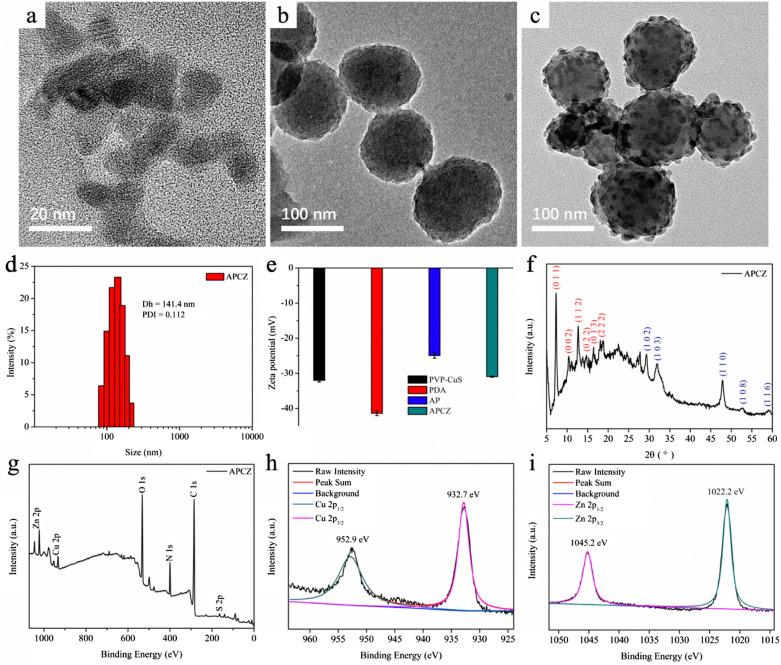
TEM images of a PVP-CuS, b AP and c APCZ. d Hydrodynamic diameter and size distribution of APCZ. e Zeta potentials of aqueous PVP-CuS, PDA, AP and APCZ dispersions. Data shown as mean ± SD, n = 3 per treatment. f XRD pattern of APCZ NPs. XPS spectra of g APCZ, h Cu 2p and i Zn 2p
Fig. 2
Fig. 2
a FTIR spectra of AIPH, PDA, AP, PVP-CuS and APCZ. b UV–vis–NIR spectra of PVP-CuS, AIPH, AP and APCZ in DI water. c UV–vis–NIR spectra of aqueous APCZ dispersions at different concentrations. d Photothermal curves of aqueous APCZ dispersions at different concentrations exposed to a 1064 nm laser (1.0 W cm−2, 10 min). e Photothermal curves of aqueous APCZ dispersion (200 µg mL−1) exposed to a 1064 nm laser with different power densities (0.5, 1.0 and 1.5 W cm−2) for 10 min. f Photothermal response of aqueous APCZ dispersion (200 µg mL−1) with (first 10 min) and without (next 10 min) exposure to a 1064 nm laser (1.0 W cm−2). g Linear fitting for time and − ln θ. h Photothermal response of aqueous APCZ dispersion (200 µg mL−1) for four successive on/off cycles under 1064 nm laser (1 W cm−2, 10 min) irradiation. i Corresponding infrared thermal images for aqueous APCZ dispersions in d after laser irradiation for 10 min
Fig. 3
Fig. 3
a Generation of ABTS+˙ in AIPH + ABTS and AIPH + ABTS + GSH at 37 or 44 °C for different time periods. [AIPH] = 20 µg mL−1, [ABTS] = 20 µg mL−1, [GSH] = 0.5 mM. b Generation of ABTS+˙ in APCZ + ABTS + GSH (pH 5.0) at 44 °C for different time periods. [APCZ] = 400 µg mL−1, [ABTS] = 20 µg mL−1, [GSH] = 0.5 mM. c The generation of ABTS+˙ in the APCZ + ABTS + GSH (pH 5.0) + Laser group. The APCZ + ABTS + GSH mixture was first exposed to 1064 nm laser (1.0 W cm−2, 10 min) and then incubated at pH 5.0 for different time periods. [APCZ] = 1 mg mL−1, [ABTS] = 50 µg mL−1, [GSH] = 1 mM. d The degradation of MB under different conditions for 60 min. [MB] = 10 µg mL−1, [H2O2] = 10 mM, [Cu2+] = 0.5 mM, [GSH] = 0.5 mM, [HCO3] = 25 mM. e The degradation of MB as a function of time (10, 20, 30, 40, 50, 60 min). [MB] = 10 µg mL−1, [H2O2] = 10 mM, [Cu2+] = 0.5 mM, [GSH] = 0.5 mM, [HCO3] = 25 mM. f The degradation of MB as a function of H2O2 concentration (0, 2, 4, 6, 8 and 10 mM) for 60 min. [MB] = 10 µg mL−1, [Cu2+] = 0.5 mM, [GSH] = 0.5 mM, [HCO3] = 25 mM. g The degradation of MB in the presence of GSH (0.25, 0.5, 1, 2, 4 and 8 mM) for 60 min. [MB] = 10 µg mL−1, [H2O2] = 10 mM, [Cu2+] = 0.5 mM, [HCO3] = 25 mM. h The degradation of MB by PVP-CuS-induced Fenton-like reaction for 5, 10 and 15 min. [MB] = 10 µg mL−1, [H2O2] = 10 mM, [PVP-CuS] = 20 µg mL−1, [GSH] = 0.5 mM, [HCO3] = 25 mM. (i) The degradation of MB by PVP-CuS-induced Fenton-like reaction at room temperature (25 °C), 37, 45 and 53 °C for 5 min. [MB] = 10 µg mL−1, [H2O2] = 10 mM, [PVP-CuS] = 20 µg mL−1, [GSH] = 0.5 mM, [HCO3] = 25 mM
Fig. 4
Fig. 4
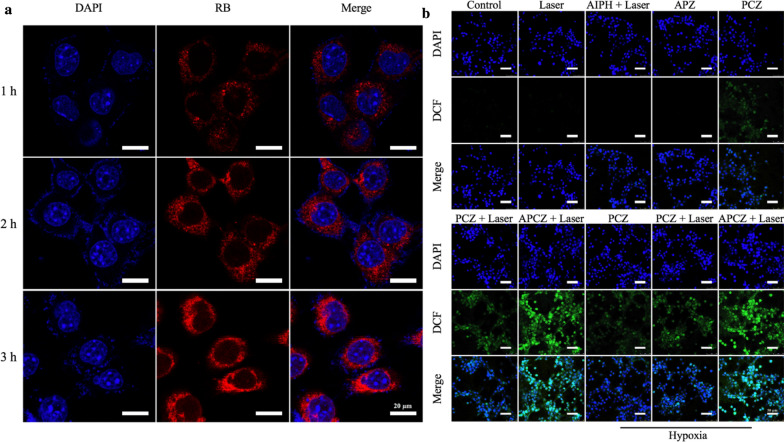
a Fluorescence images of 4T1 cells incubated with RB-APCZ ([RB] = 5 µg mL−1) for 1, 2 and 3 h. Scale bar = 20 μm. b Detection of intracellular ROS generation by DCFH-DA in both normoxic and hypoxic conditions. [AIPH] = 12.6 µg mL−1, [CuS] = 11.4 µg mL−1, scale bar = 50 μm
Fig. 5
Fig. 5
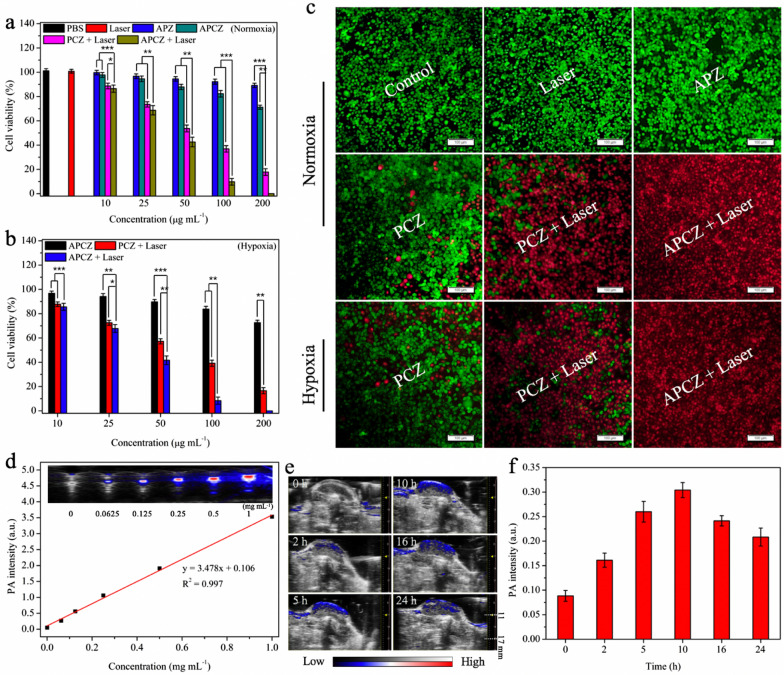
Cell viabilities of 4T1 cells after different treatments in normoxic (a) and hypoxic (b) conditions. Data shown as mean ± SD, n = 3 per treatment. Statistical significance was set at *p < 0.05, **p < 0.01, ***p < 0.001. c The calcein AM/PI co-stained images of 4T1 cells after different treatments in both normoxic and hypoxic conditions. Scale bar = 50 μm. d PA values as a function of APCZ concentration. Insert shows the corresponding in vitro PA images. e In vivo PA images of the tumor site after tail intravenous injection of APCZ dispersion for different time periods (0, 2, 5, 10, 16, 24 h). f Average PA values at tumor site corresponding to e. Data shown as mean ± SD, n = 3 per treatment
Fig. 6
Fig. 6
a Infrared thermal images and b temperature changes at the tumor site under 1064 nm laser irradiation for 2, 4, 6, 8 and 10 min. c The body weight changes and d the relative tumor growth curves in different groups. Data shown as mean ± SD, n = 4 per treatment. Statistical significance was set at *p < 0.05, **p < 0.01. e Digital images of tumors after different treatments and representative mice after treatment with PBS or APCZ + Laser. f Histological H&E and TUNEL staining tumor sections from different treatment groups. Scale bars = 50 and 100 μm, respectively

References

    1. Liu C, Cao Y, Cheng Y, Wang D, Xu T, Su L, Zhang X, Dong H. An open source and reduce expenditure ROS generation strategy for chemodynamic/photodynamic synergistic therapy. Nat Commun. 2020;11:1–9. - PMC - PubMed
    1. Li L, Yang Z, Fan W, He L, Cui C, Zou J, Tang W, Jacobson O, Wang Z, Niu G. In situ polymerized hollow mesoporous organosilica biocatalysis nanoreactor for enhancing ROS-mediated anticancer therapy. Adv Funct Mater. 2020;30:1907716. doi: 10.1002/adfm.201907716. - DOI - PMC - PubMed
    1. Xu J, Shi R, Chen G, Dong S, Yang P, Zhang Z, Niu N, Gai S, He F, Fu Y. All-in-one theranostic nanomedicine with ultrabright second near-infrared emission for tumor-modulated bioimaging and chemodynamic/photodynamic therapy. ACS Nano. 2020;14:9613–9625. doi: 10.1021/acsnano.0c00082. - DOI - PubMed
    1. Fang H, Gai Y, Wang S, Liu Q, Zhang X, Ye M, Tan J, Long Y, Wang K, Zhang Y. Biomimetic oxygen delivery nanoparticles for enhancing photodynamic therapy in triple-negative breast cancer. J Nanobiotechnol. 2021;19:1–14. doi: 10.1186/s12951-021-00827-2. - DOI - PMC - PubMed
    1. Zhang C, Qin WJ, Bai XF, Zhang XZ. Nanomaterials to relieve tumor hypoxia for enhanced photodynamic therapy. Nano Today. 2020;35:100960. doi: 10.1016/j.nantod.2020.100960. - DOI

LinkOut - more resources