


Researching and Practicing Positive Psychology in Second/Foreign Language Learning and Teaching: The Past, Current Status and Future Directions
- PMID: 34489835
- PMCID: PMC8417049
- DOI: 10.3389/fpsyg.2021.731721
Researching and Practicing Positive Psychology in Second/Foreign Language Learning and Teaching: The Past, Current Status and Future Directions
Abstract
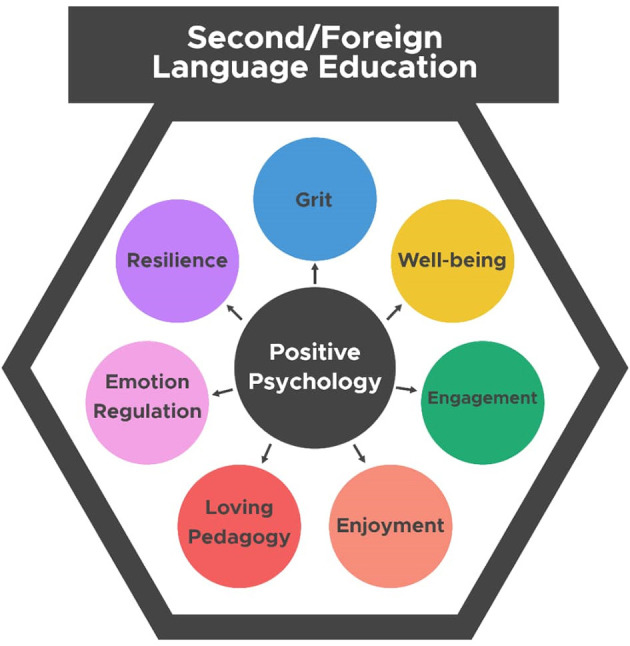
In addressing the recent special issue in Frontiers in Psychology, namely "Positive Psychology in Foreign and Second Language Education: Approaches and Applications," calling language education researchers around the globe to study positive emotions, positive personality traits, and positive institutional tendencies and their implications for language education systems, stakeholders, and policy practices, the present conceptual review paper aims to acquaint language education researchers, practitioners, instructors, and learners with the main tenets of positive psychology and their application in second/foreign language (L2) education research. Accordingly, by drawing on the broaden-and-build theory of positive emotions, we explain how individuals' positivity can result in their flourishment and development in any aspect of life, including L2 learning and teaching. Then, we introduce and conceptualize seven instances of positive psychology variables, namely academic engagement, emotion regulation, enjoyment, grit, loving pedagogy, resilience, and well-being and explain how these positive factors contribute to desirable L2 learning and teaching experiences. Subsequently, potential theoretical and pedagogical implications are drawn to enhance the quality and effectiveness of language education systems and their respective stakeholders. In the end, the limitations of the studies in this area are explicated, and suggestions for future research are provided to expand the extant literature on positive psychology in the domain of L2 education.
Keywords: broaden-and-build theory; positive emotions; positive individual features; positive institutions; positive psychology; second/foreign language education.
Copyright © 2021 Wang, Derakhshan and Zhang.
Conflict of interest statement
The authors declare that the research was conducted in the absence of any commercial or financial relationships that could be construed as a potential conflict of interest.
Figures
References
-
- Akos P., Kretchmar J. (2017). Investigating grit at a non-cognitive predictor of college success. Rev. Higher Educ. 40, 163–186. 10.1353/rhe.2017.0000 - DOI
-
- Arnold J. (ed.). (1999). Affect in Language Learning. Cambridge: Cambridge University Press.
-
- Arnold J., Fonseca Mora C. (2011). Introduction: an affective perspective on language learning and teaching. Anglistik Int. J. English Stud. 22, 7–9.
-
- Arnold J., Fonseca C. (2007). Affect in teacher talk, in Language Acquisition and Development, ed Tomlinson B. (London: Continuum; ), 107–121.
-
- Bielak J., Mystkowska-Wiertelak A. (2020). Language teachers' interpersonal learner-directed emotion-regulation strategies. Lang. Teach. Res. 10.1177/1362168820912352 - DOI
Publication types
LinkOut - more resources
Full Text Sources
Miscellaneous
