Review
. 2021 Aug 19:12:710085.
doi: 10.3389/fmicb.2021.710085. eCollection 2021.

Adaptive Response of Listeria monocytogenes to the Stress Factors in the Food Processing Environment

Affiliations
Review

Adaptive Response of Listeria monocytogenes to the Stress Factors in the Food Processing Environment

Natalia Wiktorczyk-Kapischke et al. Front Microbiol. .

Abstract

Listeria monocytogenes are Gram-positive, facultatively anaerobic, non-spore-forming bacteria that easily adapt to changing environmental conditions. The ability to grow at a wide range of temperatures, pH, and salinity determines the presence of the pathogen in water, sewage, soil, decaying vegetation, and animal feed. L. monocytogenes is an etiological factor of listeriosis, especially dangerous for the elderly, pregnant women, and newborns. The major source of L. monocytogenes for humans is food, including fresh and smoked products. Its high prevalence in food is associated with bacterial adaptation to the food processing environment (FPE). Since the number of listeriosis cases has been progressively increasing an efficient eradication of the pathogen from the FPE is crucial. Understanding the mechanisms of bacterial adaptation to environmental stress will significantly contribute to developing novel, effective methods of controlling L. monocytogenes in the food industry.

Keywords: Listeria monocytogenes; adaptive response; disinfectants; food processing environment; stress factors.


Conflict of interest statement

The authors declare that the research was conducted in the absence of any commercial or financial relationships that could be construed as a potential conflict of interest.

Figures
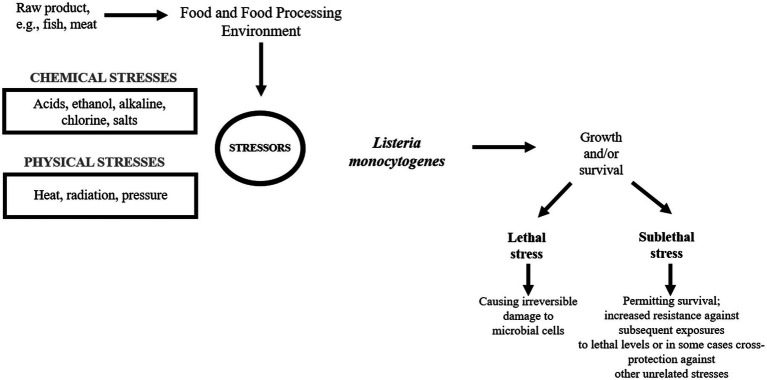
Figure 1
Figure 1
Listeria monocytogenes in the food processing environment.
Figure 2
Figure 2
The stress response in L. monocytogenes.
Figure 3
Figure 3
Transport of compatible solutes in response to osmotic stress in L. monocytogenes (CtsR – negative transcription regulator; ClpP, ClpC – ATP-dependent Clp protease; HtrA – serine protease; Csp – cold shock proteins; Hfq – the RNA binding protein; Ctc – 50S ribosomal protein L25; ProBA – proline synthesis enzyme system; Kdp – operon response regulator; Gbu – glycine betaine; OpuC – ATP-dependent carnitine transporter; ATP – adenosine triphosphate; ADP – Adenosine 5'-diphosphate; and BetL – glycine betaine transporter).
Figure 4
Figure 4
Regulation of heat shock response of L. monocytogenes (ROS – reactive oxygen species; Msc – tyrosine kinase; McsA – zinger finger protein; HtrA – serine protease; ClpC – ATP-dependent Clp protease; HrcA – Heat-inducible transcription repressor; CtsR – negative transcription regulator; Fri – ferritin-like protein; and RNAP – RNA polymerase enzyme).
Figure 5
Figure 5
Interaction of various stress response mechanisms in L. monocytogenes.
Figure 6
Figure 6
Cold stress response of L. monocytogenes (OpuC – ATP-dependent carnitine transporter; Gbu – glycine betaine; ROS – reactive oxygen species; Csp – cold-shock protein; Cap – cold acclimatization protein; and Flp – ferritin-like proteins).
Figure 7
Figure 7
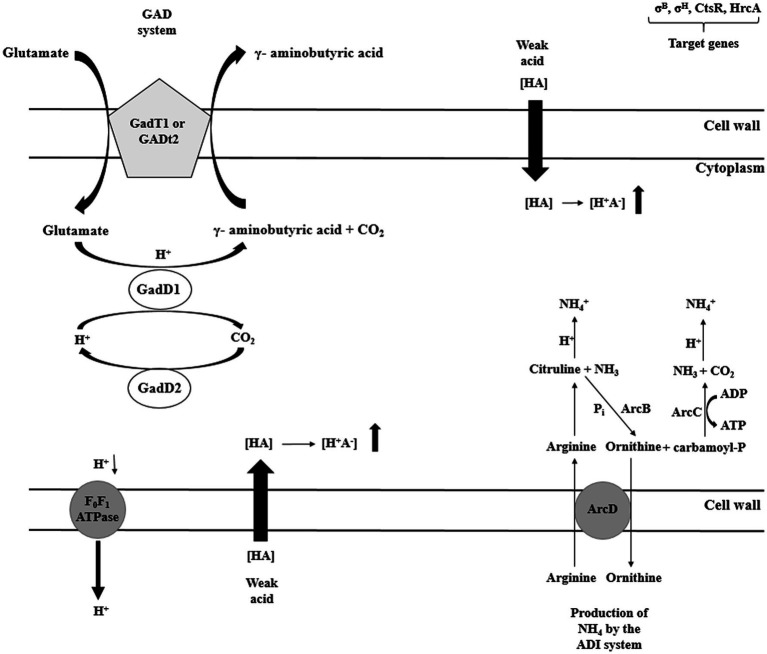
Selected mechanisms of acid stress response of L. monocytogenes (GAD – glutamate decarboxylase system; ADI – arginine deiminase system; HrcA – Heat-inducible transcription repressor; CtsR – negative transcription regulator; ArcA – arginine deiminase; ArcB – catabolic ornithine carbamoyltransferase; ArcC – carbamate kinase; ArcD – membrane-bound arginine-ornithine antiporter; and F0F1 –ATPase – proton efflux membrane ATPase).

References

    1. Abachin E., Poyart C., Pellegrini E., Milohanic E., Fiedler F., Berche P., et al. (2002). Formation of D-alanyl-lipoteichoic acid is required for adhesion and virulence of Listeria monocytogenes. Mol. Microbiol. 43, 1–14. 10.1046/j.1365-2958.2002.02723.x, PMID: - DOI - PubMed
    1. Alonso-Hermando A., Capita R., Prieto M., Alonso-Calleja C. (2009). Adaptation and cross-adaptation of Listeria monocytogenes and Salmonella enterica to poultry decontaminations. J. Microbiol. 47, 142–146. 10.1007/s12275-008-0237-5, PMID: - DOI - PubMed
    1. Angelidis A. S., Smith G. M. (2003). Three transporters mediate uptake of glycine betaine and carnitine by Listeria monocytogenes in response to hyperosmotic stress. Appl. Environ. Microbiol. 69, 1013–1022. 10.1128/AEM.69.2.1013-1022.2003, PMID: - DOI - PMC - PubMed
    1. Archambaud C., Nahori M. A., Pizarro-Cerda J., Cossart P., Dussurget O. (2006). Control of Listeria superoxide dismutase by phosphorylation. J. Biol. Chem. 281, 31812–31822. 10.1074/jbc.M606249200, PMID: - DOI - PubMed
    1. Arioli S., Montanari C., Magnani M., Tabanelli G., Patrignani F., Lanciotti R., et al. (2019). Modelling of Listeria monocytogenes Scott A after a mild heat treatment in the presence of thymol and carvacrol: effects on culturability and viability. J. Food Eng. 240, 73–82. 10.1016/j.jfoodeng.2018.07.014 - DOI

LinkOut - more resources