. 2021 Aug 13:12:694973.
doi: 10.3389/fpls.2021.694973. eCollection 2021.

Comparative Proteomic Analysis of the Defense Response to Gibberella Stalk Rot in Maize and Reveals That ZmWRKY83 Is Involved in Plant Disease Resistance

Affiliations

Comparative Proteomic Analysis of the Defense Response to Gibberella Stalk Rot in Maize and Reveals That ZmWRKY83 Is Involved in Plant Disease Resistance

Hua Bai et al. Front Plant Sci. .

Abstract

Fusarium graminearum is the causal agent of Gibberella stalk rot in maize stem, resulting in maize lodging, yield, quality, and mechanical harvesting capacity. To date, little is known about the maize stem defense mechanism in response to the invasion of F. graminearum. This study represents a global proteomic approach to document the infection by F. graminearum. A total of 1,894 differentially expressed proteins (DEPs) were identified in maize stem with F. graminearum inoculation. Functional categorization analysis indicated that proteins involved in plant-pathogen interaction were inducible at the early stages of infection. We also found that the expression of proteins involved in phenylpropanoid, flavonoid, and terpenoid biosynthesis were upregulated in response to F. graminearum infection, which may reflect that these secondary metabolism pathways were important in the protection against the fungal attack in maize stem. In continuously upregulated proteins after F. graminearum infection, we identified a WRKY transcription factor, ZmWRKY83, which could improve the resistance to plant pathogens. Together, the results show that the defense response of corn stalks against F. graminearum infection was multifaceted, involving the induction of proteins from various immune-related pathways, which had a directive significance for molecular genetic breeding of maize disease-resistant varieties.

Keywords: Fusarium graminearum; ZmWRKY83; maize; proteomic; stalk rot.


Conflict of interest statement

The authors declare that the research was conducted in the absence of any commercial or financial relationships that could be construed as a potential conflict of interest.

Figures
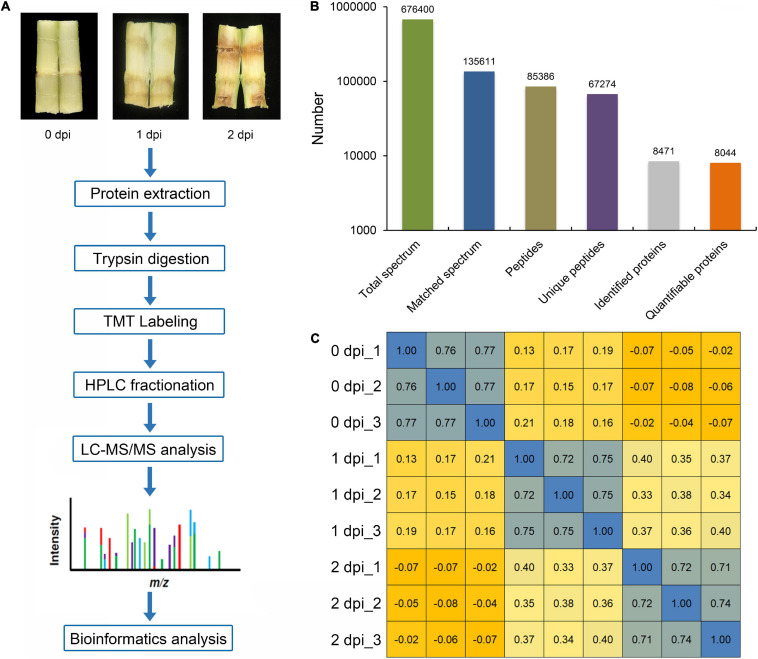
FIGURE 1
FIGURE 1
Overview of treatments and proteome profiling. (A) Differentially expressed proteins (DEPs) were quantified and analyzed by tandem mass tag (TMT) labeling and LC-MS/MS. (B) Summary of sampled spectra, peptides, acetylated peptides, and identified proteins. (C) Pearson correlation statistics of the replicates of every experiment.
FIGURE 2
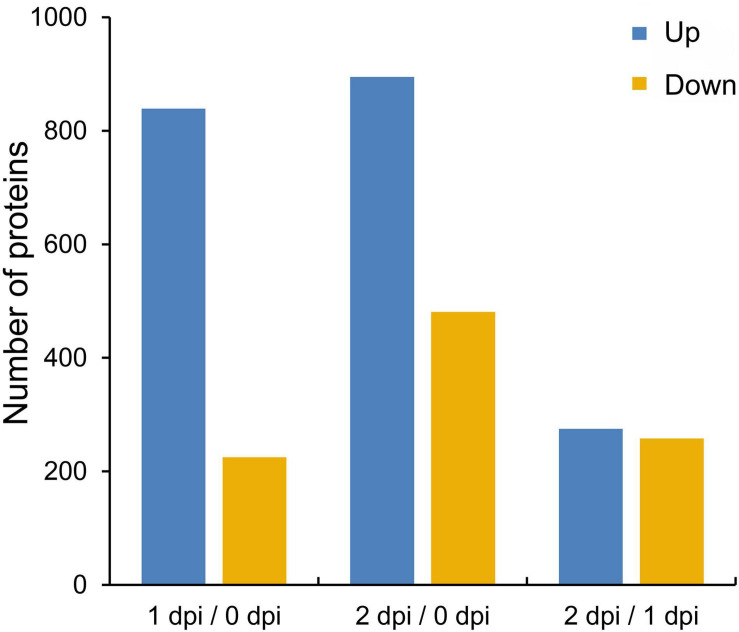
FIGURE 2
The numbers of upregulated and downregulated proteins in maize stem following Fusarium graminearum infection. A cutoff of 1.3-fold and p-value < 0.05 were used to select DEPs.
FIGURE 3
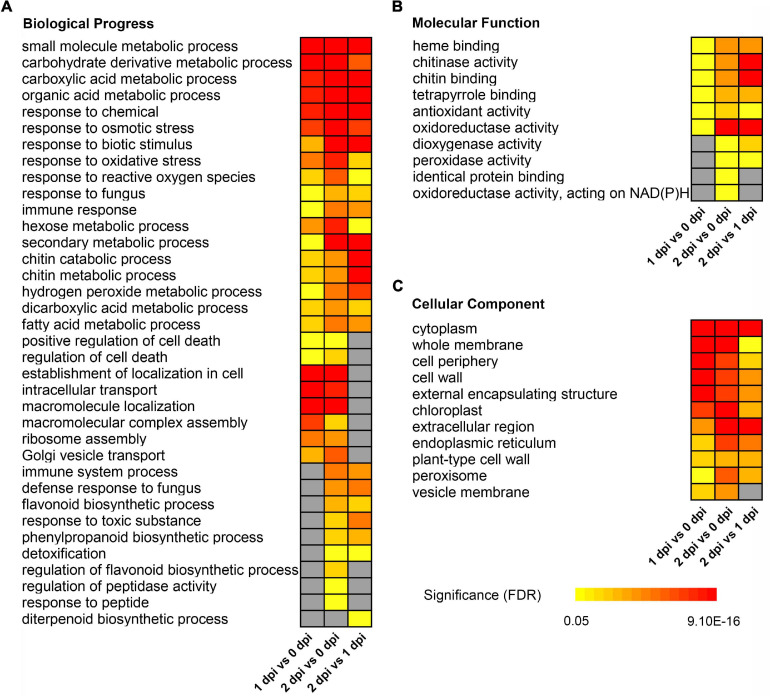
FIGURE 3
Gene ontology enrichment of up-regulated differentially expressed proteins between 0, 1, and 2 dpi. Enriched GO terms showed in biological progress (A), molecular function (B), and cellular component (C). (C) The colors from yellow to red represent the significance level of the GO terms from high to low. Fisher’s exact test, P-value was adjusted using the Benjamini-Yekutieli method, FDR < 0.05.
FIGURE 4
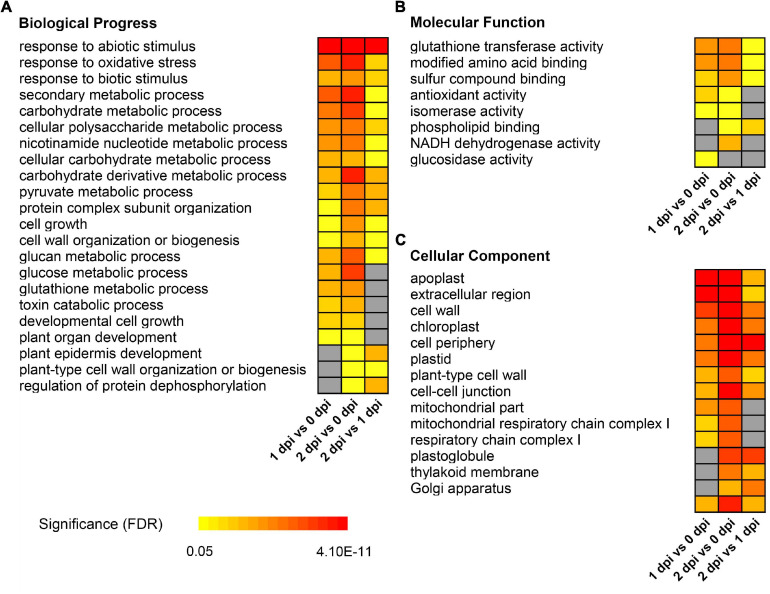
FIGURE 4
Gene ontology enrichment of down-regulated differentially expressed proteins between 0, 1, and 2 dpi. Enriched GO terms showed in biological progress (A), molecular function (B), and cellular component (C). The colors from yellow to red represent the significance level of the GO terms from low to high. Fisher’s exact test, P-value was adjusted using the Benjamini-Yekutieli method, FDR < 0.05.
FIGURE 5
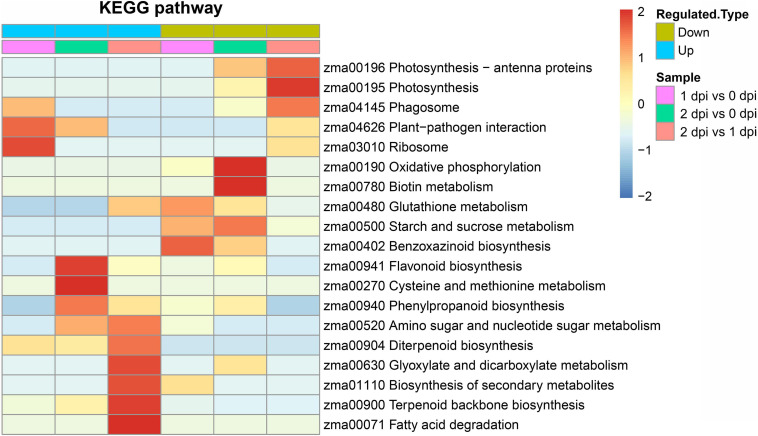
FIGURE 5
Kyoto encyclopedia of genes and genomes (KEGG) enrichment analysis of upregulated and downregulated DEPs between 0, 1, and 2 dpi. The colors from blue-to-red represent the significance level of the KEGG pathways from low to high.
FIGURE 6
FIGURE 6
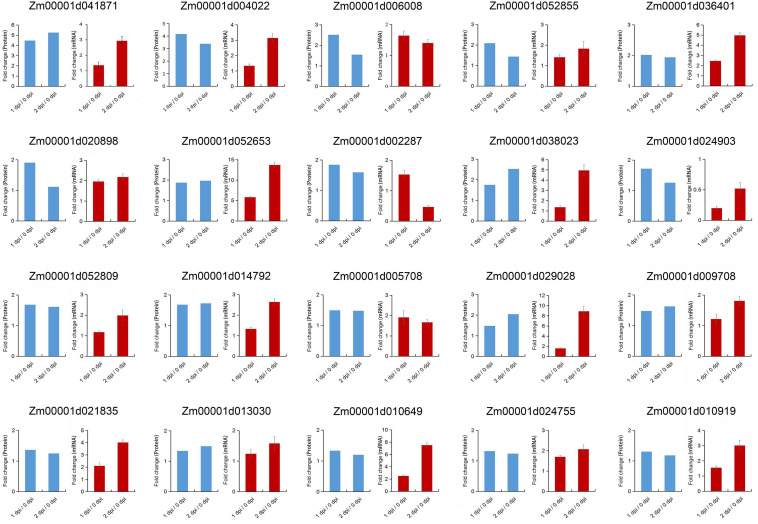
Correlation between proteomics and quantitative real-time PCR (qRT-PCR) results of the proteins enriched in plant-pathogen interaction pathway. Error bars represent SD from the mean.
FIGURE 7
FIGURE 7
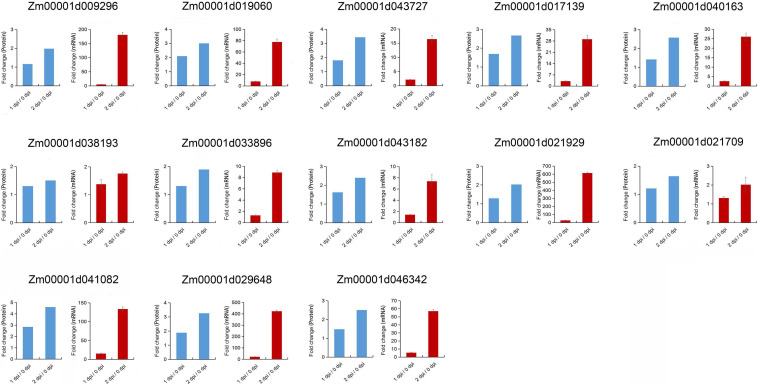
Correlation between proteomics and qRT-PCR results of the proteins enriched in terpenoid backbone and diterpenoid biosynthesis pathway. Error bars represent SD from the mean.
FIGURE 8
FIGURE 8
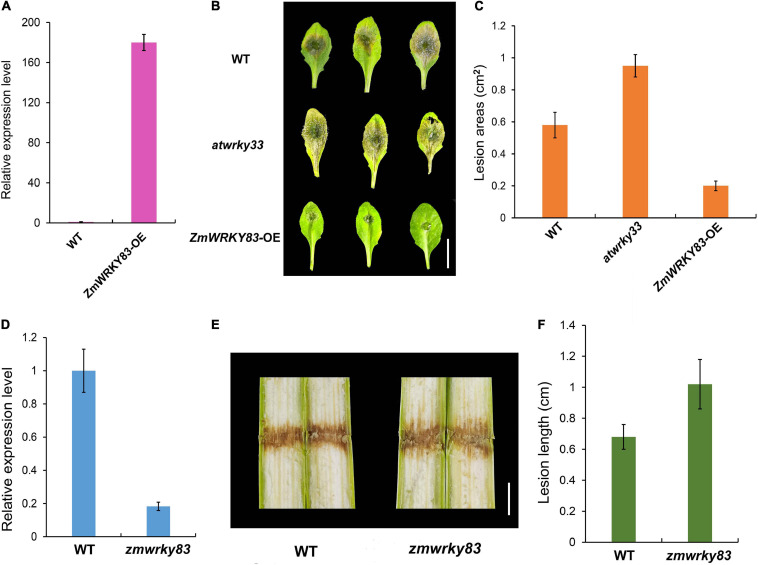
ZmWRKY83 overexpression in transgenic Arabidopsis increases B. cinerea resistance. (A) The relative expression level of ZmWRKY83 in Col-0 and ZmWRKY83 overexpressing transgenic plants. (B) Altered disease resistance of Col-0, atwrky33 mutant, and ZmWRKY83 overexpressing transgenic plants against B. cinerea. Four-week-old plants were inoculated by B. cinerea spore suspension (106 ml–1) and kept at high humidity. The experiments were repeated three times with similar results. (C) Measurement of lesion areas on B. cinerea-inoculated Arabidopsis leaves shown in panel B. The necrotic lesion areas on each leaf were measured using ImageJ. Data represent the mean ± SD. (D) The relative expression level of ZmWRKY83 in B73 and zmwrky83 mutant. (E) Altered disease resistance of B73, zmwrky33 mutant against F. graminearum. V7 stage plants were inoculated by F. graminearum spore suspension (106 ml–1) and kept at high humidity. (F) Measurement of lesion length on F. graminearum-inoculated maize stem shown in panel E. Data represent the mean ± SD.

References

    1. Ahuja I., Kissen R., Bones A. M. (2012). Phytoalexins in defense against pathogens. Trends Plant Sci. 17 73–90. 10.1016/j.tplants.2011.11.002 - DOI - PubMed
    1. Akira S., Uematsu S., Takeuchi O. (2006). Pathogen recognition and innate immunity. Cell 124 783–801. 10.1016/j.cell.2006.02.015 - DOI - PubMed
    1. Birkenbihl R. P., Diezel C., Somssich I. E. (2012). Arabidopsis WRKY33 is a key transcriptional regulator of hormonal and metabolic responses toward Botrytis cinerea infection. Plant Physiol. 159 266–285. 10.1104/pp.111.192641 - DOI - PMC - PubMed
    1. Birkenbihl R. P., Kracher B., Roccaro M., Somssich I. E. (2017a). Induced genome-wide binding of three Arabidopsis WRKY transcription factors during early MAMP-triggered immunity. Plant Cell 29 1175–1175. 10.1105/tpc.17.00278 - DOI - PMC - PubMed
    1. Birkenbihl R. P., Kracher B., Somssich I. E. (2017b). Induced genome-wide binding of three Arabidopsis WRKY transcription factors during early MAMP-triggered immunity. Plant Cell 29 20–38. 10.1105/tpc.16.00681 - DOI - PMC - PubMed

LinkOut - more resources