


Genome-wide association study dissects the genetic control of plant height and branch number in response to low-phosphorus stress in Brassica napus
- PMID: 34490877
- PMCID: PMC8577194
- DOI: 10.1093/aob/mcab115
Genome-wide association study dissects the genetic control of plant height and branch number in response to low-phosphorus stress in Brassica napus
Abstract
Background and aims: Oilseed rape (Brassica napus) is one of the most important oil crops worldwide. Phosphorus (P) deficiency severely decreases the plant height and branch number of B. napus. However, the genetic bases controlling plant height and branch number in B. napus under P deficiency remain largely unknown. This study aims to mine candidate genes for plant height and branch number by genome-wide association study (GWAS) and determine low-P-tolerance haplotypes.
Methods: An association panel of B. napus was grown in the field with a low P supply (P, 0 kg ha-1) and a sufficient P supply (P, 40 kg ha-1) across 2 years and plant height and branch number were investigated. More than five million single-nucleotide polymorphisms (SNPs) were used to conduct GWAS of plant height and branch number at two contrasting P supplies.
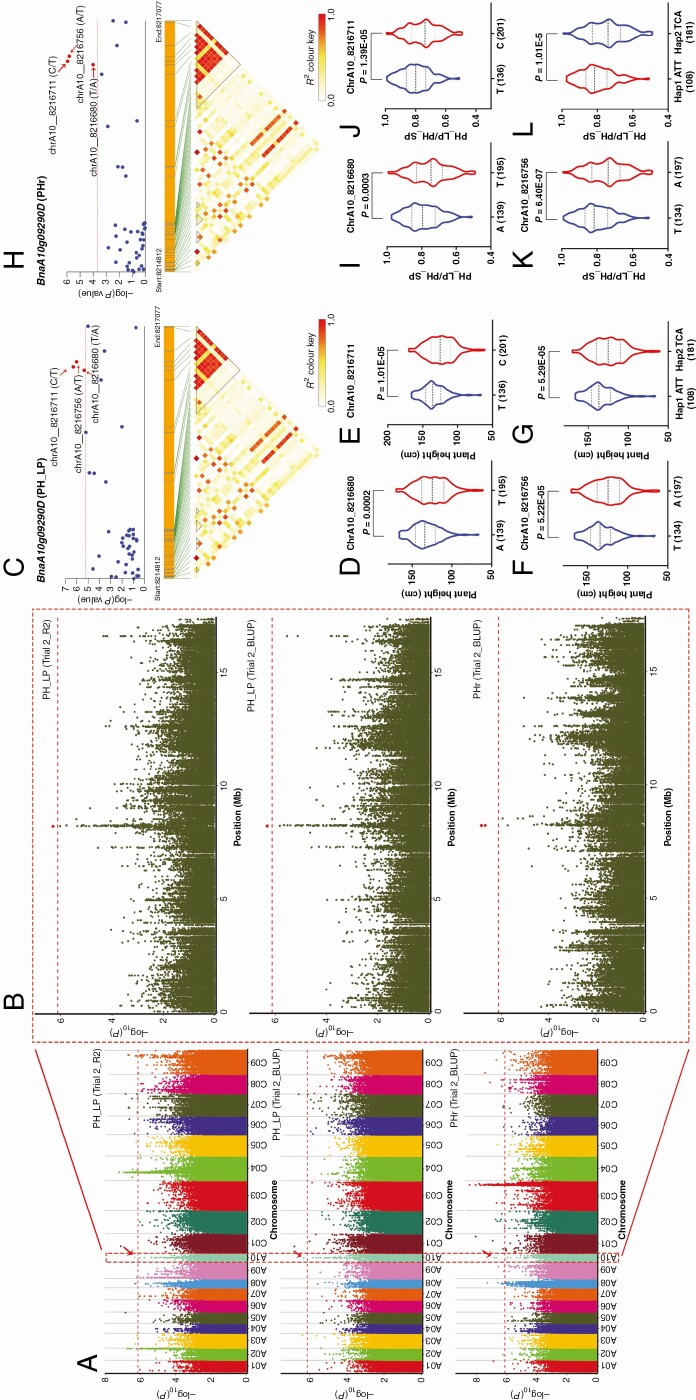
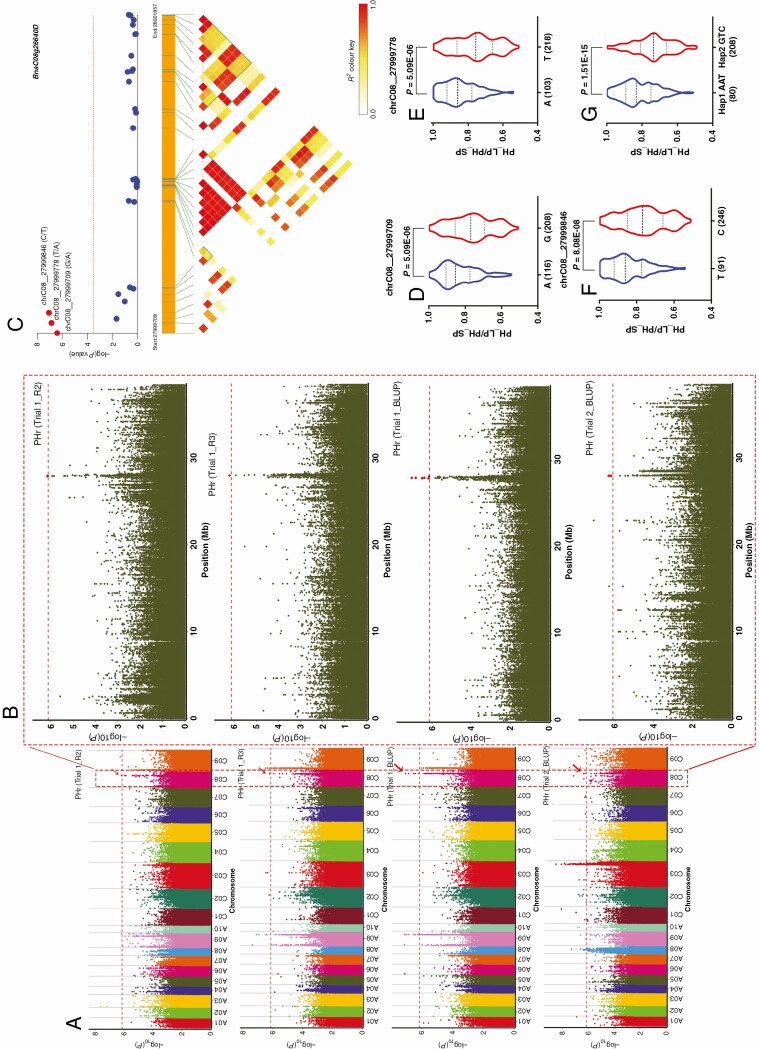
Key results: A total of 2127 SNPs were strongly associated (P < 6·25 × 10-07) with plant height and branch number at two P supplies. There was significant correlation between phenotypic variation and the number of favourable alleles of associated loci on chromosomes A10 (chrA10_821671) and C08 (chrC08_27999846), which will contribute to breeding improvement by aggregating these SNPs. BnaA10g09290D and BnaC08g26640D were identified to be associated with chrA10_821671 and chrC08_27999846, respectively. Candidate gene association analysis and haplotype analysis showed that the inbred lines carrying ATT at BnaA10g09290Hap1 and AAT at BnaC08g26640Hap1 had greater plant height than lines carrying other haplotype alleles at low P supply.
Conclusion: Our results demonstrate the power of GWAS in identifying genes of interest in B. napus and provided insights into the genetic basis of plant height and branch number at low P supply in B. napus. Candidate genes and favourable haplotypes may facilitate marker-based breeding efforts aimed at improving P use efficiency in B. napus.
Keywords: Oilseed rape; branch number; genome wide association study; haplotype analysis; low phosphorus supply; plant height.
© The Author(s) 2021. Published by Oxford University Press on behalf of the Annals of Botany Company. All rights reserved. For permissions, please e-mail: journals.permissions@oup.com.
Figures
References
-
- Barrett JC, Fry B, Maller J, Daly MJ. 2005. Haploview: analysis and visualization of LD and haplotype maps. Bioinformatics 21: 263–265. - PubMed
-
- Bradbury PJ, Zhang Z, Kroon DE, Casstevens TM, Ramdoss Y, Buckler ES. 2007. TASSEL: software for association mapping of complex traits in diverse samples. Bioinformatics 23: 2633–2635. - PubMed
-
- Che J, Yamaji N, Miyaji T, et al. 2020. Node-localized transporters of phosphorus essential for seed development in rice. Plant & Cell Physiology 61: 1387–1398. - PubMed
-
- Chen B, Xu K, Li J, et al. 2014. Evaluation of yield and agronomic traits and their genetic variation in 488 global collections of Brassica napus L. Genetic Resources and Crop Evolution 61: 979–999.
Publication types
MeSH terms
Substances
Grants and funding
LinkOut - more resources
Full Text Sources
Research Materials
Miscellaneous
