


Weighing the Risk: Developmental Pathways and Processes Underlying Obesity to Substance Use in Adolescence
- PMID: 34490962
- PMCID: PMC8897223
- DOI: 10.1111/jora.12610
Weighing the Risk: Developmental Pathways and Processes Underlying Obesity to Substance Use in Adolescence
Abstract
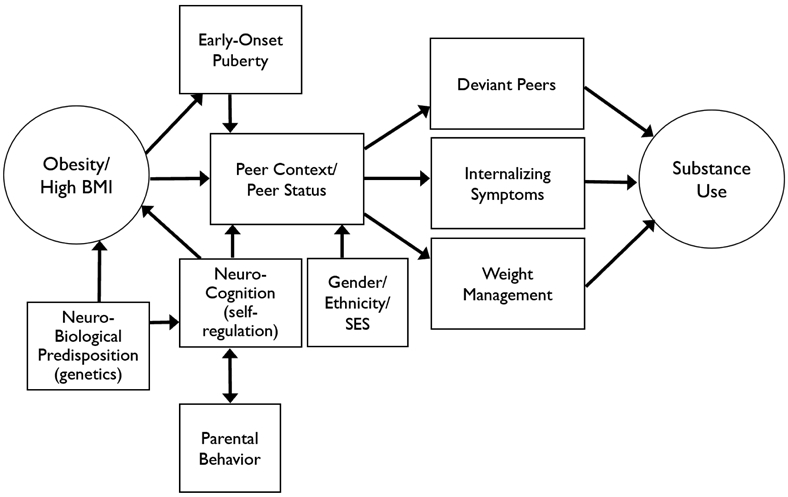
Research on co-occurring obesity and substance use in adolescence has grown substantially in the past decade, but questions on the pathways and processes underlying co-occurrence remain. This review first synthesizes empirical findings on the relationship between obesity and substance use (e.g., alcohol, cannabis, tobacco use). Multidisciplinary theoretical frameworks referencing behavioral medicine, neuroscience, psychology, and public health are then used to inform an interdisciplinary, conceptual model focused on pathways and processes by which obesity increases risk of substance use. Recommendations for future research underscore the importance of prospective studies that encompass multiple domains of development. Recommendations for practice include family-based interventions that promote adaptive self-regulation, targeted antibullying or victimization interventions, and increased attention by health professionals on risky behavior associated with adolescent obesity.
Keywords: co-occurring; obesity; substance use.
© 2021 Society for Research on Adolescence.
Figures
References
-
- Ahmed ML, Ong KK, & Dunger DB (2009). Childhood obesity and the timing of puberty. Trends in Endocrinology & Metabolism, 20(5), 237–242. - PubMed
-
- Ajzen I (2005). Attitudes, personality, and behavior. McGraw-Hill Education (UK).
-
- Ali MM, Amialchuk A, & Rizzo JA (2012). The influence of body weight on social network ties among adolescents. Economics & Human Biology, 10(1), 20–34. - PubMed
-
- Anderson KG, Ramo DE, & Brown SA (2006). Life stress, coping and comorbid youth: An examination of the stress-vulnerability model for substance relapse. Journal of Psychoactive Drugs, 38(3), 255–262. - PubMed
-
- Bartholdy S, Dalton B, Daly OG, Campbell IC, & Schmidt U (2016). A systematic review of the relationship between eating, weight and inhibitory control using the stop signal task. Neuroscience & Biobehavioral Reviews, 64, 35–62. - PubMed
Publication types
MeSH terms
Grants and funding
LinkOut - more resources
Full Text Sources
Medical
Miscellaneous