


Effectiveness of a Multistrategy Behavioral Intervention to Increase the Nutritional Quality of Primary School Students' Web-Based Canteen Lunch Orders (Click & Crunch): Cluster Randomized Controlled Trial
- PMID: 34491207
- PMCID: PMC8456336
- DOI: 10.2196/26054
Effectiveness of a Multistrategy Behavioral Intervention to Increase the Nutritional Quality of Primary School Students' Web-Based Canteen Lunch Orders (Click & Crunch): Cluster Randomized Controlled Trial
Abstract
Background: School food outlets represent a key setting for public health nutrition intervention. The recent proliferation of web-based food ordering systems provides a unique opportunity to support healthy purchasing from schools. Embedding evidence-based choice architecture strategies within these routinely used systems provides the opportunity to impact the purchasing decisions of many users simultaneously and warrants investigation.
Objective: This study aims to assess the effectiveness of a multistrategy behavioral intervention implemented via a web-based school canteen lunch ordering system in reducing the energy, saturated fat, sugar, and sodium content of primary students' web-based lunch orders.
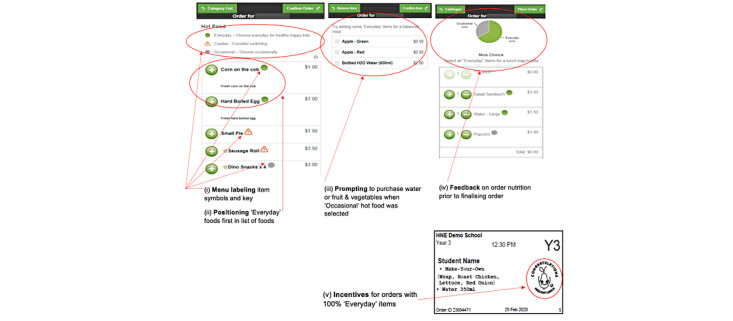
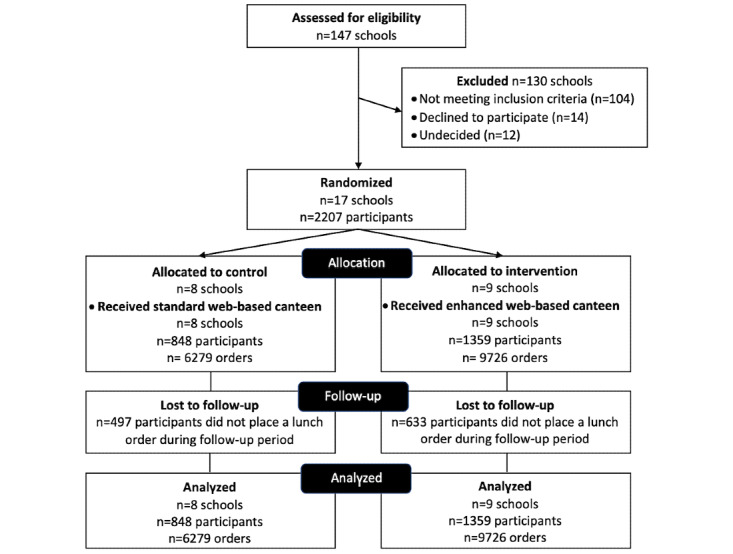
Methods: The study used a parallel-group, cohort, cluster randomized controlled trial design with 2207 students from 17 Australian primary schools. Schools with a web-based canteen lunch ordering system were randomly assigned to receive either a multistrategy behavioral intervention that included choice architecture strategies embedded in the web-based system (n=9 schools) or the standard web-based ordering system only (n=8 control schools). Automatically collected student purchasing data at baseline (term 2, 2018) and 12 months later (term 2, 2019) were used to assess trial outcomes. Primary trial outcomes included the mean energy (kJ), saturated fat (g), sugar (g), and sodium (mg) content of student lunch orders. Secondary outcomes included the proportion of all web-based lunch order items classified as everyday, occasional, and caution (based on the New South Wales Healthy School Canteen Strategy) and canteen revenue.
Results: From baseline to follow-up, the intervention lunch orders had significantly lower energy content (-69.4 kJ, 95% CI -119.6 to -19.1; P=.01) and saturated fat content (-0.6 g, 95% CI -0.9 to -0.4; P<.001) than the control lunch orders, but they did not have significantly lower sugar or sodium content. There was also a small significant between-group difference in the percentage of energy from saturated fat (-0.9%, 95% CI -1.4% to -0.5%; P<.001) but not in the percentage of energy from sugar (+1.1%, 95% CI 0.2% to 1.9%; P=.02). Relative to control schools, intervention schools had significantly greater odds of having everyday items purchased (odds ratio [OR] 1.7, 95% CI 1.5-2.0; P<.001), corresponding to a 9.8% increase in everyday items, and lower odds of having occasional items purchased (OR 0.7, 95% CI 0.6-0.8; P<.001), corresponding to a 7.7% decrease in occasional items); however, there was no change in the odds of having caution (least healthy) items purchased (OR 0.8, 95% CI 0.7-1.0; P=.05). Furthermore, there was no change in schools' revenue between groups.
Conclusions: Given the evidence of small statistically significant improvements in the energy and saturated fat content, acceptability, and wide reach, this intervention has the potential to influence dietary choices at a population level, and further research is warranted to determine its impact when implemented at scale.
Trial registration: Australian New Zealand Clinical Trials Registry (ANZCTR) ACTRN12618000855224; https://www.anzctr.org.au/Trial/Registration/TrialReview.aspx?id=375075.
International registered report identifier (irrid): RR2-10.1136/bmjopen-2019-030538.
Keywords: canteens; choice architecture; digital interventions; intervention; menu labeling; nudge; online canteen; online ordering systems; school children; school food service.
©Rebecca Wyse, Tessa Delaney, Fiona Stacey, Rachel Zoetemeyer, Christophe Lecathelinais, Hannah Lamont, Kylie Ball, Karen Campbell, Chris Rissel, John Attia, John Wiggers, Sze Lin Yoong, Christopher Oldmeadow, Rachel Sutherland, Nicole Nathan, Kathryn Reilly, Luke Wolfenden. Originally published in the Journal of Medical Internet Research (https://www.jmir.org), 07.09.2021.
Conflict of interest statement
Conflicts of Interest: None declared.
Figures
Similar articles
-
The efficacy of a multi-strategy choice architecture intervention on improving the nutritional quality of high school students' lunch purchases from online canteens (Click & Crunch High Schools): a cluster randomized controlled trial.Int J Behav Nutr Phys Act. 2022 Sep 14;19(1):120. doi: 10.1186/s12966-022-01362-5. Int J Behav Nutr Phys Act. 2022. PMID: 36104738 Free PMC article. Clinical Trial.
-
Long-term Effectiveness of a Multistrategy Behavioral Intervention to Increase the Nutritional Quality of Primary School Students' Online Lunch Orders: 18-Month Follow-up of the Click & Crunch Cluster Randomized Controlled Trial.J Med Internet Res. 2021 Nov 29;23(11):e31734. doi: 10.2196/31734. J Med Internet Res. 2021. PMID: 34847063 Free PMC article. Clinical Trial.
-
Long-Term Effectiveness of a Multi-Strategy Choice Architecture Intervention in Increasing Healthy Food Choices of High-School Students From Online Canteens (Click & Crunch High Schools): Cluster Randomized Controlled Trial.J Med Internet Res. 2024 Mar 19;26:e51108. doi: 10.2196/51108. J Med Internet Res. 2024. PMID: 38502177 Free PMC article. Clinical Trial.
-
The Effectiveness of Interventions Delivered Using Digital Food Environments to Encourage Healthy Food Choices: A Systematic Review and Meta-Analysis.Nutrients. 2021 Jun 30;13(7):2255. doi: 10.3390/nu13072255. Nutrients. 2021. PMID: 34208869 Free PMC article.
-
The effect of healthy food guidance for schools on food availability, purchasing and consumption among school children in New Zealand and Australia: an integrative review.Nutr Res Rev. 2024 Nov 27:1-15. doi: 10.1017/S0954422424000362. Online ahead of print. Nutr Res Rev. 2024. PMID: 39600226 Review.
Cited by
-
A Cluster Randomized Controlled Trial Evaluating the Impact of Tailored Feedback on the Purchase of Healthier Foods from Primary School Online Canteens.Nutrients. 2021 Jul 14;13(7):2405. doi: 10.3390/nu13072405. Nutrients. 2021. PMID: 34371914 Free PMC article. Clinical Trial.
-
Effectiveness of a Multi-Strategy Behavioral Intervention to Increase Vegetable Sales in Primary School Canteens: A Randomized Controlled Trial.Nutrients. 2022 Oct 10;14(19):4218. doi: 10.3390/nu14194218. Nutrients. 2022. PMID: 36235870 Free PMC article. Clinical Trial.
-
A Cross-Sectional Study of the Nutritional Quality of New South Wales High School Student Food and Drink Purchases Made via an Online Canteen Ordering System.Nutrients. 2021 Nov 30;13(12):4327. doi: 10.3390/nu13124327. Nutrients. 2021. PMID: 34959881 Free PMC article.
-
The efficacy of a multi-strategy choice architecture intervention on improving the nutritional quality of high school students' lunch purchases from online canteens (Click & Crunch High Schools): a cluster randomized controlled trial.Int J Behav Nutr Phys Act. 2022 Sep 14;19(1):120. doi: 10.1186/s12966-022-01362-5. Int J Behav Nutr Phys Act. 2022. PMID: 36104738 Free PMC article. Clinical Trial.
-
Characterisation of At-Scale Community Health Interventions Aimed to Improve Healthy Eating Behaviour in Australia: A Rapid Review.Health Promot J Austr. 2025 Jul;36(3):e70061. doi: 10.1002/hpja.70061. Health Promot J Austr. 2025. PMID: 40566934 Free PMC article. Review.
References
-
- Australian Burden of Disease Study 2015: Interactive data on risk factor burden. Australian Institute of Health and Welfare. 2020. [2021-07-16]. https://www.aihw.gov.au/reports/burden-of-disease/interactive-data-risk-... .
-
- World Health Organization . School Policy Framework: Implementation of the WHO Global Strategy on Diet, Physical Activity and Health. Geneva: World Health Organization; 2008. pp. 1–48.
-
- Finch M, Sutherland R, Harrison M, Collins C. Canteen purchasing practices of year 1-6 primary school children and association with SES and weight status. Aust N Z J Public Health. 2006 Jun;30(3):247–51. doi: 10.1111/j.1467-842X.2006.tb00865.x. doi: 10.1111/j.1467-842x.2006.tb00865.x. - DOI - DOI - PubMed
-
- Delaney T, Sutherland R, Wyse R, Wolfenden L, Lecathelinais C, Janssen L, Reilly K, Wiggers J, Yoong S. A cross-sectional study of the nutritional quality of student canteen purchases from New South Wales primary-school canteens. Public Health Nutr. 2019 Jul 25;22(16):3092–100. doi: 10.1017/S1368980019001903. doi: 10.1017/s1368980019001903. - DOI - DOI - PMC - PubMed
-
- Wolfenden L, Nathan N, Janssen LM, Wiggers J, Reilly K, Delaney T, Williams CM, Bell C, Wyse R, Sutherland R, Campbell L, Lecathelinais C, Oldmeadow C, Freund M, Yoong SL. Multi-strategic intervention to enhance implementation of healthy canteen policy: a randomised controlled trial. Implement Sci. 2017 Jan 11;12(1):6. doi: 10.1186/s13012-016-0537-9. https://implementationscience.biomedcentral.com/articles/10.1186/s13012-... 10.1186/s13012-016-0537-9 - DOI - DOI - PMC - PubMed
Publication types
MeSH terms
LinkOut - more resources
Full Text Sources
Miscellaneous
