


Transversus abdominis release (TAR) for ventral hernia repair: open or robotic? Short-term outcomes from a systematic review with meta-analysis
- PMID: 34491460
- PMCID: PMC8613152
- DOI: 10.1007/s10029-021-02487-5
Transversus abdominis release (TAR) for ventral hernia repair: open or robotic? Short-term outcomes from a systematic review with meta-analysis
Abstract
Purpose: To compare early postoperative outcomes after transversus abdominis release (TAR) for ventral hernia repair with open (oTAR) and robotic (rTAR) approach.
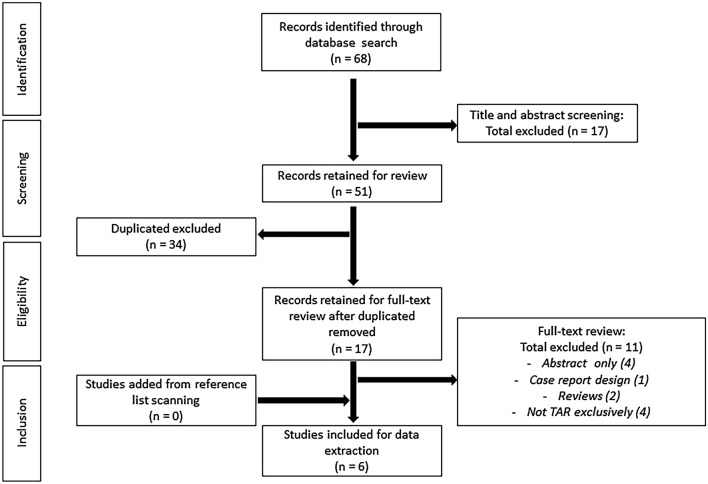
Methods: A systematic search of PubMed/MEDLINE, EMBASE, SCOPUS and Web of Science databases was conducted to identify comparative studies until October 2020. A meta-analysis of postoperative short-term outcomes was performed including complications rate, operative time, length of stay, surgical site infection (SSI), surgical site occurrence (SSO), SSO requiring intervention (SSOPI), systemic complications, readmission, and reoperation rates as measure outcomes.
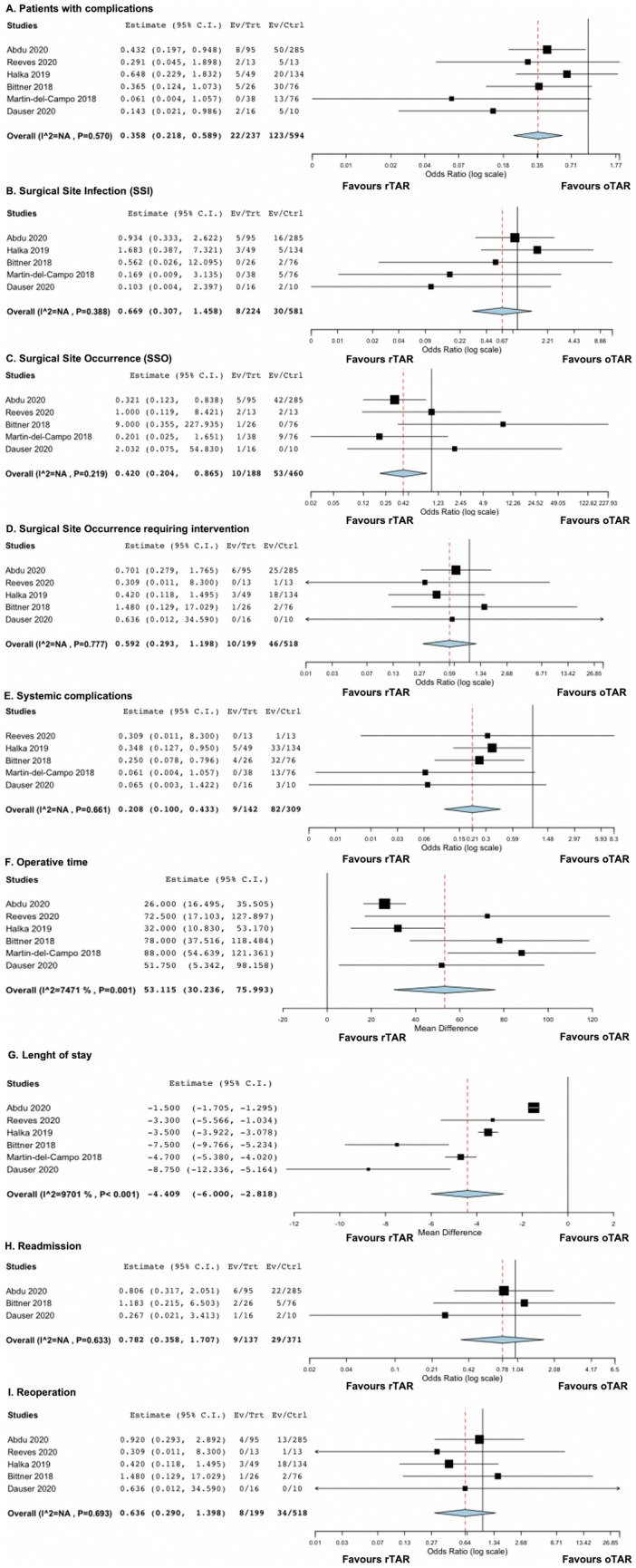
Results: Six retrospective studies were included in the analysis with a total of 831 patients who underwent rTAR (n = 237) and oTAR (n = 594). Robotic TAR was associated with lower risk of complications rate (9.3 vs 20.7%, OR 0.358, 95% CI 0.218-0.589, p < 0.001), lower risk of developing SSO (5.3 vs 11.5%, OR 0.669, 95% CI 0.307-1.458, p = 0.02), lower risk of developing systemic complications (6.3 vs 26.5%, OR 0.208, 95% CI 0.100-0.433, p < 0.001), shorter hospital stay (SMD - 4.409, 95% CI - 6.000 to - 2.818, p < 0.001) but longer operative time (SMD 53.115, 95% CI 30.236-75.993, p < 0.01) compared with oTAR. There was no statistically significant difference in terms of SSI, SSOPI, readmission, and reoperation rates.
Conclusion: Robotic TAR improves recovery by adding the benefits of minimally invasive procedures when compared to open surgery. Although postoperative complications appear to decrease with a robotic approach, further studies are needed to support the real long-term and cost-effective advantages.
Keywords: Robotic TAR; Transversus abdominis release; Ventral hernia repair.
© 2021. The Author(s).
Conflict of interest statement
Umberto Bracale, Francesco Corcione, Daniele Neola, Simone Castiglioni, Giuseppe Cavallaro, Cesare Stabilini, Emanuele Botteri, Francesco Corcione, Maurizio Sodo, Nicola Imperatore, Roberto Peltrini declare that they have no conflict of interest.
Figures
Comment in
-
Comment to: transversus abdominis release (TAR) for ventral hernia repair: open or robotic? Short-term outcomes from a systematic review with meta-analysis.Hernia. 2022 Aug;26(4):1211-1212. doi: 10.1007/s10029-022-02568-z. Epub 2022 Jan 19. Hernia. 2022. PMID: 35044546 No abstract available.
-
Transversus abdominis release (TAR) for ventral hernia repair: open or robotic? Author's reply.Hernia. 2022 Aug;26(4):1213-1214. doi: 10.1007/s10029-022-02590-1. Epub 2022 Mar 7. Hernia. 2022. PMID: 35254554 No abstract available.
References
-
- Stabilini C, Bracale U, Pignata G, Frascio M, Casaccia M, Pelosi P, Signori A, Testa T, Rosa GM, Morelli N, Fornaro R, Palombo D, Perotti S, Bruno MS, Imperatore M, Righetti C, Pezzato S, Lazzara F, Gianetta E. Laparoscopic bridging vs anatomic open reconstruction for midline abdominal hernia mesh repair [LABOR]: single-blinded, multicenter, randomized, controlled trial on long-term functional results. Trials. 2013;14:357. doi: 10.1186/1745-6215-14-357. - DOI - PMC - PubMed
Publication types
MeSH terms
LinkOut - more resources
Full Text Sources
