


doi: 10.1007/s13238-021-00874-3.
Epub 2021 Sep 7.
Persisting lung pathogenesis and minimum residual virus in hamster after acute COVID-19
Affiliations
- PMID: 34491552
- PMCID: PMC8422370
- DOI: 10.1007/s13238-021-00874-3
Item in Clipboard
Persisting lung pathogenesis and minimum residual virus in hamster after acute COVID-19
Protein Cell.
2022 Jan.
No abstract available
Figures
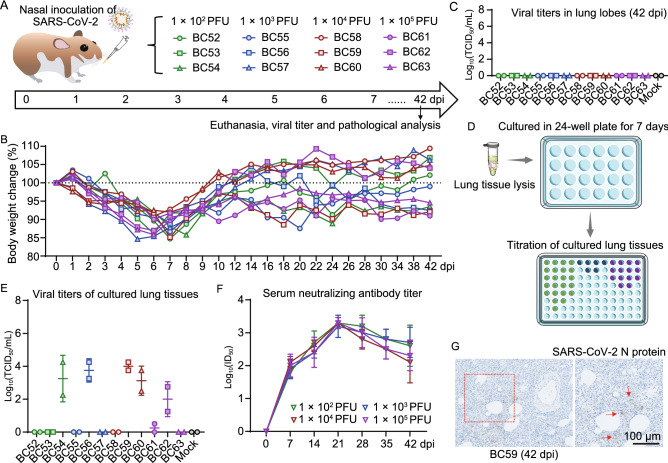
Acute infection and recovery of hamsters with SARS-CoV-2. (A) Schematic diagram of SARS-CoV-2 infection and animal operations for observation of persisting symptoms after acute SARS-CoV-2 infection. Hamsters were intranasally inoculated with 1 × 10² to 1 × 10⁵ PFU of SARS-CoV-2, respectively (n = 3/group). All of the animals were euthanized at 42 dpi for virological and histological analysis. (B) Body weight changes after SARS-CoV-2 infection from 0 to 7 dpi (n = 3/group). (C) Titers of live virus in lung tissues collected at 42 dpi by a CPE-based titration assay in 96-well plates. For each hamster, one near-hilum lung tissue sample and one away-hilum lung tissue sample were used for titration. (D) The samples collected at 42 dpi were incubated with Vero-E6 cells in 24-well plates for a 7-day culture. (E) And then, the Vero-E6 cells were collected for a second-round titration. (F) Titers of serum neutralizing antibody levels from 0 to 42 dpi (n = 3/group). There is no significant difference between the NAb titers of different groups at 42 dpi (1 × 10² PFU vs. 1 × 10³ PFU, P > 0.05; 1 × 10² PFU vs. 1 × 10⁴ PFU, P > 0.05; 1 × 10² PFU vs. 1 × 10⁵ PFU, P > 0.05). (G) Representative image of immunohistochemistry staining for SARS-CoV-2 NP in lung lobe sections collected at 42 dpi (left). The area in the scattered square was enlarged (bar = 100 μm), the arrows points to the NP positive cells
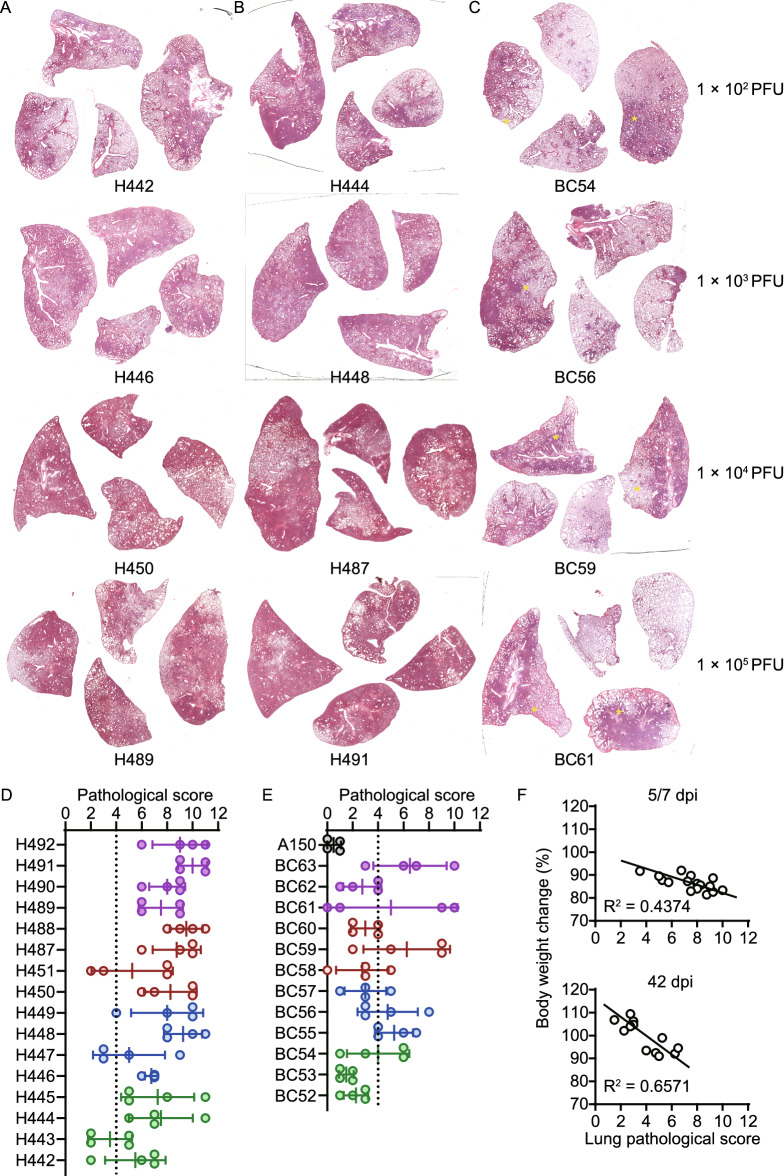
Pathological analysis of lung lobe tissues collected from hamsters in acute SARS-CoV-2 infection phase and convalescent phase. For each hamster, four lung lobes were fixed in formalin for pathological analysis. Representative H&E staining for lung lobe sections collected from SARS-CoV-2 infected hamsters at (A) 5, (B) 7 and (C) 42 dpi, respectively. These hamsters were infected with 1 × 10² PFU (line 1), 1 × 10³ PFU (line 2), 1 × 10² PFU (line 3) and 1 × 10⁵ PFU (line 4) of SARS-CoV-2, respectively. H&E staining for all the rest hamsters were shown in Fig. S3. Comprehensive pathological scores for lung of hamsters during (D) the acute SARS-CoV-2 infection phase and (E) the convalescent phase. Scores were determined based on the severity and percentage of injured areas for each lung lobe. There are significant differences between the lung pathological scores of different groups at 5 dpi (1 × 10² PFU vs. 1 × 10³ PFU, P = 0.048; 1 × 10² PFU vs. 1 × 10⁴ PFU, P > 0.05; 1 × 10² PFU vs. 1 × 10⁵ PFU, P = 0.022). There is no significant difference between the lung pathological scores of different groups at 7 and 42 dpi (1 × 10² PFU vs. 1 × 10³ PFU, P > 0.05; 1 × 10² PFU vs. 1 × 10⁴ PFU, P > 0.05; 1 × 10² PFU vs. 1 × 10⁵ PFU, P > 0.05). (F) The linear relationship between body weight change and average lung pathological score of each individual hamster
References
-
- Chan JF, Zhang AJ, Yuan S, Poon VK, Chan CC, Lee AC, Chan WM, Fan Z, Tsoi HW, Wen L, et al. Simulation of the clinical and pathological manifestations of coronavirus disease 2019 (COVID-19) in a Golden Syrian Hamster Model: implications for disease pathogenesis and transmissibility. Clin Infect Dis. 2020;71:2428–2446. - PMC - PubMed
Publication types
MeSH terms
Substances
Grants and funding
LinkOut - more resources
Full Text Sources
Medical
